Doing our bit for the cure … and the cause

I have a soft spot for breast cancer research, but I have to admit that it seemed a little silly when I started getting hay with pink baling twine.

But now it seems the Susan G. Komen foundation for breast cancer has really jumped the shark, with pink drill bits from oilfield service company Baker Hughes. Funding cancer care with revenue derived in part from pumping carcinogens into the ground, providing pinkwash for that practice, seems like rather unsystemic thinking. What’s next, pink cigarettes?

Not so fast?

Maybe Baker Hughes is deriving some enlightenment from the relationship. In a less-noticed bit of news:

As part of our ongoing commitment, we have adopted a new policy with respect to the information that we provide about the chemistry contained within our hydraulic fracturing fluid systems. Beginning October 1, 2014, Baker Hughes will provide a complete, detailed, and public listing of all chemical constituents for all wells that the company fractures using its hydraulic fracturing fluid products.

An unwinnable arms race

It seems that we Americans are engaged in an arms race with our own government. Bozeman is the latest to join in, with its recent acquisition of an armored vehicle:

armoredArms races are an instance of the escalation archetype, where generally the only winning strategy is not to play, but it’s particularly foolish to run an arms race against ourselves.

Here’s how it works:
WeaponEscalation
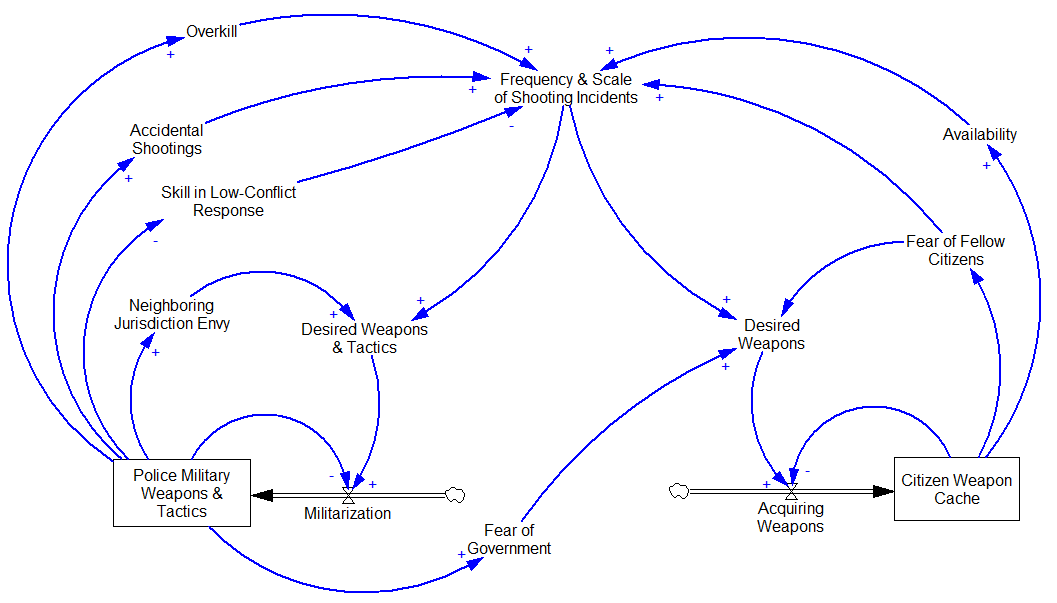
The police (left) and citizens (right) each have stocks of weapons and associated skills and attitudes. Each “side” adjusts those stocks toward a desired level, which is set by various signals.

Citizens, for example, see media coverage of school shootings and less spectacular events, and arm themselves against their fellow citizens and against the eventuality of totalitarian government. A side effect of this is that, as the general availability of weapons increases, the frequency and scale of violent conflict increases, all else equal. This in itself reinforces the citizen perception of the need to arm.

The government (i.e. the police) respond to the escalation of violent conflict in their own locally rational way as well. They acquire heavy weapons and train tactical teams. But this has a number of side effects that further escalate conflict. Spending and training on paramilitary approaches necessarily comes at the expense of non-violent policing methods.

Lester said he’s concerned about the potential overuse of such commanding vehicles among some police departments, a common criticism in the wake of the Ferguson protests.“When you bring that to the scene,” he said, “you bring an attitude that’s not necessarily needed.”

Accidents happen, and the mere availability of heavy armor encourages overkill, as we saw in Ferguson. And police departments are not immune to keeping up with the Joneses:

“For a community our size, we’re one of the last communities that does not have an armored rescue vehicle,” he said.

This structure is a nest of reinforcing feedback loops – I haven’t labeled them, because every loop above is positive, except the two inner loops in the acquisition/militarization stock control processes.

Strangely, this is happening at a time in which violent crime rates are trending down. This means that the driver of escalation must be more about perceptions and fear of potential harm than about actual shooting incidents.

Carrying the escalation to its conclusion, one of two things has to happen. The police win, and we have a totalitarian state. Or, the citizens win, and we have stateless anarchy. Neither outcome is really a “win.”

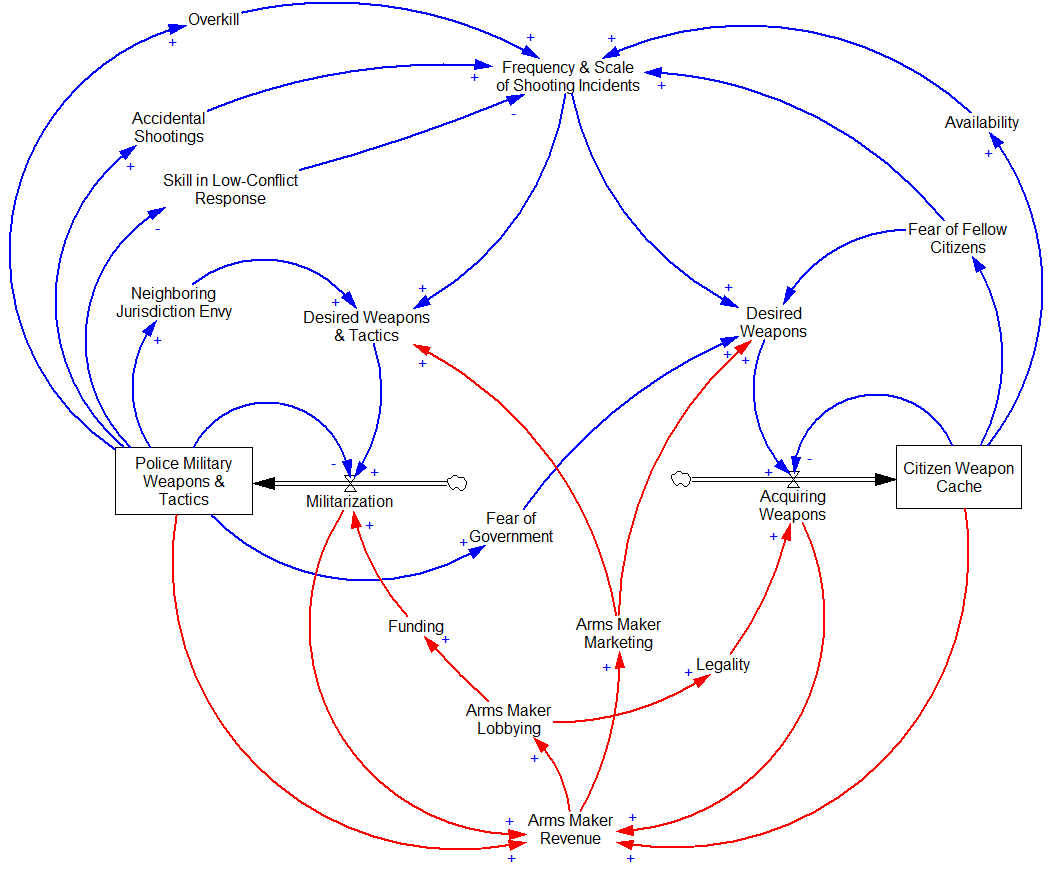
The alternative is to reverse the escalation, and make the reinforcing loops virtuous rather than vicious cycles. This is harder than it should be, because there’s a third party involved, that profits from escalation (red):
EscalationLobbying
Arms makers generate revenue from weapon sales and service, and reinvest that in marketing, to increase both parties desired weapons, and in lobbying to preserve the legality of assault weapons and fund the grant programs that enable small towns to have free armor.
EscalationEngagement
Fortunately, there is a remedy. Voters can (at least indirectly) fire the Bozeman officials who “forgot” to run the armored vehicle acquisition through any public process, and defund the Homeland (In)Security programs that bring heavy weapons to our doorsteps.

The difficult pill to swallow is that, for this to work, citizens have to de-escalate too. Reinstating the assault weapons ban is messy, and perhaps ineffective given the large stock of weapons now widely distributed. Maybe the first change should be cultural: recognizing that arming oneself to the teeth is a fear-driven antisocial response to our situation, and that ballots are a better solution than bullets.

The end is here

Facebook is down.

Runaway positive feedback is the culprit:

To make matters worse, every time a client got an error attempting to query one of the databases it interpreted it as an invalid value, and deleted the corresponding cache key. This meant that even after the original problem had been fixed, the stream of queries continued. As long as the databases failed to service some of the requests, they were causing even more requests to themselves. We had entered a feedback loop that didn’t allow the databases to recover.

The way to stop the feedback cycle was quite painful – we had to stop all traffic to this database cluster, which meant turning off the site. Once the databases had recovered and the root cause had been fixed, we slowly allowed more people back onto the site.

This got the site back up and running today, and for now we’ve turned off the system that attempts to correct configuration values. We’re exploring new designs for this configuration system following design patterns of other systems at Facebook that deal more gracefully with feedback loops and transient spikes.

It’s faintly ironic, since positive feedback of a different sort is responsible for Facebook’s success.

Reflections on Virgin Earth

Colleagues just pointed out the Virgin Earth Challenge, “a US$25 million prize for an environmentally sustainable and economically viable way to remove greenhouse gases from the atmosphere.”

John Sterman writes:

I think it inevitable that we will see more and more interest in CO2 removal. And IF it can be done without undermining mitigation I’d be all for it. I do like biochar as a possibility; though I am very skeptical of direct air capture and CCS. But the IF in the prior sentence is clearly not true: if there were effective removal technology it would create moral hazard leading to less mitigation and more emissions.

Even more interesting, direct air capture is not thermodynamically favored; needs lots of energy. All the finalists claim that they will use renewable energy or “waste” heat from other processes to power their removal technology, but how about using those renewable sources and waste heat to directly offset fossil fuels and reduce emissions instead of using them to power less efficient removal processes? Clearly, any wind/solar/geothermal that is used to power a removal technology could have been used directly to reduce fossil emissions, and will be cheaper and offset more net emissions. Same for waste heat unless the waste heat is too low temp to be used to offset fossil fuels. Result: these capture schemes may increase net CO2 flux into the atmosphere.

Every business knows it’s always better to prevent the creation of a defect than to correct it after the fact. No responsible firm would say “our products are killing the customers; we know how to prevent that, but we think our money is best spent on settling lawsuits with their heirs.” (Oh: GM did exactly that, and look how it is damaging them). So why is it ok for people to say “fossil fuel use is killing us; we know how to prevent that, but we’ve decided to spend even more money to try to clean up the mess after the pollution is already in the air”?

To me, many of these schemes reflect a serious lack of systems thinking, and the desire for a technical solution that allows us to keep living the way we are living without any change in our behavior. Can’t work.

I agree with John, and I think there are some additional gaps in systemic thinking about these technologies. Here are some quick reflections, in pictures.

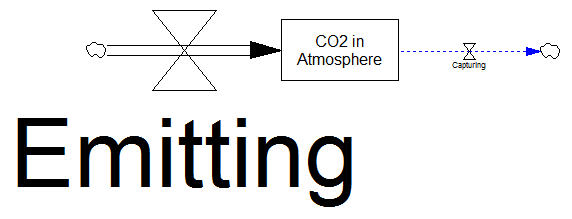
EmittingCapturingA basic point for any system is that you can lower the level of a stock (all else equal) by reducing the inflow or increasing the outflow. So the idea of capturing CO2 is not totally bonkers. In fact, it lets you do at least one thing that you can’t do by reducing emissions. When emissions fall to 0, there’s no leverage to reduce CO2 in the atmosphere further. But capture could actively draw down the CO2 stock. However, we are very far from 0 emissions, and this is harder than it seems:
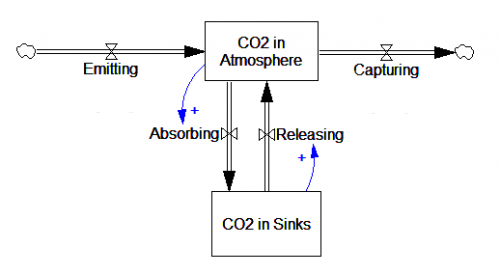
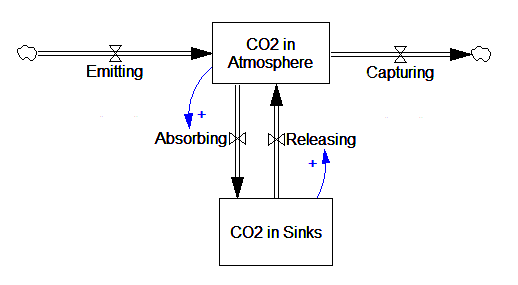
AirCapturePushbackNatural sinks have been graciously absorbing roughly half of our CO2 emissions for a long time. If we reduce emissions dramatically, and begin capturing, nature will be happy to give us back that CO2, ton for ton. So, the capture problem is actually twice as big you’d think from looking at the excess CO2 in the atmosphere.

Currently, there’s also a problem of scale. Emissions are something like two orders of magnitude larger than potential markets for CO2, so there’s a looong way to go. And capture doesn’t scale like like a service running on Amazon Elastic Cloud servers; it’s bricks and mortar.
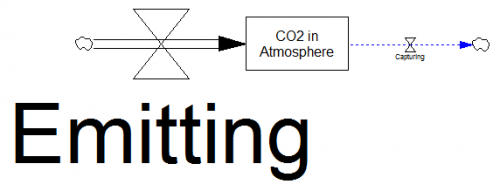
EmitCaptureScaleAnd where does that little cloud go, anyway? Several proposals gloss over this, as in:

The process involves a chemical solution (that naturally absorbs CO2) being brought into contact with the air. This solution, now containing the captured CO2, is sent to through a regeneration cycle which simultaneously extracts the CO2 as a high-pressure pipeline-quality product (ready to be put to numerous commercial uses) …

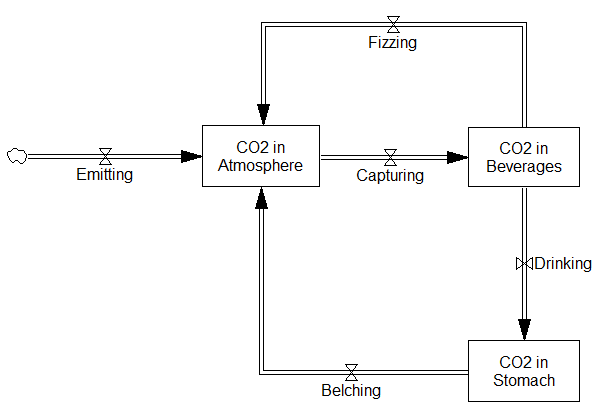
The biggest commercial uses I know of are beverage carbonation and enhanced oil recovery (EOR). Consider the beverage system:
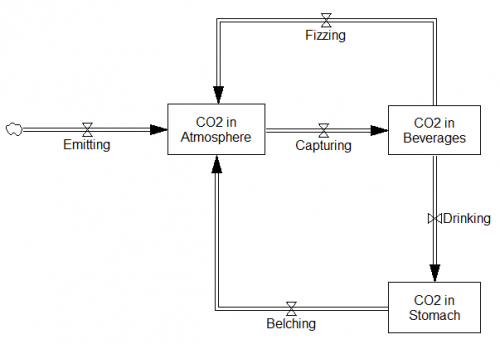
BeverageCO2CO2 sequestered in beverages doesn’t stay there very long! You’d have to start stockpiling vast quantities of Coke in salt mines to accumulate a significant quantity. This reminds me of Nike’s carbon-sucking golf ball. EOR is just as bad, because you put CO2 down a hole (hopefully it stays there), and oil and gas come back up, which are then burned … emitting more CO2. Fortunately the biochar solutions do not suffer so much from this problem.

Next up, delays and moral hazard:
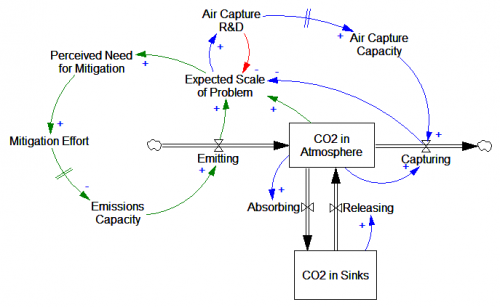
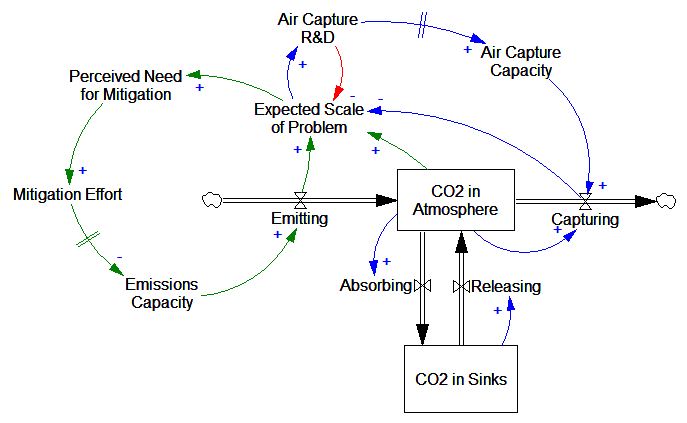
CO2moralHazardThis is a cartoonish view of the control system driving mitigation and capture effort. The good news is that air capture gives us another negative loop (blue, top) by which we can reduce CO2 in the atmosphere. That’s good, especially if we mismanage the green loop. The moral hazard side effect is that the mere act of going through the motions of capture R&D reduces the perceived scale of the climate problem (red link), and therefore reduces mitigation, which actually makes the problem harder to solve.

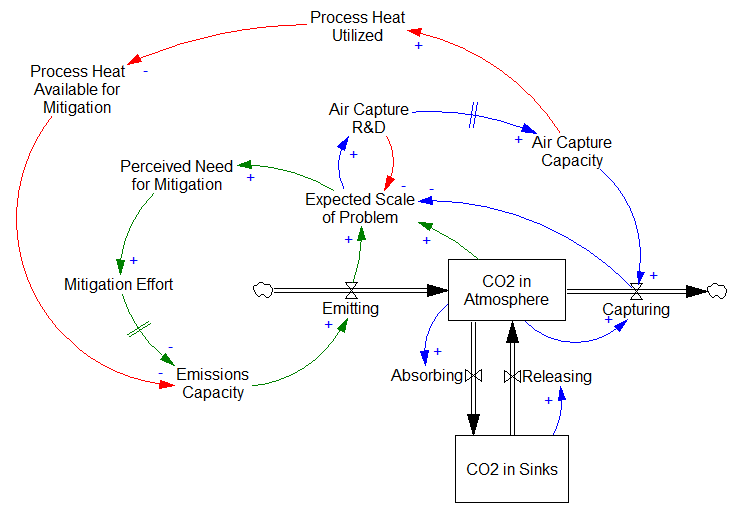
Capture also competes with mitigation for resources, as in John’s process heat example:
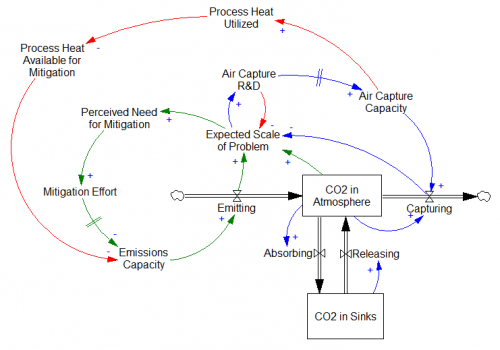
ProcessHeat

It’s even worse than that, because a lot of mitigation efforts have fairly rapid effects on emissions. There are certainly long-lived aspects of energy and infrastructure that must be considered, but behavior can change a lot of emissions quickly and with off-the-shelf technology. The delay between air capture R&D and actual capturing, on the other hand, is bound to be fairly long, because it’s in its infancy, and has to make it through multiple discover/develop/deploy hurdles.

One of those hurdles is cost. Why would anyone bother to pay for air capture, especially in cases where it’s a sure loser in terms of thermodynamics and capital costs? Altruism is not a likely candidate, so it’ll take a policy driver. There are essentially two choices: standards and emissions pricing.

A standard might mandate (as the EPA and California have) that new power plants above a certain emissions intensity must employ some kind of offsetting capture. If coal wants to stay in business, it has to ante up. The silly thing about this, apart from inevitable complexity, is that any technology that meets the standard without capture, like combined cycle gas electricity currently, pays 0 for its emissions, even though they too are harmful.

Similarly, you could place a subsidy or bounty on tons of CO2 captured. That would be perverse, because taxpayers would then have to fund capture – not likely a popular measure. The obvious alternative would be to price emissions in general – positive for emissions, negative for capture. Then all sources and sinks would be on a level playing field. That’s the way to go, but of course we ought to do it now, so that mitigation starts working, and air capture joins in later if and when it’s a viable competitor.

I think it’s fine if people work on carbon capture and sequestration, as long as they don’t pretend that it’s anywhere near a plausible scale, or even remotely possible without comprehensive changes in incentives. I won’t spend my own time on a speculative, low-leverage policy when there are more effective, immediate and cheaper mitigation alternatives. And I’ll certainly never advise anyone to pursue a geoengineered world, any more than I’d advise them to keep smoking but invest in cancer research.


Climate Interactive – #12 climate think tank

Climate Interactive is #12 (out of 210) in the International Center for Climate Governance’s Standardized Ranking of climate think tanks (by per capita productivity):

  1. Woods Hole Research Center (WHRC)
  2. Basque Centre for Climate Change (BC3)
  3. Centre for European Policy Studies (CEPS)*
  4. Centre for European Economic Research (ZEW)*
  5. International Institute for Applied Systems Analysis (IIASA)
  6. Worldwatch Institute
  7. Fondazione Eni Enrico Mattei (FEEM)
  8. Resources for the Future (RFF)
  9. Mercator Research Institute on Global Commons and Climate Change (MCC)
  10. Centre International de Recherche sur l’Environnement et le De?veloppement (CIRED)
  11. Institut Pierre Simon Laplace (IPSL)
  12. Climate Interactive
  13. The Climate Institute
  14. Buildings Performance Institute Europe (BPIE)
  15. International Institute for Environment and Development (IIED)
  16. Center for Climate and Energy Solutions (C2ES)
  17. Global Climate Forum (GCF)
  18. Potsdam Institute for Climate Impact Research (PIK)
  19. Sandbag Climate Campaign
  20. Civic Exchange

That’s some pretty illustrious company! Congratulations to all at CI.

Where's my stuff?

I’ve just acquired a pair of 18″ Dell XPS portable desktop tablets. It’s one slick piece of hardware, that makes my iPad seem about as sexy as a beer coaster.

They came with Win8 installed. Now I know why everyone hates it. It makes a good first impression with pretty colors and a simple layout. But after a few minutes, you wonder, where’s all my stuff? There’s no obvious way to run a desktop application, so you end up scouring the web for ways to resurrect the Start menu.

It’s bizarre that Microsoft seems to have forgotten the dynamics that made it a powerhouse in the first place. It’s basically this:

Software is a big nest of positive feedbacks, producing winner-take-all behavior. A few key loops are above. The bottom pair is the classic Bass diffusion model – reinforcing feedback from word of mouth, and balancing feedback from saturation (running out of potential customers). The top loop is an aspect of complementary infrastructure – the more users you have on your platform, the more attractive it is to build apps for it; the more apps there are, the more users you get.

There are lots of similar loops involving accumulation of knowledge, standards, etc. More importantly, this is not a one-player system; there are multiple platforms competing for users, each with its own reinforcing loops. That makes this a success-to-the-successful situation. Microsoft gained huge advantage from these reinforcing loops early in the PC game. Being the first to acquire a huge base of users and applications carried it through many situations in which its tech was not the most exciting thing out there.

So, if you’re Microsoft, and Apple throws you a curve ball by launching a new, wildly successful platform, what should you do? It seems to me that the first imperative should be to preserve the advantages conferred by your gigantic user and application base.

Win8 does exactly the opposite of that:

  • Hiding the Start menu means that users have to struggle to find their familiar stuff, effectively chucking out a vast resource, in favor of new apps that are slicker, but pathetically few in number.
  • That, plus other decisions, enrage committed users and cause them to consider switching platforms, when a smoother transition would have them comfortably loyal.

This strategy seems totally bonkers.

The dynamics of UFO sightings

The Economist reports on UFO sightings:

UFOdataThis deserves a model:

UFOs

UFOs.vpm (Vensim published model, requires Pro/DSS or the free Reader)

The model is a mixed discrete/continuous simulation of an individual sleeping, working and drinking. This started out as a multi-agent model, but I realized along the way that sleeping, working and drinking is a fairly ergodic process on long time scales (at least with respect to UFOs), so one individual with a distribution of behaviors over time or simulations is as good as a population of agents.

The model replicates the data somewhat faithfully:

UFOdistributionThe model shows a morning peak (people awake but out and about) and a workday dip (inside, lurking near the water cooler) but the data do not. This suggests to me that:

  • Alcohol is the dominant factor in sightings.
  • I don’t party nearly enough to see a UFO.

Actually, now that I’ve built this version, I think the interesting model would have a longer time horizon, to address the non-ergodic part: contagion of sightings across individuals.

h/t Andreas Größler.

Footing the bill for Iraq

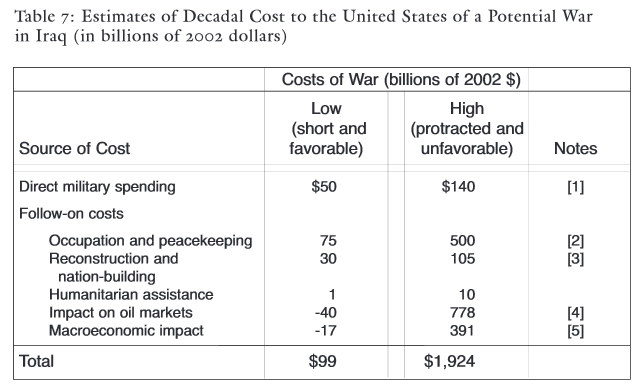
Back in 2002, when invasion of Iraq was on the table and many Democrats were rushing patriotically to the President’s side rather than thinking for themselves, William Nordhaus (staunchest critic of Limits) went out on a limb a bit to attempt a realistic estimate of the potential cost.

All the dangers that lead to ignoring or underestimating the costs of war can be reduced by a thoughtful public discussion. Yet neither the Bush administration nor the Congress – neither the proponents nor the critics of war – has presented a serious estimate of the costs of a war in Iraq. Neither citizens nor policymakers are able to make informed judgments about the realistic costs and benefits of a potential conflict when no estimate is given.

His worst case: about $755 billion direct (military, peacekeeping and reconstruction) plus indirect effects totaling almost $2 trillion for a decade of conflict and its aftermath.

NordhausIraqNordhaus’ worst case is pretty close to actual direct spending in Iraq to date. But with another trillion for Afghanistan and 2 to 4 in the pipeline from future obligations related to the war, the grand total is looking like a lowball estimate. Other pre-invasion estimates, in the low billions, look downright ludicrous.

Recent news makes Nordhaus’ parting thought even more prescient:

Particularly worrisome are the casual promises of postwar democratization, reconstruction, and nation-building in Iraq. The cost of war may turn out to be low, but the cost of a successful peace looks very steep. If American taxpayers decline to pay the bills for ensuring the long-term health of Iraq, America would leave behind mountains of rubble and mobs of angry people. As the world learned from the Carthaginian peace that settled World War I, the cost of a botched peace may be even higher than the price of a bloody war

Early economic dynamics: Samuelson's multiplier-accelerator

Paul Samuelson’s 1939 analysis of the multiplier-accelerator is a neat piece of work. Too bad it’s wrong.

Interestingly, this work dates from a time in which the very idea of a mathematical model was still questioned:

Contrary to the impression commonly held, mathematical methods properly employed, far from making economic theory more abstract, actually serve as a powerful liberating device enabling the entertainment and analysis of ever more realistic and complicated hypotheses.

Samuelson should be hailed as one of the early explorers of a very big jungle.

The basic statement of the model is very simple:

NationalIncome

In quasi-System Dynamics notation, that looks like:

SamuelsonDiagramB

A caveat:

The limitations inherent in so simplified a picture as that presented here should not be overlooked. In particular, it assumes that the marginal propensity to consume and the relation are constants; actually these will change with the level of income, so that this representation is strictly a marginal analysis to be applied to the study of small oscillations. Nevertheless it is more general than the usual analysis.

Samuelson hand-simulated the model (it’s fun – once – but he runs four scenarios):Simulated Samuelson then solves the discrete time system, to identify four regions with different behavior: goal seeking (exponential decay to a steady state), damped oscillations, unstable (explosive) oscillations, and unstable exponential growth or decline. He nicely maps the parameter space:

parameterSpace

ParamRegionBehaviorSo where’s the problem?

The first is not so much of Samuelson’s making as it is a limitation of the pre-computer era. The essential simplification of the model for analytic solution is;

Simplified

This is fine, but it’s incredibly abstract. Presented with this equation out of context – as readers often are – it’s almost impossible to posit a sensible description of how the economy works that would enable one to critique the model. This kind of notation remains common in econometrics, to the detriment of understanding and progress.

At the first SD conference, Gil Low presented a critique and reconstruction of the MA model that addressed this problem. He reconstructed the model, providing an operational description of the economy that remains consistent with the multiplier-accelerator framework.

LowThe mere act of crafting a stock-flow description reveals problem #1: the basic multiplier-accelerator doesn’t conserve stuff.

inventory1 InventoryCapital2Non-conservation of stuff leads to problem #2. When you do implement inventories and capital stocks, the period of multiplier-accelerator oscillations moves to about 2 decades – far from the 3-7 year period of the business cycle that Samuelson originally sought to explain. This occurs in part because the capital stock, with a 15-year lifetime, introduces considerable momentum. You simply can’t discover this problem in the original multiplier-accelerator framework, because too many physical and behavioral time constants are buried in the assumptions associated with its 2 parameters.

Low goes on to introduce labor, finding that variations in capacity utilization do produce oscillations of the required time scale.

ShortTermI think there’s a third problem with the approach as well: discrete time. Discrete time notation is convenient for matching a model to data sampled at regular intervals. But the economy is not even remotely close to operating in discrete annual steps. Moreover a one-year step is dangerously close to the 3-year period of the business cycle phenomenon of interest. This means that it is a distinct possibility that some of the oscillatory tendency is an artifact of discrete time sampling. While improper oscillations can be detected analytically, with discrete time notation it’s not easy to apply the simple heuristic of halving the time step to test stability, because it merely compresses the time axis or causes problems with implicit time constants, depending on how the model is implemented. Halving the time step and switching to RK4 integration illustrates these issues:

RK4

It seems like a no-brainer, that economic dynamic models should start with operational descriptions, continuous time, and engineering state variable or stock flow notation. Abstraction and discrete time should emerge as simplifications, as needed for analysis or calibration. The fact that this has not become standard operating procedure suggests that the invisible hand is sometimes rather slow as it gropes for understanding.

The model is in my library.

See Richardson’s Feedback Thought in Social Science and Systems Theory for more history.

How many things can you get wrong on one chart?

Let’s count:

  1. stupidGraphTruncate records that start ca. 1850 at an arbitrary starting point.
  2. Calculate trends around a breakpoint cherry-picked to most favor your argument.
  3. Abuse polynomial fits generally. (See this series.)
  4. Report misleading linear trends by simply dropping the quadratic term.
  5. Fail to notice the obvious: that temperature in the second period is, on average, higher than in the first.
  6. Choose a loaded color scheme that emphasizes #5.
  7. Fail to understand that temperature integrates CO2.
  8. Fallacy of the single cause (only CO2 affects temperature – in good company with Burt Rutan).