That’s the title of a cool article at Plus. Click the image to check it out:
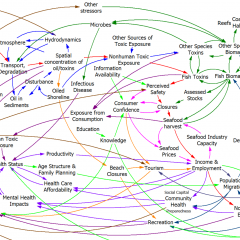
Don't just do something, stand there! Reflections on the counterintuitive behavior of complex systems, seen through the eyes of System Dynamics, Systems Thinking and simulation.
From RealClimate:
Over the mid-20th century, sulfate precursor emissions appear to have been so large that they more then compensated for greenhouse gases, leading to a slight cooling in the Northern Hemisphere. During the last 3 decades, the reduction in sulfate has reversed that cooling, and allowed the effects of greenhouse gases to clearly show. In addition, black carbon aerosols lead to warming, and these have increased during the last 3 decades.
For an analogy, picture a reservoir. Say that around the 1930s, rainfall into the watershed supplying the reservoir began to increase. However, around the same time, a leak developed in the dam. The lake level stayed fairly constant as the rainfall increased at about the same rate the leak grew over the next few decades. Finally, the leak was patched (in the early 70s). Over the next few decades, the lake level increased rapidly. Now, what’s the cause of that increase? Is it fair to say that lake level went up because the leak was fixed? Remember that if the rainfall hadn’t been steadily increasing, then the leak would have led to a drop in lake levels whereas fixing it would have brought the levels back to normal. However, it’s also incomplete to ignore the leak, because then it seems puzzling that the lake levels were flat despite the increased rain during the first few decades and that, were you to compare the increased rain with the lake level rise, you’d find the rise was more rapid during the past three decades than you could explain by the rain changes during that period. You need both factors to understand what happened, as you need both greenhouse gases and aerosols to explain the surface temperature observations (and the situation is more complex than this simple analogy due to the presence of both cooling and warming types of aerosols).
Read the rest: Yet More Aerosols
Some admin stuff:
I don’t often get to read about my adopted hometown in the national papers; it’s usually pretty obscure. When FAA analysts look for a small-time airport to poke fun at, we’re first on the list. However, today the NYT has covered the gas explosion that destroyed half a block of downtown, including some wonderful historic brick buildings. The blast was so powerful that we heard it from our house, 6 miles away with an intervening ridge. Sadly there’s no recovery for one person, but I hope the rest of downtown bounces back quickly.
I was just looking up Archimedean copulas, and stumbled across a bunch of articles blaming the Gaussian copula for the crash, like this interesting one at Wired.
Getting into trouble by ignoring covariance actually has a long and glorious history. Want to make your complex device look super reliable? Decompose it into a zillion parts, then assess their collective probability of failure without regard for collateral damage and other feedbacks that correlate the failure of one part with another. Just don’t check for leaks with a candle afterwards.
Still, blaming copulas, or any other model, for the financial crisis strikes me as a lot like blaming a telephone pole for your car crash. Never mind that you were speeding, drunk, and talking on the phone. It’s not the models, but a general predisposition to ignore systemic risk that brought down the system.
Two relevant conversations from the SD email list archive:
Where are we in the long wave?
Bill Harris asks, in 2003,
… should a reasonable person think we are now in the down side of a long wave? That the tough economic times we’ve seen for the past few years will need years to work through, as levels adjust? That simple, short-term economic fixes wont work as they may have in the past? That the concerns we’ve heard about deflation should be seen in a longer context of an entire cycle, not as an isolated event to be overcome? Is there a commonly accepted date for the start of this decline?
Was Bill 5 years ahead of schedule?
Preventing the next boom and bust
Kim Warren asks, in 2001,
This is a puzzle – we take a large fraction of the very brightest and best educated people in the world, put them through 2 years of further intensive education in how business, finance and economics are supposed to work, set them to work in big consulting firms, VCs, and investment banks, pay them highly and supervise them with very experienced and equally bright managers. Yet still we manage to invent quite implausible business ideas, project unsustainable earnings and market performance, and divert huge sums of money and talented people from useful activity into a collective fantasy. Some important questions remain unanswered, like who they are, what they did, how they got away with it, and why the rest of us meekly went along with them? So the challenge to SDers in business is … where is the next bubble coming from, what will it look like, and how can we stop it?
Clearly this is one nut we haven’t cracked.
The launch of the Orbiting Carbon Observatory failed today. Nature News has the story. This must be incredibly frustrating for everyone who worked on the project, or anticipated using the data.
Steve Chu says the t word in an NYT interview:
He said that while President Obama and Congressional Democratic leaders had endorsed a so-called cap-and-trade system to control global warming pollutants, there were alternatives that could emerge, including a tax on carbon emissions or a modified version of cap-and-trade.
Glad the option isn’t totally dead.
Paul Krugman’s letter to Obama
Reasoning-from-conclusions-to-assumptions? (a perspective on modeling)
Sell-off drops EUAs to $11.60/TonCO2
Via Nature, a google search doesn’t really produce 7 grams of carbon, and you can’t build carbon infrastructure to get to a low-carbon future.
Four new CCSP reports from the last days of the Bush administration:
Final Report of Synthesis and Assessment Product 4.1 (Coastal Sensitivity to Sea-Level Rise: A Focus on the Mid-Atlantic Region)
Final Report of Synthesis and Assessment Product 4.2 (Thresholds of Climate Change in Ecosystems)
Final Report of Synthesis and Assessment Product 2.3 (Aerosol properties and their impacts on climate)
Final Report of Synthesis and Assessment Product 1.2 (Past Climate Variability and Change in the Arctic and at High Latitudes)
Plus last month’s USGS report on abrupt climate change, buried over the holidays.