During C-ROADS development, we explored several ways of accounting for cumulative per capita emissions. One practice that seems to be widespread is to accumulate (integrate) emissions divided by population, i.e.
| cumulative emissions per cap | = INTEGRAL( emissions per capita(t) ) |
| = INTEGRAL( emissions(t)/population(t) ) |
This is physically meaningless. Emissions per capita is an intensive variable, and you can’t average or accumulate intensive variables in this way. It’s like averaging the temperature of a duck and a supertanker without accounting for the tankers 100,000x greater mass.
A proper thing to do is integrate emissions, then divide by population:
| cumulative emissions per cap | = INTEGRAL( emissions per capita(t) ) / population |
That yields a physically meaningful number, interpreted as cumulative emissions of a nation per current inhabitant. That’s a bit like per capita national debt.
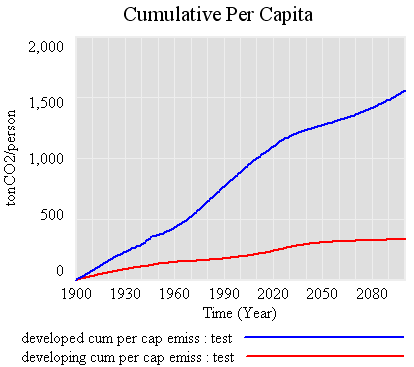
A big question is what population to use as a basis. If you use current population, that’s fine, but it’s important to recognize that a comparison of per caps in 2100 between countries with slow and rapid population growth in effect gives credit for creating more people – possibly not a desirable incentive. Here are cumulative per capita emissions for developed and developing countries on a current basis, along a hypothetical 2C path with stricter commitments for developed countries:
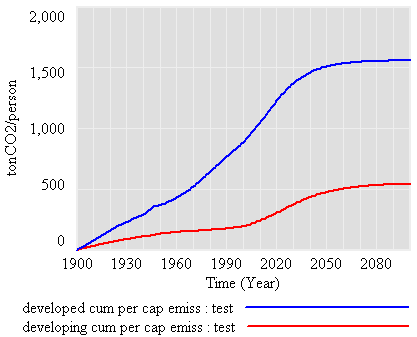
If you don’t want your metric to credit future population growth, you can freeze population in the denominator at current levels, which looks like this:
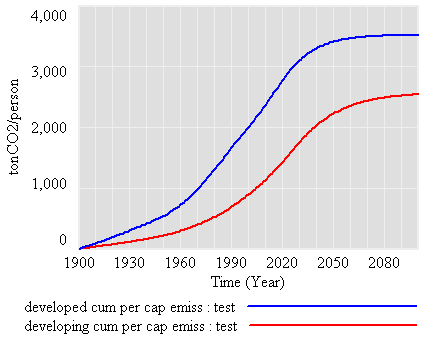
If you wanted to ponder history, you could use a 1900 population basis:
Isn’t it more natural to use INTEGRAL( emissions(t) ) / INTEGRAL(population(t)) or some reweighting that multiplies the integrands by a function of time?
We experimented with INTEGRAL( emissions(t) ) / INTEGRAL(population(t)), but it’s effectively an average rate – gigations/(person*years). What people seem to be referring to with cumulative emissions is, how much carbon debt do you have per person?
A related number that’s harder to calculate is the carbon debt of an average individual. To do that you have to account for births/deaths/migration, and decide whether today’s individuals are responsible for the emissions of their ancestors (debtor’s prison for heirs, anyone?).