Don't just do something, stand there! Reflections on the counterintuitive behavior of complex systems, seen through the eyes of System Dynamics, Systems Thinking and simulation.
What is SD? 2.0
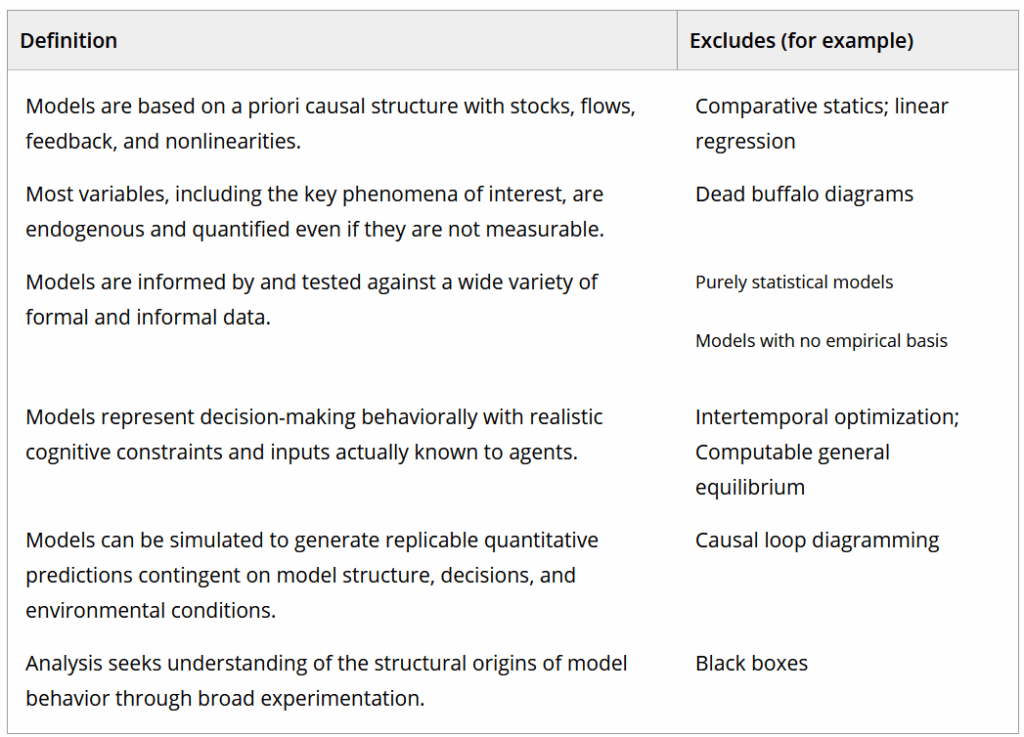
I’ve just realized that I never followed up on my What is SD post to link in subsequent publication of the paper and 5 commentaries (including mine) in the System Dynamics Review.
Interestingly, I think I’ve already violated at least two of my examples (more on that another time). I guess I contain multitudes.
The other commentaries each raise interesting points about the definition as well as the very idea of defining.
This topic came to mind because I rediscovered an old Barry Richmond article that also probes the definition of SD. Interestingly it slipped through the cracks and wasn’t cited by any of us (theoretically it was delivered at the ’94 SD conference, but it’s not in the proceedings).
What is Systems Thinking, and how does it relate to System Dynamics? Let me begin by briefly saying what Systems Thinking is not. Systems Thinking is not General Systems Theory, nor is it “Soft Systems” or Systems Analysis – though it shares elements in common with all of these. Furthermore, Systems Thinking is not the same thing as Chaos Theory, Dissipative Structures, Operations Research, Decision Analysis, or what control theorists mean when they say System Dynamics – though, again, there are similarities both in subject matter and aspects of the associated methodologies. Nor is Systems Thinking hexagrams, personal mastery, dialogue, or total quality.
…
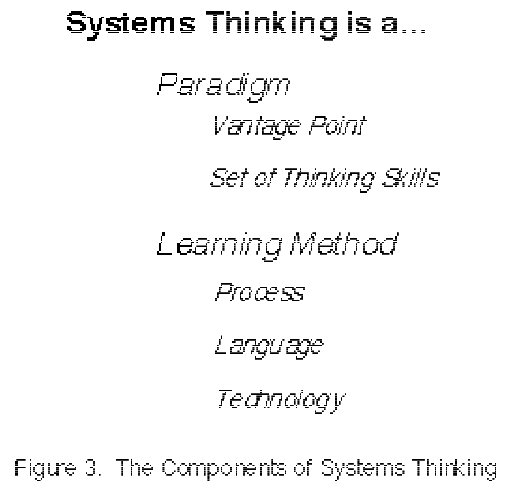
The definition of Systems Thinking at which I have arrived is: Systems Thinking is the art and science of making reliable inferences about behavior by developing an increasingly deep understanding of underlying structure. The art and science is composed of the pieces which are summarized in Figure 3.
I find Barry’s definition to be a particularly pithy elevator pitch for SD – I’m going to use it.
1 thought on “What is SD? 2.0”
Love this. Gonna get Barry’s paper into the proceedings. And think it might be helpful if the Society could try to circle around a shared definition…
Love this. Gonna get Barry’s paper into the proceedings. And think it might be helpful if the Society could try to circle around a shared definition…
Rebecca