Funny stuff from the Daily Show. It would be funnier if it weren’t a bit too real.
Author: Tom
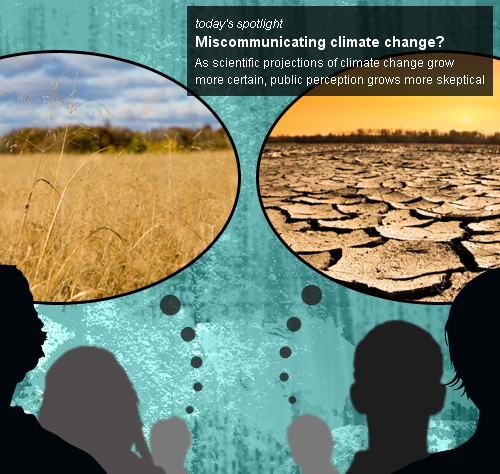
Climate misperceptions, front page at MIT
Mingling models and text
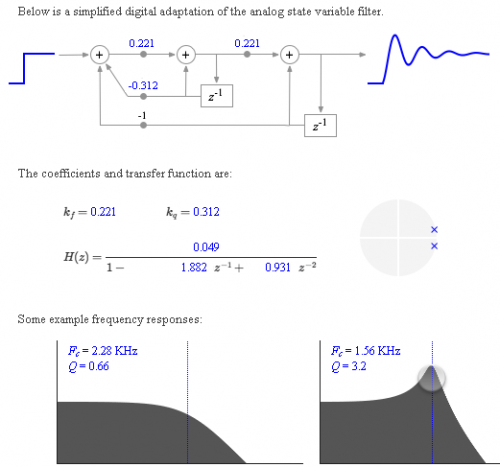
Tangle is an interesting javascript library for mixing calculations into text. It permits interactive calculations, with dragging on parameters to vary the outcome. If I can figure out how to run javascript in WordPress quickly I’ll demo it, but in the meantime, check it out:
The BEST of times, the worst of times
Climate skeptics’ opinions about global temperatures and the BEST project are a moving target:
August 27, 2010 (D’Aleo & Watts), there is no warming:
SUMMARY FOR POLICY MAKERS
1. Instrumental temperature data for the pre-satellite era (1850-1980) have been so widely, systematically, and uni-directionally tampered with that it cannot be credibly asserted there has been any significant “global warming” in the 20th century.
February 11, 2011 (Watts), an initial lovefest with the Berkeley Earth Surface Temperature (BEST) project:
Good news travels fast. I’m a bit surprised to see this get some early coverage, as the project isn’t ready yet. However since it has been announced by press, I can tell you that this project is partly a reaction and result of what we’ve learned in the surfacesations project, but mostly, this project is a reaction to many of the things we have been saying time and again, only to have NOAA and NASA ignore our concerns, or create responses designed to protect their ideas, rather than consider if their ideas were valid in the first place. …Note: since there’s been some concern in comments, I’m adding this: Here’s the thing, the final output isn’t known yet. There’s been no “peeking” at the answer, mainly due to a desire not to let preliminary results bias the method. It may very well turn out to agree with the NOAA surface temperature record, or it may diverge positive or negative. We just don’t know yet.
February 19, 2011 (Fred Singer @ wattsupwiththat):
The Berkeley Earth Surface Temperature (BEST) Project aims to do what needs to be done: That is, to develop an independent analysis of the data from land stations, which would include many more stations than had been considered by the Global Historic Climatology Network. The Project is in the hands of a group of recognized scientists, who are not at all “climate skeptics” — which should enhance their credibility….
I applaud and support what is being done by the Project — a very difficult but important undertaking. I personally have little faith in the quality of the surface data, having been exposed to the revealing work by Anthony Watts and others. However, I have an open mind on the issue and look forward to seeing the results of the Project in their forthcoming publications.
… The approaches that I’ve seen during my visit give me far more confidence than the “homogenization solves all” claims from NOAA and NASA GISS, and that the BEST result will be closer to the ground truth that anything we’ve seen.
… I think, based on what I’ve seen, that BEST has a superior method. Of course that is just my opinion, with all of it’s baggage; it remains to be seen how the rest of the scientific community will react when they publish.
In the meantime, never mind the yipping from climate chihuahuas like Joe Romm over at Climate Progress who are trying to destroy the credibility of the project before it even produces a result (hmmm, where have we seen that before?) , it is simply the modus operandi of the fearful, who don’t want anything to compete with the “certainty” of climate change they have been pushing courtesy NOAA and GISS results.
…
But here’s the thing: I have no certainty nor expectations in the results. Like them, I have no idea whether it will show more warming, about the same, no change, or cooling in the land surface temperature record they are analyzing. Neither do they, as they have not run the full data set, only small test runs on certain areas to evaluate the code. However, I can say that having examined the method, on the surface it seems to be a novel approach that handles many of the issues that have been raised.
As a reflection of my increased confidence, I have provided them with my surfacestations.org dataset to allow them to use it to run a comparisons against their data. The only caveat being that they won’t release my data publicly until our upcoming paper and the supplemental info (SI) has been published. Unlike NCDC and Menne et al, they respect my right to first publication of my own data and have agreed.
And, I’m prepared to accept whatever result they produce, even if it proves my premise wrong. I’m taking this bold step because the method has promise. So let’s not pay attention to the little yippers who want to tear it down before they even see the results. I haven’t seen the global result, nobody has, not even the home team, but the method isn’t the madness that we’ve seen from NOAA, NCDC, GISS, and CRU, and, there aren’t any monetary strings attached to the result that I can tell. If the project was terminated tomorrow, nobody loses jobs, no large government programs get shut down, and no dependent programs crash either. That lack of strings attached to funding, plus the broad mix of people involved especially those who have previous experience in handling large data sets gives me greater confidence in the result being closer to a bona fide ground truth than anything we’ve seen yet. Dr. Fred Singer also gives a tentative endorsement of the methods.
My gut feeling? The possibility that we may get the elusive “grand unified temperature” for the planet is higher than ever before. Let’s give it a chance.
I still believe that BEST represents a very good effort, and that all parties on both sides of the debate should look at it carefully when it is finally released, and avail themselves to the data and code that is promised to allow for replication.
March 31, 2011 (Watts), beginning to grumble when the results don’t look favorable to the no-warming point of view:
There seems a bit of a rush here, as BEST hasn’t completed all of their promised data techniques that would be able to remove the different kinds of data biases we’ve noted. That was the promise, that is why I signed on (to share my data and collaborate with them). Yet somehow, much of that has been thrown out the window, and they are presenting some results today without the full set of techniques applied. Based on my current understanding, they don’t even have some of them fully working and debugged yet. Knowing that, today’s hearing presenting preliminary results seems rather topsy turvy. But, post normal science political theater is like that.
… I’ll point out that on the front page of the BEST project, they tout openness and replicability, but none of that is available in this instance, even to Dr. Pielke and I. They’ve had a couple of weeks with the surfacestations data, and now without fully completing the main theme of data cleaning, are releasing early conclusions based on that data, without providing the ability to replicate. I’ve seen some graphical output, but that’s it. What I really want to see is a paper and methods. Our upcoming paper was shared with BEST in confidence.
The Berkeley Earth Surface Temperature project puts PR before peer review
… [Lots of ranting, primarily about the use of a 60 year interval] …
So now (pending peer-review and publication) we have the interesting situation of a Koch institution, a left-wing boogy-man, funding an unbiased study that confirms the previous temperature estimates, “consistent with global land-surface warming results previously reported, but with reduced uncertainty.”
Oct. 21, 2011 (Keenan @ wattsupwiththat), an extended discussion of smoothing, AR(1) noise and other statistical issues, much of which appears to be founded on misconceptions*:
This problem seems to invalidate much of the statistical analysis in your paper.
Oct. 22, 2011 (Eschenbach @ wattsupwiththat), preceded by a lot of nonsense based on the fact that he’s too lazy to run BEST’s Matlab code:
PS—The world is warming. It has been for centuries.
* Update: or maybe not. Still, the paper has nothing to do with the validity of the BEST version of the observational record.
Singing bowls, clapping books, shaking dogs and exploding jets
Some amazing dynamics of everyday things, plus cool explosions:
Via the TechReview arXiv physics blog. There’s more amazing stuff in the AIP Gallery of Fluid Motion.
Forest Cover Tipping Points
There’s an interesting discussion of forest tipping points in a new paper in Science:
Global Resilience of Tropical Forest and Savanna to Critical Transitions
Marina Hirota, Milena Holmgren, Egbert H. Van Nes, Marten Scheffer
It has been suggested that tropical forest and savanna could represent alternative stable states, implying critical transitions at tipping points in response to altered climate or other drivers. So far, evidence for this idea has remained elusive, and integrated climate models assume smooth vegetation responses. We analyzed data on the distribution of tree cover in Africa, Australia, and South America to reveal strong evidence for the existence of three distinct attractors: forest, savanna, and a treeless state. Empirical reconstruction of the basins of attraction indicates that the resilience of the states varies in a universal way with precipitation. These results allow the identification of regions where forest or savanna may most easily tip into an alternative state, and they pave the way to a new generation of coupled climate models.
The paper is worth a read. It doesn’t present an explicit simulation model, but it does describe the concept nicely. The basic observation is that there’s clustering in the distribution of forest cover vs. precipitation:
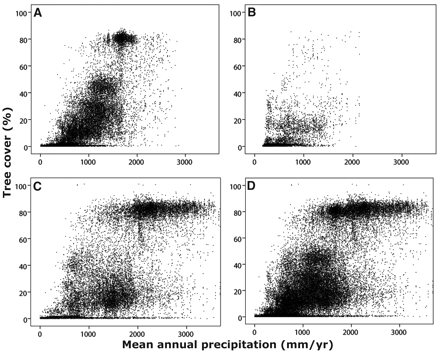
Hirota et al., Science 14 October 2011
In the normal regression mindset, you’d observe that some places with 2m rainfall are savannas, and others are forests, and go looking for other explanatory variables (soil, latitude, …) that explain the difference. You might learn something, or you might get into trouble if forest cover is not-only nonlinear in various inputs, but state-dependent. The authors pursue the latter thought: that there may be multiple stable states for forest cover at a given level of precipitation.
They use the precipitation-forest cover distribution and the observation that, in a first-order system subject to noise, the distribution of observed forest cover reveals something about the potential function for forest cover. Using kernel smoothing, they reconstruct the forest potential functions for various levels of precipitation:
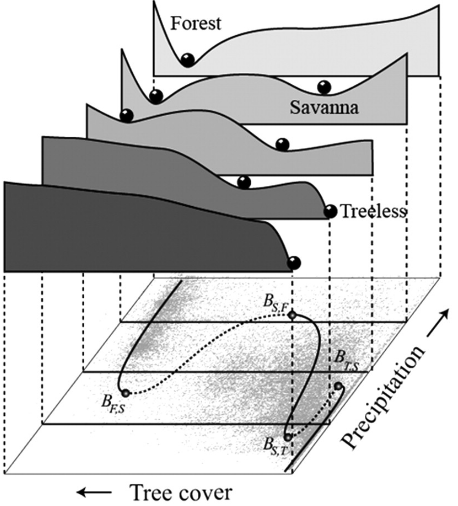
Hirota et al., Science 14 October 2011
I thought that looked fun to play with, so I built a little model that qualitatively captures the dynamics:
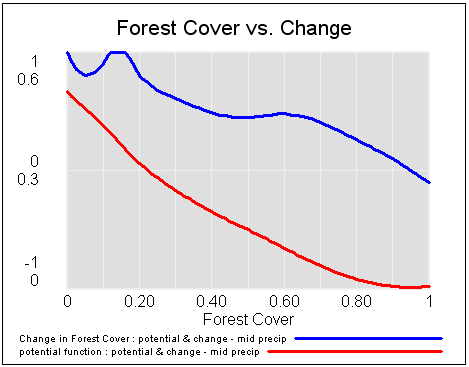
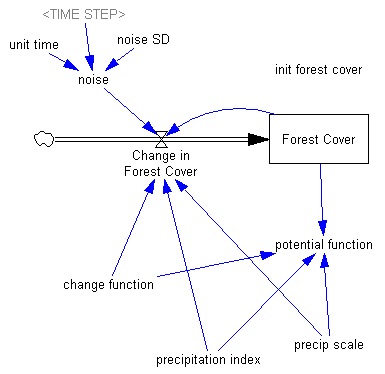 The tricky part was reconstructing the potential function without the data. It turned out to be easier to write the rate equation for forest cover change at medium precipitation (“change function” in the model), and then tilt it with an added term when precipitation is high or low. Then the potential function is reconstructed from its relationship to the derivative, dz/dt = f(z) = -dV/dz, where z is forest cover and V is the potential.
That yields the following potentials and vector fields (rates of change) at low, medium and high precipitation:
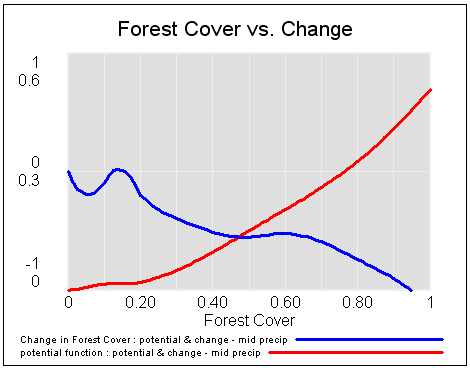
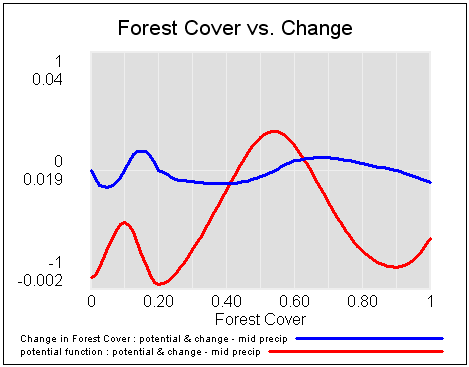
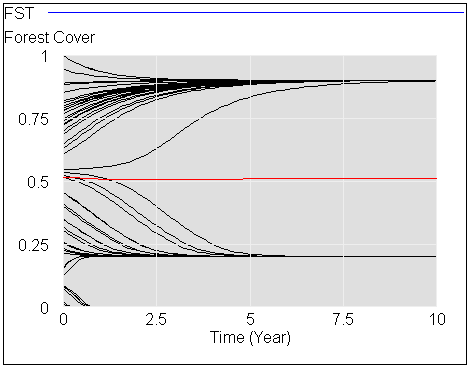
If you start this system at different levels of forest cover, for medium precipitation, you can see the three stable attractors at zero trees, savanna (20% tree cover) and forest (90% tree cover).
If you start with a stable forest, and a bit of noise, then gradually reduce precipitation, you can see that the forest response is not smooth.
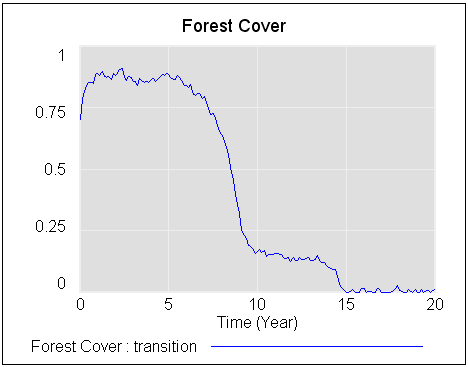
The forest is stable until about year 8, then transitions abruptly to savanna. Finally, around year 14, the savanna disappears and is replaced by a treeless state. The forest doesn’t transition to savanna until the precipitation index reaches about .3, even though savanna becomes the more stable of the two states much sooner, at precipitation of about .55. And, while the savanna state doesn’t become entirely unstable at low precipitation, noise carries the system over the threshold to the lower-potential treeless state.
The net result is that thinking about such a system from a static, linear perspective will get you into trouble. And, if you live around such a system, subject to a changing climate, transitions could be abrupt and surprising (fire might be one tipping mechanism).
The model is in my library.
Your gut may be leading you astray
An interesting comment on rationality and conservatism:
I think Sarah Palin is indeed a Rorschach test for Conservatives, but it’s about much than manners or players vs. kibbitzes – it’s about what Conservativsm MEANS.
The core idea behind Conservatism is that most of human learning is done not by rational theorizing, but by pattern recognition. Our brain processes huge amounts of data every second, and most information we get out of it is in the form of recognized patterns, not fully logical theories. It’s fair to say that 90% of our knowledge is in patterns, not in theories.
This pattern recognition is called common sense, and over generations, it’s called traditions, conventions etc. Religion is usually a carrier meme for these evolved patterns. It’s sort of an evolutionary process, like a genetic algorithm.
Liberals, Lefties and even many Libertarians want to use only 10% of the human knowledge that’s rational. And because our rational knowledge cannot yet fully explain neither human nature in itself nor everything that happens in society, they fill the holes with myths like that everybody is born good and only society makes people bad etc.
Conservatives are practical people who instinctively recognize the importance of evolved patterns in human learning: because our rational knowledge simply isn’t enough yet, these common sense patterns are our second best option to use. And to use these patterns effectively you don’t particularly have to be very smart i.e. very rational. You have to be _wise_ and you have to have a good character: you have to set hubris and pride aside and be able to accept traditions you don’t fully understand.
Thus, for a Conservative, while smartness never hurts, being wise and having a good character is more important than being very smart. Looking a bit simple simply isn’t a problem, you still have that 90% of knowledge at hand.
Anti-Palin Conservatives don’t understand it. They think Conservativism is about having different theories than the Left, they don’t understand that it’s that theories and rational knowledge isn’t so important.
(via Rabbett Run)
A possible example of the writer’s perspective at work is provided by survey research showing that Tea Partiers are skeptical of anthropogenic climate change (established by models) but receptive to natural variation (vaguely, patterns), and they’re confident that they’re well-informed about it in spite of evidence to the contrary. Another possible data point is conservapedia’s resistance to relativity, which is essentially a model that contradicts our Newtonian common sense.
As an empirical observation, this definition of conservatism seems plausible at first. Humans are fabulous pattern recognizers. And, there are some notable shortcomings to rational theorizing. However, as a normative statement – that conservatism is better because of the 90%/10% ratio, I think it’s seriously flawed.
The quality of the 90% is quite different from the quality of the 10%. Theories are the accumulation of a lot of patterns put into a formal framework that has been shared and tested, which at least makes it easy to identify the theories that fall short. Common sense, or wisdom or whatever you want to call it, is much more problematic. Everyone knows the world is flat, right?
Sadly, there’s abundant evidence that our evolved heuristics fall short in complex systems. Pattern matching in particular falls short even in simple bathtub systems. Inappropriate mental models and heuristics can lead to decisions that are exactly the opposite of good management, even when property rights are complete; noise only makes things worse.
Real common sense would have the brains to abdicate when faced with situations, like relativity or climate change, where it was clear that experience (low velocities, local weather) doesn’t provide any patterns that are relevant to the conditions under consideration.
After some reflection, I think there’s more than pattern recognition to conservatism. Liberals, anarchists, etc. are also pattern matchers. We all have our own stylized facts and conventional wisdom, all of which are subject to the same sorts of cognitive biases. So, pattern matching doesn’t automatically lead to conservatism. Many conservatives don’t believe in global warming because they don’t trust models, yet observed warming and successful predictions of models from the 70s (i.e. patterns) also don’t count. So, conservatives don’t automatically respond to patterns either.
In any case, running the world by pattern recognition alone is essentially driving by looking in the rearview mirror. If you want to do better, i.e. to make good decisions at turning points or novel conditions, you need a model.
The crisis was not predicted because crises aren't predictable?
There’s a terrific essay on economics by John Kay on the INET blog. Some juicy excerpts follow, but it’s really worth the trip to read the whole thing. They’ve invited some other economists to respond, which should be interesting.
The Map is Not the Territory: An Essay on the State of Economics
by JOHN KAY
The reputation of economics and economists, never high, has been a victim of the crash of 2008. The Queen was hardly alone in asking why no one had predicted it. An even more serious criticism is that the economic policy debate that followed seems only to replay the similar debate after 1929. The issue is budgetary austerity versus fiscal stimulus, and the positions of the protagonists are entirely predictable from their previous political allegiances.
The doyen of modern macroeconomics, Robert Lucas, responded to the Queen’s question in a guest article in The Economist in August 2009.[1] The crisis was not predicted, he explained, because economic theory predicts that such events cannot be predicted. Faced with such a response, a wise sovereign will seek counsel elsewhere.
[…]All science uses unrealistic simplifying assumptions. Physicists describe motion on frictionless plains, gravity in a world without air resistance. Not because anyone believes that the world is frictionless and airless, but because it is too difficult to study everything at once. A simplifying model eliminates confounding factors and focuses on a particular issue of interest. To put such models to practical use, you must be willing to bring back the excluded factors. You will probably find that this modification will be important for some problems, and not others – air resistance makes a big difference to a falling feather but not to a falling cannonball.
But Lucas and those who follow him were plainly engaged in a very different exercise, as the philosopher Nancy Cartwright has explained.[4] The distinguishing characteristic of their approach is that the list of unrealistic simplifying assumptions is extremely long. Lucas was explicit about his objective[5] – ‘the construction of a mechanical artificial world populated by interacting robots that economics typically studies’. An economic theory, he explains, is something that ‘can be put on a computer and run’. Lucas has called structures like these ‘analogue economies’, because they are, in a sense, complete economic systems. They loosely resemble the world, but a world so pared down that everything about them is either known, or can be made up. Such models are akin to Tolkien’s Middle Earth, or a computer game like Grand Theft Auto.
[… interesting discussion of the fiscal crisis as a debate over Ricardian equivalence …]
But another approach would discard altogether the idea that the economic world can be described by a universally applicable model in which all key relationships are predetermined. Economic behaviour is influenced by technologies and cultures, which evolve in ways that are certainly not random but which cannot be described fully, or perhaps at all, by the kinds of variables and equations with which economists are familiar. Models, when employed, must therefore be context specific, in the manner suggested in a recent book by Roman Frydman and Michael Goldberg.[8][…]
But you would not nowadays be able to publish similar articles in a good economics journal. You would be told that your model was theoretically inadequate – it lacked rigour, failed to demonstrate consistency. You might be accused of the cardinal sin of being ‘ad hoc’. Rigour and consistency are the two most powerful words in economics today.
[…]
Consistency and rigour are features of a deductive approach, which draws conclusions from a group of axioms – and whose empirical relevance depends entirely on the universal validity of the axioms. The only descriptions that fully meet the requirements of consistency and rigour are complete artificial worlds, like those of Grand Theft Auto, which can ‘be put on a computer and run’.
For many people, deductive reasoning is the mark of science, while induction – in which the argument is derived from the subject matter – is the characteristic method of history or literary criticism. But this is an artificial, exaggerated distinction. ‘The first siren of beauty’, says Cochrane, ‘is logical consistency’. It seems impossible that anyone acquainted with great human achievements – whether in the arts, the humanities or the sciences – could really believe that the first siren of beauty is consistency. This is not how Shakespeare, Mozart or Picasso – or Newton or Darwin – approached their task.
[…] Economists who assert that the only valid prescriptions in economic policy are logical deductions from complete axiomatic systems take prescriptions from doctors who often know little more about these medicines than that they appear to treat the disease. Such physicians are unashamedly ad hoc; perhaps pragmatic is a better word. With exquisite irony, Lucas holds a chair named for John Dewey, the theorist of American pragmatism.
[…] The modern economist is the clinician with no patients, the engineer with no projects. And since these economists do not appear to engage with the issues that confront real businesses and actual households, the clients do not come.There are, nevertheless, many well paid jobs for economists outside academia. Not, any more, in industrial and commercial companies, which have mostly decided economists are of no use to them. Business economists work in financial institutions, which principally use them to entertain their clients at lunch or advertise their banks in fillers on CNBC. Economic consulting employs economists who write lobbying documents addressed to other economists in government or regulatory agencies.
[…]A review of economics education two decades ago concluded that students should be taught ‘to think like economists’. But ‘thinking like an economist’ has come to be interpreted as the application of deductive reasoning based on a particular set of axioms. Another Chicago Nobel Prize winner, Gary Becker, offered the following definition: ‘the combined assumptions of maximising behaviour, market equilibrium, and stable preferences, used relentlessly and consistently form the heart of the economic approach’.[13] Becker’s Nobel citation rewards him for ‘having extended the domain of microeconomic analysis to a wide range of economic behavior.’ But such extension is not an end in itself: its value can lie only in new insights into that behaviour.
‘The economic approach’ as described by Becker is not, in itself, absurd. What is absurd is the claim to exclusivity he makes for it: a priori deduction from a particular set of unrealistic simplifying assumptions is not just a tool but ‘the heart of the economic approach’. A demand for universality is added to the requirements of consistency and rigour. Believing that economics is like they suppose physics to be – not necessarily correctly – economists like Becker regard a valid scientific theory as a representation of the truth – a description of the world that is independent of time, place, context, or the observer. […]
The further demand for universality with the consistency assumption leads to the hypothesis of rational expectations and a range of arguments grouped under the rubric of ‘the Lucas critique’. If there were to be such a universal model of the economic world, economic agents would have to behave as if they had knowledge of it, or at least as much knowledge of it as was available, otherwise their optimising behaviour be inconsistent with the predictions of the model. This is a reductio ad absurdum argument, which demonstrates the impossibility of any universal model – since the implications of the conclusion for everyday behaviour are preposterous, the assumption of model universality is false.
[…]Economic models are no more, or less, than potentially illuminating abstractions. Another philosopher, Alfred Korzybski, puts the issue more briefly: ‘the map is not the territory’.[15] Economics is not a technique in search of problems but a set of problems in need of solution. Such problems are varied and the solutions will inevitably be eclectic.
This is true for analysis of the financial market crisis of 2008. Lucas’s assertion that ‘no one could have predicted it’ contains an important, though partial, insight. There can be no objective basis for a prediction of the kind ‘Lehman Bros will go into liquidation on September 15’, because if there were, people would act on that expectation and, most likely, Lehman would go into liquidation straight away. The economic world, far more than the physical world, is influenced by our beliefs about it.
Such thinking leads, as Lucas explains, directly to the efficient market hypothesis – available knowledge is already incorporated in the price of securities. […]
In his Economist response, Lucas acknowledges that ‘exceptions and anomalies’ to the efficient market hypothesis have been discovered, ‘but for the purposes of macroeconomic analyses and forecasts they are too small to matter’. But how could anyone know, in advance not just of this crisis but also of any future crisis, that exceptions and anomalies to the efficient market hypothesis are ‘too small to matter’?
[…]The claim that most profit opportunities in business or in securities markets have been taken is justified. But it is the search for the profit opportunities that have not been taken that drives business forward, the belief that profit opportunities that have not been arbitraged away still exist that explains why there is so much trade in securities. Far from being ‘too small to matter’, these deviations from efficient market assumptions, not necessarily large, are the dynamic of the capitalist economy.
[…]
The preposterous claim that deviations from market efficiency were not only irrelevant to the recent crisis but could never be relevant is the product of an environment in which deduction has driven out induction and ideology has taken over from observation. The belief that models are not just useful tools but also are capable of yielding comprehensive and universal descriptions of the world has blinded its proponents to realities that have been staring them in the face. That blindness was an element in our present crisis, and conditions our still ineffectual responses. Economists – in government agencies as well as universities – were obsessively playing Grand Theft Auto while the world around them was falling apart.
The first response, from Paul Davidson, is already in.
Less is more
He hits a lot of the key points that I raised in my system diagram for stuff recently, and does a better job of conveying the benefits of a low-footprint life.
Fat taxes & modeling
NPR covers a Danish move to tax saturated fat:
So when the tiny Scandinavian country announced it would be imposing a 16 Kroner (about $3 U.S.) tax on every kilogram of saturated fat as a way to discourage poor eating habits and raise revenue, we were left scratching our heads.
How’s that going to work?
Ole Linnet Juul, food director at Denmark’s Confederation of Industries, tells The Washington Post that the tax will increase the price of a burger by around $0.15 and raise the price of a small package of butter by around $0.40.
Our pals over at Planet Money took a stab last year at explaining the economics of our version of the fat tax — the soda tax. They conclude that price increases do drive down demand somewhat.
But couldn’t Danes just easily sneak over to neighboring Sweden for butter and oil and simply avoid paying the tax, throwing all revenue calculations off?
Meanwhile, some health studies indicate a soda tax doesn’t work to curb obesity anyways.
First a few obvious problems: oil is typically not saturated and therefore presumably wouldn’t fall under the tax. And sneaking over the border for butter? Seriously? You’d better bring back a heckuva lot, because there’s the little matter of the Øresund Strait, which now has a handy bridge, and a 36 EUR toll to go with it.
More interesting is the use of models in the linked studies. From the second (“doesn’t work”):
But new research from Northwestern University suggests that soda taxes don’t actually help obese people lose weight, largely because people with weight problems already tend to drink diet soda rather than the sugary kind. So taxing full-calorie sodas may not help many Americans make better dietary choices.
Patel ran computer simulations designed to track how soda prices would affect obesity rates. The findings demonstrated that a sugar tax would cause a negligible drop in obesity, about 1.4%, and that obese people would not lose much weight. “For people going from [body mass indexes] of over 30 to below that…most people are not having massive swings,” Patel said.
For the study, Patel’s team collected data on people with “all ranges of BMI” from the Centers for Disease Control and Prevention’s Behavioral Risk Factor Surveillance System, which has tracked health conditions in the U.S. for nearly three decades. They also collected a data set of soda prices and sales to estimate consumer practices, which they used to predict what people would purchase before and after the implementation of a soda tax. Based on the resulting change in total calories consumed per day over a set time period, the team modeled long-term changes in weight using existing nutrition literature.
Kelly Brownell, the director of the Rudd Center for Food Policy and Obesity at Yale University, has doubts about the accuracy of studies such as Patel’s. Simulations of the potential impact of public health actions such as a soda tax are based on a huge number of assumptions — about consumption, spending behavior, weight change — that are, in reality, difficult to make accurately, he explains.
“All of those changes are unknown,” he said. “So it’s not hard to allow those assumptions to create the results you want.”
Patel counters that assumptions are inevitable in research, and that previous studies that have produced results in favor of soda taxes have also made assumptions, typically about consumer preferences. “I’m trying to see if there are any critical assumptions here that really change the results, but so far I haven’t had anything like that,” he said. “It’s a somewhat valid criticism, but the paper is still being fleshed out, and there are a variety of robustness checks.”
But Patel acknowledges that his study could not predict whether a soda tax would help prevent people from consuming sweetened drinks in the first place and becoming fat later on — another point raised by Brownell. “The question of whether a soda tax could prevent people from becoming obese in the future…that’s still kind of an open question because there are some issues on how you model weight change that to my knowledge haven’t been addressed,” he said. “It’s possible that a soda tax could prevent people from becoming obese in the future, but for people already obese it’s not really going to do anything.”
As press coverage of models goes, this is actually pretty good, and Patel is nicely circumspect about the limitations of the work. The last paragraph hints at one thing that strikes me as extremely important though: the study model is essentially open loop, with price->choice->calories->body mass causality. The real world is closed loop, with important feedbacks between health and future choices of diet and exercise, and social interactions involved in choices. I suspect that the net result is that the long term effect of pricing, or any other measure, on health is substantially greater than the open loop analysis indicates, especially if you’re clever about exploiting the various positive loops that create obesity traps.
Brownell’s complaint – that we know nothing, so we can just plug in assumptions to get whatever answer we want – irks me. It betrays an ignorance of models (especially nonlinear dynamic ones), which are typically more constrained than unstated mental models, not less.
There seems to be a flowering of health and obesity models in system dynamics lately, with some interesting posters and papers at the last few conferences. There’s hope for closing those loops yet.