You are what you eat

I’m on my way home from the 29th meeting of the Balaton Group, held in Iceland. Iceland seems to be rising gracefully from it’s financial crisis, with introspection into the values that led to it and a renewed interest in sustainability. Author Andri Magnason visited us at dinner, and talked a bit about Iceland and his wonderful book, Dreamland – A Self-help Manual for a Frightened Nation. I picked up a copy in the airport (can’t get it at amazon yet) and got halfway through on the plane – I highly recommend it.

Another Magnason project is a book of Bonus Poetry, named for and spoofing the Icelandic Walmart.

You are what you eat
My grandfather was 70% water
He was 70% the stream
that trickled past his farm
he was the 30%
the sheep that grazed on his mountain
he was the fish swimming in his lake
he was the cow eating
in his field
he was the stream, he was the grass,
the mountain and the lake
I am not 70% water
perhaps 15% mineral water
the rest is beer and coca cola
I am italian pasta, swiss cheese
danish pork and chinese rice
american ketchup
runs through my veins
you are what you eat
I am a miniature of the world
no
I am a miniature of Bonus

Fuel economy makeover

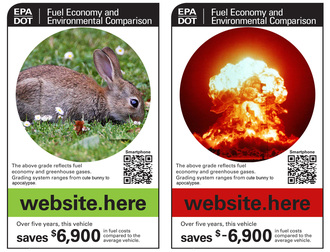
The EPA is working on new fuel economy window stickers for cars (you can vote on alternatives). I like this one:

New Fuel Econ Sticker
hoisted from the comments at jalopnik

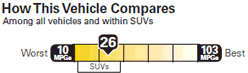
There are some things to like about the possible new version. For example, it indicates fuel economy on an absolute scale, so that there’s no implicit allocation of pollution rights to bigger vehicles (unlike Energy Star and the CAFE standard):

New Fuel Econ ScaleSince the new stickers will indicate fueling costs, emissions taxes on fuels will be a nice complementary policy, as they’ll be more evident on the dealer lot.

Waiting for a miracle at Lake Mead

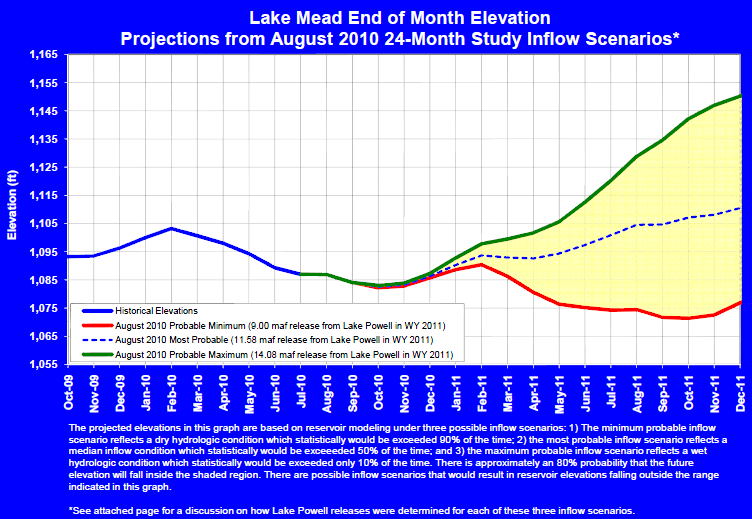
Lake Mead has dropped another ten feet since I wrote about its open-loop management,

My hypothesis is that the de facto policy for managing water levels is to wait for good years to restore the excess withdrawals of bad years, and that demand management measures in the interim are toothless. That worked back when river flows were not fully subscribed. The trouble is, supply isn’t stationary, and there’s no reason to assume that it will return to levels that prevailed in the early years of river compacts. At the same time, demand isn’t stationary either, as population growth in the west drives it up. To avoid Lake Mead drying up, the system is going to have to get a spine, i.e. there’s going to have to be some feedback between water availability and demand.

An article in the Arizona Republic confirms my thinking,

To slow the lake’s years-long decline, river users have built a reservoir west of Yuma to catch unused runoff, paid farmers to leave fields unplanted and are negotiating with Mexico to leave some of its allocation in Lake Mead while its farmers recover from an earthquake.

None of the steps will yield significant amounts of water, but together, they could keep Lake Mead from sinking below the drought triggers, buying time until a wet winter can replenish some of the water lost to drought.

“It’s time that we need,” said David Modeer, general manager of the Central Arizona Project, which moves water from the Colorado River to Phoenix and Tucson. “The reservoirs have shown they’re resilient. After a 12-year drought, they’re still half-full. What we do now will be worth it to stay out of a shortage.”

Managers are assuming that a return to historic rainfall patterns will save their bacon. But if climate models are right, and the Southwest will be on the losing end of trends in precipitation, that won’t happen. Even if they’re wrong, increasing demand can easily overwhelm restored rainfall. At some point, the loop will have to close – the question is how. Will property rights get reallocated and price signals aligned so that people live within the limits of supply? Or will the lake wind up permanently depleted? There are some signs of improved cooperation among states, but Nevada appears to be betting on failure:

if the reservoir fell below elevation 1,050 feet, one of the tunnels Nevada uses to draw water from the lake would sit above the waterline and would be useless. Nevada is working on a new, deeper tunnel

Gallatin County's Zoning Enforcement Trap

I’m playing a big role in a local effort to get the regulations of our zoning district enforced in the case of an egregious violation. Our planning and zoning commission’s habit, and apparent preference in this case, is not to enforce. Instead, it is proposed to enable the violation through a PUD amendment, and issue a trivial fine ($200, or 0.2% of the stated value of the structure).

Unfortunately, this proposal is illegal, because it contradicts existing covenants and a variety of goals and specific provisions of our General Plan and Zoning Regulation. This action might make sense if it were a naked political ploy to undermine the zoning through administrative rather than legislative means, which I hope is not the case. I think it is more likely an effort to “play nice” with violators and to avoid costly enforcement action.

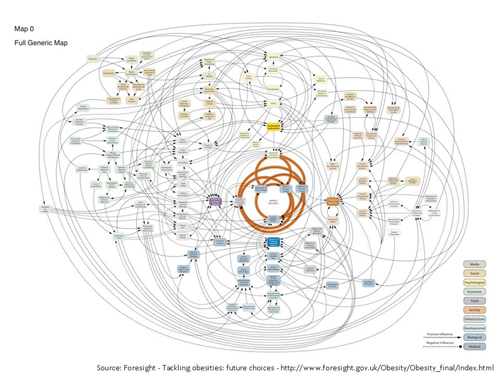
If so, the resulting weak enforcement posture is a short-sighted avoidance of conflict, that encourages far more problems in the long run. As the diagram below illustrates, backing down on the case at hand solves the immediate problem, but has terrible consequences.

Enforcement Dynamics

  • The precedent for non-enforcement and amendments to legalize violations erodes the legal basis for future enforcement actions.
  • Accommodation creates an expectation of forgiveness, encouraging owners and builders to violate in the future.
  • Exceptions created to accommodate violations make planning documents and title histories more complex, creating more opportunities for errors.

These side effects of lax enforcement accumulate. As violations mount, time that could be spent on productive activity (ensuring a thorough permitting process, or revising zoning regulations to clarify standards and streamline processes) gets squeezed out by time wasted on enforcement.

These reinforcing feedbacks create a deadly trap, into which the unsuspecting can easily step. Once triggered, the vicious cycle creates more pressure to relax enforcement standards, capturing the county in an undesirable equilibrium with many violations and no meaningful enforcement. Ultimately, the citizens (who initiated the zoning district) suffer from the side effects of density granted to violators, that is unavailable to those who comply with the law.

Fortunately, with a little fortitude, the process can be reversed. A single forceful enforcement action has a salutary effect on expectations, stemming the tide of violations and freeing up time for the improvement of regulations. There’s still the hangover of side effects of past accommodation to contend with, but surely the withdrawal is better than the addiction to accommodation.

When sea level chartjunk attacks

SeaLevelAttack

This informationisbeautiful graphic is pretty, but I don’t find it informative. The y scale is nonlinear, and I don’t know if the x scale conveys anything. It’s hard to work out the timing of inundation, which is really the key. The focus on the low points of big cities in developed countries is misleading, because those will be defended for a long time. Ho Chi Minh city should be on there, as well as the US gulf coast. USA Today would love this.

My head may explode from the irony

Next week I’m off to the EMF Snowmass conference on climate change impacts and integrated assessment. I’m more excited about the great minds than the great venue, though I can’t complain about the latter. Except this: “to ensure your safety, the steep road winding its way from the mountain’s base to the Top of the Village is heated in the winter to keep it dry.”

Cap & trade is dead. Long live cap & trade?

Democrats have pulled the plug on a sweeping energy bill this year. There is no heir apparent. This is not cause for panic. In climate, as in education, there are no emergencies.

However, the underlying reasons may be cause for panic. It seems that voters are unwilling to accept any policy that will significantly raise the price of emissions. Given that price is a predominant information carrier in our economy, other polices are unlikely to work efficiently, absent a price signal. That leaves us in a bit of a pickle. What to do?

If you don’t want to buck public opinion, advise the people to invest in (then pray for) a technological miracle. Ask yourself, “Do I feel lucky?” It might even work.

Alternatively, you might conclude that the public hasn’t quite grasped the nature of the problem – that wait and see is not a good policy in systems with long delays. But then you’d be accused of scientism, for the equivalent of challenging the efficient market hypothesis or the notion that the customer is always right. That’s rather puzzling, given that there’s direct evidence that people don’t intuitively appreciate the dynamics of accumulation, and that snowstorms in the East cause half of Americans to question the reality of climate change.

The anti-scientism, pro-technology crowd takes opposition to meaningful mitigation policy as a sure sign that the public is on to something. The wisdom of crowds is powerful when there’s diverse information and rapid feedback, as in price discovery through a market. But it has a pretty disastrous history in the runup to bubbles and other catastrophes, as we’ve recently seen. Surely there are some legitimate worries about current climate proposals (I’ve expressed a number here), but it doesn’t follow that pricing emissions is a bad decision.

So, what’s a modeler to do? Opening up political debates is a good idea, though not quite in the way that I think proponents intend. We already have plenty of political debates. The problem is that they tend to lack ready access to scientific or other information that can be agreed upon or at least presented in a way that permits testing of hypotheses against data or evaluation of decisions against contingencies. That means that questions of values and distribution of benefits (which politics is rightfully about) get mixed up with muddled thinking about science, economics, and social system dynamics.

The solution typically proposed is to open up science and models to more public scrutiny. That’s a good idea for a variety of reasons, but by itself it’s a losing proposition for scientists- they get all the criticism, and the public process doesn’t assimilate much of their insights. What’s needed is a fair exchange, where everyone shows their hands. Scientists make their stuff accessible, and in return participants in policy debates actually use it, and additionally submit to formalization of their arguments to facilitate shared understanding and testing.

Coming back to cap & trade, I don’t see that the major political players are willing to do that. Following a successful round of multi-stakeholder workshops that brought a systems perspective to conversations about climate policy, funded by the petro industry in California, we spent a fair amount of time marketing the idea of a model-assisted deliberation process targeted at shared design of federal climate policy. Lobbyists at some of the big stakeholders told us very forthrightly that they were unwilling to engage in any process with an outcome that they couldn’t predict and control.

In an environment where everyone’s happy with their own entrenched position, their isn’t much hope for a good solution to emerge. The only solution I see is to make an end run around the big players, and go straight to the public with better information, in order to expand the set of things they’ll accept. I hope there’s time for that to work.

Hatchetations, interrupted

The temperance movement may have won the prohibition war (temporarily), but a minor battle was lost just down the road from here, in Butte.

Despite the reformers’ best efforts, Butte’s demimonde was larger and seedier than ever by 1910. That year the federal census recorded Butte’s highly transient population at more than 39,000 and enumerated more than 250 prostitutes.  In 1910 when temperance crusader Carrie Nation came to Butte, “booze joints” in nearby Anaconda sported signs that read: “All Nations Are Welcome Except Carrie.” Butte’s morally upright citizens, who had invited Nation, welcomed her with open arms, yet her performance failed to match their expectations.  With a flourish and a crowd in tow, the stout sixty-three-year-old Nation charged down the length of Pleasant Alley. Once back on Mercury Street, she stormed into the Irish World, where she met her match in madam May Maloy. The two women joined in a scuffle, and Nation emerged the obvious loser. It was a moment savored by May’s patrons and celebrated with drinks all around. – Ellen Baumler, Montana Historical Society

Nation died 6 months later.