The Insidious Dynamics of Driving to School

When I passed by my old high school a few years ago, I was astonished to see that they’d paved over a nice grass field to make room for a vast parking lot, which must be for students. There’s really no excuse for driving to school in Palo Alto, CA – the weather is great, it’s flat, and no one lives more than a couple miles away.
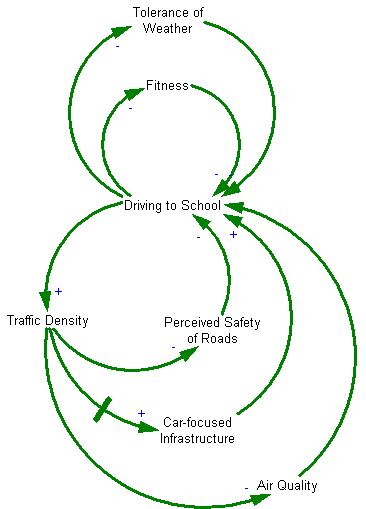
Most of the responsibility falls to this nest of positive feedback loops:

I’ll start with a perception: parents worried about the safety of their kids start driving them to school (or, in Palo Alto, buy them a BMW so they can drive themselves). All that extra driving adds to traffic density, reinforcing the perceived danger on the roads. Over the long haul, all that traffic demands more lane space, so bike lanes and sidewalks get crowded out. And who wants to bike next to a bunch of hot, smelly tailpipes?

The more students drive, the less fit they get, which diminishes the fun of riding. They also become less tolerant of weather – in spite of Gore Tex, a lot of people react to a little water falling from the sky like the Wicked Witch of the West.

The result of all this is a kind of phase transition – at some point, conditions are right for all these positive loops to kick in, and everyone shifts from bike-dominated transport to driving.

This transition should not be irreversible, if one is patient. One can move the point at which the phase transition occurs, to encourage bicycling. I think there are two leverage points. First, a society that can afford cars for kids can afford to provide Dutch- or Danish-style traffic separation, breaking the safety loop and decreasing the attractiveness of driving by removing traffic lanes, which causes congestion until people go back to bikes. Second, make the cars pay for the infrastructure they use and the environmental and safety externalities they cause. Once people are back on bikes, they’ll get fitter and healthier, and the positive loops will help lock in a more sustainable mode.

Inspired by a comment in Bert de Vries’ talk this morning at the 30th Balaton Group meeting.

The GDP Song

In SD, we often talk about the pitfalls of managing systems with delays and feedback while paying attention to the wrong indicators. The classic example is navigating a car at high speed in the fog on an icy road by looking in the rearview mirror.

A related problem is managing your system to maximize the wrong goals, e.g. running the economy by a problematic metric like GDP. Here’s Alan AtKisson’s musical take on that:

Sharing Systems

I’m at the 30th Balaton Group meeting this week. A group of us just put our heads together to think about online approaches to teaching and sharing systems thinking and systems modeling. The basic question was, if you needed thousands of systems thinkers in a hurry, how could you scale up systems education quickly?

My list of interesting things people might want to do online:

  • Model building
    • Group model building (in the spirit of SUNY Albany work)
    • Collaborative modeling (e.g., a distributed team working on federated modules of a model, but not necessarily involving the client and group conceptualization processes)
    • Collaborative causal loop diagramming
    • Model code sharing and reuse
  • Model consumption
    • Online games (playing through a simulation in real time) – possibly multiplayer
    • Online simulations (interactive experimentation with a model) – possibly with a social aspect as at Climate Colab

Much can already be done through online model services like Forio and other means. However, I think there’s a lot more to be done. In particular, we’re weak on providing shared model transparency and quality control for any but the simplest models.

Some interesting systems & sustainability online learning links that came up in the conversation:

http://www.unep.org/ieacp/iea/

http://www.google.com/tools/dlpage/res/talkvideo/hangouts/

http://ecotippingpoints.org/

http://www.cotelco.net/

http://www.bfi.org/

http://www.seedsystems.net/

http://www.clexchange.org/

http://www.watersfoundation.org/

http://climateinteractive.org

http://www.systemdynamics.org/MITCollectionRoadMaps.htm

http://www.systemswiki.org/index.php?title=Main_Page

http://insightmaker.com/

http://forio.com/

http://dt.asu.edu/

A natural driver of increasing CO2 concentration?

You wouldn’t normally look at a sink with the tap running and conclude that the water level must be rising because the drain is backing up. Nevertheless, a physically similar idea has been popular in climate skeptic circles lately.

You actually don’t need much more than a mass balance to conclude that anthropogenic emissions are the cause of rising atmospheric CO2, but with a model and some data you can really pound a lot of nails into the coffin of the idea that temperature is somehow responsible.

This notion has been adequately debunked already, but here goes:

This is another experimental video. As before, there’s a lot of fine detail, so you may want to head over to Vimeo to view in full screen HD. I find it somewhat astonishing that it takes 45 minutes to explore a first-order model.

Here’s the model: co2corr2.vpm (runs in Vensim PLE; requires DSS or Pro for calibration optimization)

Update: a new copy, replacing a GET DATA FIRST TIME call to permit running with simpler versions of Vensim. co2corr3.vpm

Gumowski-Mira Attractor

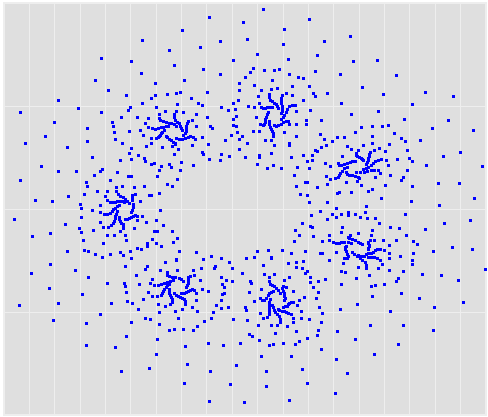
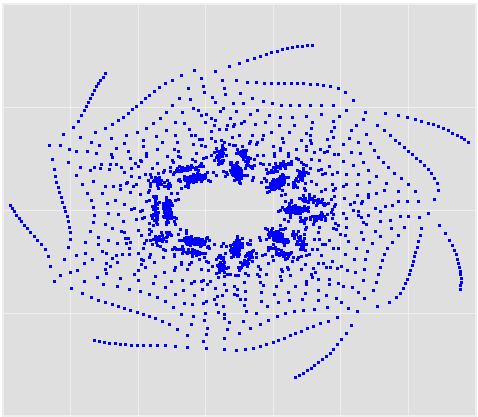
I became aware of this neat model via the Vensim forum. I have no idea what the physical basis is, but the diverse and beautiful output it generates is quite amazing.

Interestingly, if you only looked at time series of this sequence, you’d probably never notice it.

This runs in any version of Vensim. gumowski mira.mdl

Exploring stimulus policy

To celebrate the debt ceiling deal, I updated my copy of Nathan Forrester’s model, A Dynamic Synthesis of Basic Macroeconomic Theory.

Now, to celebrate the bad economic news and increasing speculation of a double-dip depression replay, here are some reflections on policy, using that model.

The model combines a number of macro standards: the multiplier-accelerator, inventory adjustment, capital accumulation, the IS-LM model, aggregate supply/aggregate demand dynamics, the permanent income hypothesis and the Phillips curve.

Forrester experimented with the model to identify the effects of five policies intended to stabilize fluctuations: countercyclical government transfers and spending, graduated income taxes, and money supply growth or targets. He used simulations experiments and linear system analysis (frequency response and eigenvalue elasticity) to identify the contribution of policies to stability.

Interestingly, the countercyclical policies tend to destabilize the business cycle. However, they prove to be stabilizing for a long-term cycle associated with the multiplier-accelerator and involving capital stock and long-term expectations.

I got curious about the effect of these policies through a simulated recession like the one we’re now in. So, I started from equilibrium and created a recession by imposing a negative shock to final sales, which passes immediately into aggregate demand. Here’s what happens:

There’s a lot of fine detail, so you may want to head over to Vimeo to view in full screen HD.

This is part of a couple of experiments I’ve tried with screencasting models, as practice for creating some online Vensim training materials. My preliminary observation is that even a perfunctory exploration of a simple model is time consuming to create and places high demands on audience attention. It’s no wonder you never see any real data or math on the Discovery Channel. I’d be interested to hear of examples of this sort of thing done well.

Energy unprincipled

I’ve been browsing the ALEC model legislation on ALECexposed, some of which infiltrated the Montana legislature. It’s discouragingly predictable stuff, but not without a bit of amusement. Take the ALEC Energy Principles:

Mission: To define a comprehensive strategy for energy security, production, and distribution in the states consistent with the Jeffersonian principles of free markets and federalism.

Except when authoritarian government is needed to stuff big infrastructure projects down the throats of unwilling private property owners:

Reliable electricity supply depends upon significant improvement of the transmission grid. Interstate and intrastate transmission siting authority and procedures must be addressed to facilitate the construction of needed new infrastructure.

Like free markets, federalism apparently has its limits:

Such plan shall only be approved by the commission if the expense of implementing such a plan is borne by the federal government.

Go ahead, shut down the EPA

Companies self-regulate just fine, without any rule of law, like they do in Nigeria:

Some of the results are “horrifying” and “unprecedented,” Brown says. The wells serving at least 10 Ogoni communities, for instance, have unsafe levels of hydrocarbons; one well had levels of benzene, a known carcinogen, that were 900 times greater than those deemed safe by the World Health Organization. In some areas, the researchers measured 8 centimeters of oil floating on top of groundwater and oil-soaked soils 5 meters deep. “Areas which appear unaffected at the surface are in reality severely contaminated underground,” the report concluded. In one bit of good news, the researchers concluded that spilled oil had not tainted local fish, a major source of protein, although it had ruined numerous fish farms.

Thinking about stuff

A while back I decided to never buy another garden plant unless I’d first dug the hole for it. In a single stroke, this simple rule eliminated impulse shopping at the nursery, improved the survival rate of new plants, and increased overall garden productivity.

This got me thinking about the insidious dynamics of stuff, by which tools come to rule their masters. I’ve distilled most of my thinking into this picture:


Click to enlarge.

This is mainly a visual post, but here’s a quick guide to some of the loops:

Black: stuff is the accumulation of shopping, less outflows from discarding and liquidation.

Red: Shopping adjusts the stock of stuff to a goal. The goal is set by income (a positive feedback, to the extent that stuff makes you more productive, so you can afford more stuff) and by the utility of stuff at the margin, which falls as you have less and less time to use each item of stuff, or acquire increasingly useless items.

So far, Economics 101 would tell a nice story of smooth adjustment of the shopping process to an equilibrium at the optimal stuff level. That’s defeated by the complexity of all of the other dynamics, which create a variety of possible vicious cycles and misperceptions of feedback that result in suboptimal stuffing.

Orange: You need stuff to go with the stuff. The iPad needs a dock, etc. Even if the stuff is truly simple, you need somewhere to put it.

Green: Society reinforces the need for stuff, via keep-up-with-the-Joneses and neglect of shared stuff. When you have too much stuff, C.H.A.O.S. ensues – “can’t have anyone over syndrome” – which reinforces the desire for stuff to hide the chaos or facilitate fun without social contact.

Blue: Stuff takes time, in a variety of ways. The more stuff  you have, the less time you actually have for using stuff for fun. This can actually increase your desire for stuff, due to the desire to have fun more efficiently in the limited time available.

Brown: Pressure for time and more stuff triggers a bunch of loops involving quality of stuff. One response is to buy low-quality stuff, which soon increases the stock of broken stuff lying about, worsening time pressure. One response is the descent into disposability, which saves the time, at the expense of a high throughput (shopping->discarding) relative to the stock of stuff. Once you’re fully stocked with low-quality stuff, why bother fixing it when it breaks? Fixing one thing often results in collateral damage to another (computers are notorious for this).

I’m far from a successful minimalist yet, but here’s what’s working for me to various degrees:

  • The old advice, “Use it up, wear it out, make it do or do without” works.
  • Don’t buy stuff when you can rent it. Unfortunately rental markets aren’t very liquid so this can be tough.
  • Allocate time to liquidating stuff. This eats up free time in the short run, but it’s a worse-before-better dynamic, so there’s a payoff in the long run. Fortunately liquidating stuff has a learning curve – it gets easier.
  • Make underutilized and broken stuff salient, by keeping lists and eliminating concealing storage.
  • Change your shopping policy to forbid acquisition of new stuff until existing stuff has been dealt with.
  • Buy higher quality than you think you’ll need.
  • Learn low-stuff skills.
  • Require steady state stuff: no shopping for new things until something old goes to make way for it.
  • Do things, even when you don’t have the perfect gear.
  • Explicitly prioritize stuff acquisition.
  • Tax yourself, or at least mentally double the price of any proposed acquisition, to account for all the side effects that you’ll discover later.
  • Get relatives to give $ to your favorite nonprofit rather than giving you something you won’t use.

There are also some policies that address the social dimensions of stuff:

  • Underdress and underequip. Occasionally this results in your own discomfort, but reverses the social arms race.
  • Don’t reward other peoples’ shopping by drooling over their stuff. Pity them.
  • Use and promote shared stuff, like parks.

This system has a lot of positive feedback, so once you get the loops running the right way, improvement really takes off.

Downgrade causality confusion

A sort of causal loop diagram made the cover of the WSJ today:

Source: WSJ h/t Drew Jone

Is it useful, or chartjunk? When I started to look at it from the perspective of good SD diagramming practice, I realized that it’s the latter.

First off, this isn’t really a structural diagram at all. It depicts a sequence of events mixed up with icons depicting some entities involved in those events. From the chain of events, one might infer that there is causality, but that would be hazardous, particularly in this case where there is no operational description of what’s happening. Did money rush to havens because stocks fell, or did stocks fall because money was rushing to havens? How could we tell, without articulating the mechanics of stocks and flows of money in price formation?

A good diagram ought to include quantifiable elements that can vary, with clear directionality. Traders and bars of gold are clearly not helpful variables. Nor are events particularly useful; mental accounting for a “decrease in Stocks Fell” is difficult, for example.

A good diagram should also distinguish key states that describe a system, and distinguish actual states from desired states. Presumably the magnitude and direction of the “money rush to havens” is a function of desired and actual positions in various securities, but we won’t learn much about that from this picture.

Finally, a good diagram ought to give some indication of the polarity of relationships. But what exactly is happening at the top of this diagram, where blue seems to pass to red through the treasury building? Is the diagram arguing that rising treasuries caused falling stocks, so that this is a runaway positive feedback loop? (stock value down, flight to havens, treasuries up, stocks down…). Or are we to be reassured that rising treasuries lower yields, reversing the fall in stocks?

Personally, I preferred the old black & white all-text WSJ.

So far, the comedy coverage of the downgrade is more illuminating than some serious efforts: