Drunker than intended and overinvested

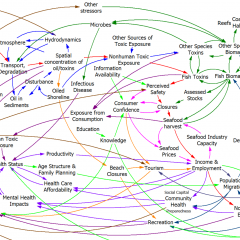
Erling Moxnes on the dangers of forecasting without structural insight and the generic structure behind getting too drunk and underestimating delays when investing in a market, with the common outcome of  instability.

More on drinking dynamics here, implemented as a game on Forio (haven’t tried it yet – curious about your experience if you do).

The seven-track melee

In boiled frogs I explored the implications of using local weather to reason about global climate. The statistical fallacies (local = global and weather = climate) are one example of the kinds of failures on my list of reasons for science denial.

As I pondered the challenge of upgrading mental models to cope with big problems like climate, I ran across a great paper by Barry Richmond (creator of STELLA, and my first SD teacher long ago). He inventories seven systems thinking skills, which nicely dovetail with my thinking about coping with complex problems.

Some excerpts:

Skill 1: dynamic thinking

Dynamic thinking is the ability to see and deduce behavior patterns rather than focusing on, and seeking to predict, events. It’s thinking about phenomena as resulting from ongoing circular processes unfolding through time rather than as belonging to a set of factors. …

Skill 2: closed-loop thinking

The second type of thinking process, closed-loop thinking, is closely linked to the first, dynamic thinking. As already noted, when people think in terms of closed loops, they see the world as a set of ongoing, interdependent processes rather than as a laundry list of one-way relations between a group of factors and a phenomenon that these factors are causing. But there is more. When exercising closed-loop thinking, people will look to the loops themselves (i.e., the circular cause-effect relations) as being responsible for generating the behavior patterns exhibited by a system. …

Skill 3: generic thinking

Just as most people are captivated by events, they are generally locked into thinking in terms of specifics. … was it Hitler, Napoleon, Joan of Arc, Martin Luther King who determined changes in history, or tides in history that swept these figures along on their crests? … Apprehending the similarities in the underlying feedback-loop relations that generate a predator-prey cycle, a manic-depressive swing, the oscillation in an L-C circuit, and a business cycle can demonstrate how generic thinking can be applied to virtually any arena.

Skill 4: structural thinking

Structural thinking is one of the most disciplined of the systems thinking tracks. It’s here that people must think in terms of units of measure, or dimensions. Physical conservation laws are rigorously adhered to in this domain. The distinction between a stock and a flow is emphasized. …

Skill 5: operational thinking

Operational thinking goes hand in hand with structural thinking. Thinking operationally means thinking in terms of how things really work—not how they theoretically work, or how one might fashion a bit of algebra capable of generating realistic-looking output. …

Skill 6: continuum thinking

Continuum thinking is nourished primarily by working with simulation models that have been built using a continuous, as opposed to discrete, modeling approach. … Although, from a mechanical standpoint, the differences between the continuous and discrete formulations may seem unimportant, the associated implications for thinking are quite profound. An “if, then, else” view of the world tends to lead to “us versus them” and “is versus is not” distinctions. Such distinctions, in turn, tend to result in polarized thinking.

Skill 7: scientific thinking

… Let me begin by saying what scientific thinking is not. My definition of scientific thinking has virtually nothing to do with absolute numerical measurement. … To me, scientific thinking has more to do with quantification than measurement. … Thinking scientifically also means being rigorous about testing hypotheses. … People thinking scientifically modify only one thing at a time and hold all else constant. They also test their models from steady state, using idealized inputs to call forth “natural frequency responses.”

When one becomes aware that good systems thinking involves working on at least these seven tracks simultaneously, it becomes a lot easier to understand why people trying to learn this framework often go on overload. When these tracks are explicitly organized, and separate attention is paid to develop each skill, the resulting bite-sized pieces make the fare much more digestible. …

The connections among the various physical, social, and ecological subsystems that make up our reality are tightening. There is indeed less and less “away,” both spatially and temporally, to throw things into. Unfortunately, the evolution of our thinking capabilities has not kept pace with this growing level of interdependence. The consequence is that the problems we now face are stubbornly resistant to our interventions. To “get back into the foot race,” we will need to coherently evolve our educational system

… By viewing systems thinking within the broader context of critical thinking skills, and by recognizing the multidimensional nature of the thinking skills involved in systems thinking, we can greatly reduce the time it takes for people to apprehend this framework. As this framework increasingly becomes the context within which we think, we will gain much greater leverage in addressing the pressing issues that await us …

Source: Barry Richmond, “Systems thinking: critical thinking skills for the 1990s and beyond” System Dynamics Review Volume 9 Number 2 Summer 1993

That was 18 years ago, and I’d argue that we’re still not back in the race. Maybe recognizing the inherent complexity of the challenge and breaking it down into digestible chunks will help though.

Boiled frogs, pattern recognition and climate policy

A friend (who shall remain nameless to avoid persecution) relates:

I just have to share a somewhat funny, mostly frustrating story.  XXX and I went to Montreal to see U2 last night …

So at the end of the show, it started raining.  Not a light rain but a sharp, arctic windy rain to the point we were all saturated within minutes.  No exaggeration.  It took us 2 hours to get out of the stadium, to the Metro, and back to the hotel because there were 80,000 people trying to get out.  It was purgatory.  It was after 3 am before we finally got to sleep.

OK, that’s not the story either.  My point, besides sharing the night with you, is to explain my state of mind leading up to the customs experience. At the border, things were going smoothly … until the security guard asked us what we do for work.  When I told him what I do, he retorted, “Global warming is not happening. Have you seen the cold weather we’ve had for the past five years?” Of course, I couldn’t let that just sit there.  I explained climate change is not just warmer weather but more extreme events and  weather is different from climate.  So then we actually started arguing about this and I got all fired up …

Now the frustrating part.  As we drove away, though, I just felt so despondent that this is the battle with much of the public that we face.  How can we convince people to act and to demand their government to act when they really don’t think there is a problem?  I’ve been thinking we should utilize some of our time to reach out to the masses who are not looking to improve their mental models of climate change because they don’t even think such a thing exists.   …

The fundamental problem, I think, is that evidence for climate change relies on a variety of measurements dispersed over the globe, and physics and models at a variety of levels of complexity. Yet neither of these is accessible to ordinary people. Therefore, when presented with a mix of inconvenience of reducing emissions, false balance, and pseudoscience, people default to a “trust no one” approach, only believing what they can perceive with their own senses: local weather.

That’s a problem, for several reasons. First, local weather is extremely noisy, and only loosely correlated with global energy balance. So, even a person with unbiased weather perception and perfect recall over a long time period really shouldn’t be drawing any conclusions about global conditions from local measurements.

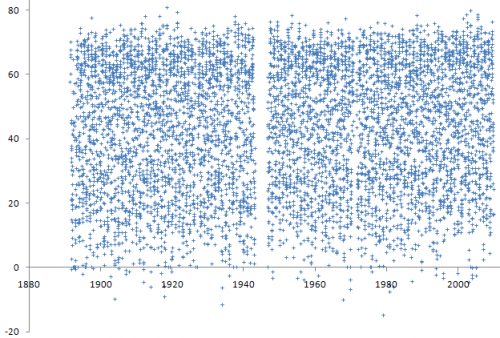
Second, no one has unbiased perception and perfect recall over long periods. Consider the “cold weather we’ve had for the past five years.” Here’s the temperature from the USHCN Enosburg Falls, VT station, near the border crossing, from 1891 through the end of 2009, in degrees Fahrenheit:

It’s hard to imagine something happening in 2010 and 2011 that could lead one to feel good about conclusively calling a 5-yr cold spell. In fact, almost the only thing you can see here is a slight upward trend.

Continue reading “Boiled frogs, pattern recognition and climate policy”

The Economic Long Wave

This is John Sterman’s model of long waves (long-duration economic cycles), driven by capital accumulation dynamics. This version is replicated from a JEBO article,

STERMAN, J. D. (1985) A Behavioral Model of the Economic Long Wave. Journal of Economic Behavior and Organization, 6, 17-53.

There’s some interesting related literature (including other economic models in this library). From Sterman’s publications list:

STERMAN, J. D. & MOSEKILDE, E. (1994) Business Cycles and Long Waves: A Behavioral, Disequilibrium Perspective. IN SEMMLER, W. (Ed.) Business Cycles: Theory and Empirical Methods. Boston, Kluwer Academic Publishers.

STERMAN, J. D. (1994) The Economic Long Wave: Theory and Evidence. IN SHIMADA, T. (Ed.) An Introduction to System Dynamics. Tokyo.

STERMAN, J. D. (2002) A Behavioral Model of the Economic Long Wave. IN EARL, P. E. (Ed.) The Legacy of Herbert Simon in Economic Analysis. Cheltenham, UK, Edward Elgar.

STERMAN, J. D. (1985) An Integrated Theory of the Economic Long Wave. Futures, 17, 104-131.

RASMUSSEN, S., MOSEKILDE, E. & STERMAN, J. D. (1985) Bifurcations and Chaotic Behavior in a Simple Model of the Economic Long Wave. System Dynamics Review, 1, 92-110.

STERMAN, J. D. (1983) The Long Wave. Science, 219, 1276.

KAMPMANN, C., HAXHOLDT, C., MOSEKILDE, E. & STERMAN, J. D. (1994) Entrainment in a Disaggregated Economic Long Wave Model. IN LEYDESDORFF, L. & VAN DEN BESSELAAR, P. (Eds.) Evolutionary Economics and Chaos Theory. London, Pinter.

MOSEKILDE, E., LARSEN, E. R., STERMAN, J. D. & THOMSEN, J. S. (1993) Mode Locking and Nonlinear Entrainment of Macroeconomic Cycles. IN DAY, R. & CHEN, P. (Eds.) Nonlinear Economics and Evolutionary Economics. New York, Oxford University Press.

MOSEKILDE, E., THOMSEN, J. S. & STERMAN, J. D. (1992) Nonlinear Interactions in the Economy. IN HAAG, G., MÜLLER, U. & TROITZSCH, K. (Eds.) Economic Evolution and Demographic Change. Berlin, Springer Verlag.

THOMSEN, J. S., MOSEKILDE, E. & STERMAN, J. D. (1991) Hyperchaotic Phenomena in Dynamic Decision Making. IN SINGH, M. G. & TRAVÉ-MASSUYÈS, L. (Eds.) Decision Support Systems and Qualitative Reasoning. Amsterdam, Elsevier Science Publishers.

THOMSEN, J. S., MOSEKILDE, E., LARSEN, E. R. & STERMAN, J. D. (1991) Mode-Locking and Chaos in a Periodically Driven Model of the Economic Long Wave. IN EBELING, W. (Ed.) Models of Self Organization in Complex Systems. Berlin, Akademie Verlag.

STERMAN, J. D. (1988) Nonlinear Dynamics in the World Economy: The Economic Long Wave. IN CHRISTIANSEN, P. & PARMENTIER, R. (Eds.) Structure, Coherence, and Chaos in Dynamical Systems. Manchester, Manchester University Press.

STERMAN, J. D. (1987) Debt, Default, and Long Waves: Is History Relevant? IN BOECKH, A. (Ed.) The Escalation in Debt and Disinflation: Prelude to Financial Mania and Crash? Montreal, BCA Publications.

STERMAN, J. D. (1987) An Integrated Theory of the Economic Long Wave. IN WANG, Q., SENGE, P., RICHARDSON, G. P. & MEADOWS, D. H. (Eds.) Theory and Application of System Dynamics. Beijing, New Times Press.

STERMAN, J. D. (1987) The Economic Long Wave: Theory and Evidence. IN VASKO, T. (Ed.) The Long Wave Debate. Berlin, Springer Verlag.

RASMUSSEN, S., MOSEKILDE, E. & STERMAN, J. D. (1987) Bifurcations and Chaotic Behavior in a Simple Model of the Economic Long Wave. IN WANG, Q., SENGE, P., RICHARDSON, G. P. & MEADOWS, D. H. (Eds.) Theory and Application of System Dynamics. Beijing, New Times Press.

And from Christian Kampmann,

“The Role of Prices in Long Wave Entrainment” (with C. Haxholdt, E. Mosekilde, and J.D. Sterman), International System Dynamics Conference, Stirling, U.K. and at the Spring 1994 ORSA/TIMS conference, Boston, MA. 1994.
“Disaggregating a simple model of the economic long wave” International Conference of the System Dynamics Society, Keystone, CO, 1985.
The long wave model was the guine pig for Kampmann’s interesting ’96 conference paper that combined a graph-theoretic identification of a set of feedback loops having independent gains with eigenvalue analysis,
Kampmann, Christian E.   Feedback Loop Gains and System Behavior
There also used to be a nifty long wave game, programmed on NEC minicomputers (32k memory?), but I’ve lost track of it. I’d be interested to here of a working version.

Economic Cycles: Underlying Causes

Nathaniel Mass’ model of economic cycles, replicated from his 1975 book, Economic Cycles: An Analysis of Underlying Causes, which unfortunately seems to have disappeared from the Productivity Press site (though you can still find used copies).

I haven’t checked, but I’m guessing that the model is quite similar to that in his PhD thesis, which you can get from MIT libraries here. Here’s the abstract:


The models: mass2.mdl mass2.vpm

These don’t have units defined, unfortunately – I’d love to have a copy with units if you’re so inclined.

The Dynamics of Commodity Production Cycles

These classic models are from Dennis Meadows’ dissertation, the Dynamics of Commodity Production Cycles:

While times have changed, the dynamics described by these models are still widespread.

These versions should work in all recent Vensim versions:

DLMhogs2.vpm DLMhogs2.mdl

DLMgeneric2.vpm DLMgeneric2.mdl


Androids rule the earth

Android activations are apparently growing 4.4% per week, on a basis of around 100 million sales per year.

By the rule of 72 for exponential growth, that means sales are doubling every 16 weeks, or about three times per year.

If sales are growing exponentially, the installed base is also growing exponentially (because the integral of e^x is e^x). Half of the accumulated sales occur in the most recent doubling (because the series sum 1+2+4+8+…+n = 2*n-1), so the integrated unit sales are roughly one doubling (16 weeks) ahead of the interval sales.

Extrapolating, there’s an Android for everyone on the planet in two years (6 doublings, or a factor of 64 increase).

Extrapolating a little further, sales equal the mass of the planet by about 2030 (ln(10^25/10^8)/ln(2)/3 = 19 years).

Limits? What limits?

Delayed negative feedback on the financial crisis

The wheels of justice grind slowly, but they grind exceedingly fine:

Too Big to Fail or Too Big to Change

While the SEC has reached several settlements in connection with misconduct related to the financial meltdown, those settlements have been characterized as “cheap,” “hollow,” “bloodless,” and merely “cosmetic,” as noted by Columbia University law professor John C. Coffee in a recent article. Moreover, one of the SEC’s own Commissioners, Luis Aguilar, has recently admitted that the SEC’s penalty guidelines are “seriously flawed” and have “adversely impact[ed]” civil enforcement actions.

For example, Judge Jed Rakoff castigated the SEC for its attempted settlement of charges that Bank of America failed to disclose key information to investors in connection with its acquisition of Merrill Lynch (“Merrill”), including that Merrill was on the brink of insolvency (necessitating a massive taxpayer bailout), and that Bank of America had entered into a secret agreement to allow Merrill to pay its executives billions of dollars in bonuses prior to the close of the merger regardless of Merrill’s financial condition. The SEC agreed to settle its action against Bank of America for $33 million in August 2009, even though its acquisition of Merrill resulted in what The New York Times characterized as “one of the greatest destructions of shareholder value in financial history.” In rejecting the deal, Judge Rakoff declared that the proposed settlement was “misguided,” “inadequate” and failed to “comport with the most elementary notions of justice and morality.” …

It has increasingly fallen to institutional investors to hold mortgage lenders, investment banks and other large financial institutions accountable for their role in the mortgage crisis by seeking redress for shareholders injured by corporate misconduct and sending a powerful message to executives that corporate malfeasance is unacceptable. For example, sophisticated public pension funds are currently prosecuting actions involving billions of dollars of losses against Bank of America, Goldman Sachs, JPMorgan Chase, Lehman Brothers, Bear Stearns, Wachovia, Merrill Lynch, Washington Mutual, Countrywide, Morgan Stanley and Citigroup, among many others. In some instances, litigations have already resulted in significant recoveries for defrauded investors.

Historically, institutional investors have achieved impressive results on behalf of shareholders when compared to government- led suits. Indeed, since 1995, SEC settlements comprise only 5 percent of the monetary recoveries arising from securities frauds, with the remaining 95 percent obtained through private litigation ….

I think the problem here is that litigation works slowly. It’s not clear that punitive legal outcomes occur on a relevant time scale. Once bonuses have been paid and leaders have moved on, there are no heads left to roll, so organizations may only learn that they’d better have good lawyers.