The rebound delusion

Lately it’s become fashionable to claim that energy efficiency is useless, because the rebound effect will always eat it up. This is actually hogwash, especially in the short term. James Barrett has a nice critique of the super-rebound position at RCE. Some excerpts:

To be clear, the rebound effect is real. The theory behind it is sound: Lower the cost of anything and people will use more of it, including the cost of running energy consuming equipment. But as with many economic ideas that are sound theory (like the idea that you can raise government revenues by cutting tax rates), the trick is in knowing how far to take them in reality. (Cutting tax rates from 100% to 50% would certainly raise revenues. Cutting them from 50% to 0% would just as surely lower them.)

The problem with knowing how far to take things like this is that unlike real scientists who can run experiments in a controlled laboratory environment, economists usually have to rely on what we can observe in the real world. Unfortunately, the real world is complicated and trying to disentangle everything that’s going on is very difficult.

Owen cleverly avoids this problem by not trying to disentangle anything.

One supposed example of the Jevons paradox that he points to in the article is air conditioning. Citing a conversation with Stan Cox, author of Losing Our Cool, Owen notes that between 1993 and 2005, air conditioners in the U.S. increased in efficiency by 28%, but by 2005, homes with air conditioning increased their consumption of energy for their air conditioners by 37%.

Accounting only for the increased income over the timeframe and fixing Owen’s mistake of assuming that every air conditioner in service is new, a few rough calculations point to an increase in energy use for air conditioning of about 30% from 1993 to 2005, despite the gains in efficiency. Taking into account the larger size of new homes and the shift from room to central air units could easily account for the rest.

All of the increase in energy consumption for air conditioning is easily explained by factors completely unrelated to increases in energy efficiency. All of these things would have happened anyway. Without the increases in efficiency, energy consumption would have been much higher.

It’s easy to be sucked in by stories like the ones Owen tells. The rebound effect is real and it makes sense. Owen’s anecdotes reinforce that common sense. But it’s not enough to observe that energy use has gone up despite efficiency gains and conclude that the rebound effect makes efficiency efforts a waste of time, as Owen implies. As our per capita income increases, we’ll end up buying more of lots of things, maybe even energy. The question is how much higher would it have been otherwise.

Why is the rebound effect suddenly popular? Because an overwhelming rebound effect is needed to make sense of proposals to give up on near-term emissions prices and invest in technology, praying for a clean-energy-supply miracle in a few decades.

As Barrett points out, the notion that energy efficiency increases energy use is an exaggeration of the rebound effect. For efficiency to increase use, energy consumption has to be elastic (e<-1). I don’t remember ever seeing an economic study that came to that conclusion. In a production function, such values aren’t physically plausible, because they imply zero energy consumption at a finite energy price.

Therefore, the notion that pursuing energy efficiency makes the climate situation worse is a fabrication. Doubly so, because of an accounting sleight-of-hand. Consider two extremes:

  1. no rebound effects (elasticity ~ 0): efficiency policies work, because they reduce energy use and its associated negative social externalities.
  2. big rebound effects (elasticity < -1): efficiency policies increase energy use, but they do so because there’s a huge private benefit from the increase in mobility or illumination or whatever private purpose the energy is put to.

The super-rebound crowd pooh-poohs #1 and conveniently ignores the welfare outcome of #2, accounting only for the negative side effects.

If rebound effects are modest, as they surely are, it makes much more sense to guide R&D and deployment for both energy supply and demand with a current price signal on emissions. That way, firms make distributed decisions about where to invest, rather than the government picking winners, and appropriate tradeoffs between conservation and clean supply are possible. The price signal can be adapted to meet environmental constraints in the face of rising income. Progress starts now, rather than after decades of waiting for the discover->apply->deploy->embody pipeline.

If the public isn’t ready for it, that doesn’t mean analysts should bargain against their own good sense by recommending things that might be popular, but are unlikely to work. That’s like a doctor advising a smoker to give to cancer research, without mentioning that he really ought to quit.

Update: there’s an excellent followup at RCE.
Rendering Data

Rendering is a process that converts waste animal tissue into stable, value-added materials. Rendering can refer to any processing of animal byproducts into more useful materials, or more narrowly to the rendering of whole animal fatty tissue into purified fats like lard or tallow. …

The majority of tissue processed comes from slaughterhouses, but also includes restaurant grease and butcher shop trimmings. This material can include the fatty tissue, bones, and offal, as well as entire carcasses of animals condemned at slaughterhouses, and those that have died on farms (deadstock), in transit, etc. …

Converting data from public sources and business archives into quality material, suitable for use in modeling, is often equally arduous if not quite so disgusting. Just substitute “back office systems” for “slaughterhouses,” “basement paper archives” for “fatty tissue, bones, and offal,” etc. Electronic systems create vast quantities of the stuff, but much of it could be aptly described as “deadstock.” The problem is that people can easily tolerate some dreck in material that they’re just browsing for information, so systems don’t go to great lengths to eliminate it. Models are pickier – a few extra zeroes somewhere can really affect calibration, for example.

There’s an interesting new weapon in the war against arcane formats, inconsistent field coding and other data flaws, google refine. It’s apparently a Freebase spinoff. I’ve only used it for one task so far: grouping ad hoc text in a column, recognizing that “Ventana Systems,” “Ventana Systems, Inc.,” and “Ventanna Systems” all mean the same thing. It has useful filtering and clustering tools that largely automate such painful manual tasks. It can also do something else I’ve often hungered for in the past: transform an indented list into a table format. I suspect there’s much more depth that I haven’t even seen. Best of all, it’s fairly easy to get started.

It won’t cure all sins of corporate data management, like throwing away everything more than a few years old, but I’ll definitely reach for it next time I have a platefull of messy data to clean up for a model. Check it out.

No animals were harmed in the writing of this post.

Deeper Lessons

From the mailbag, regarding my last post on storytelling and playing with systems,

I read your blog post from the 19th and wondered how you would compare what was presented in the blog in contrast with what Forrester said on on pg 17, “Deeper Lessons” in the paper at

http://sysdyn.clexchange.org/sdep/papers/D-4434-3.pdf

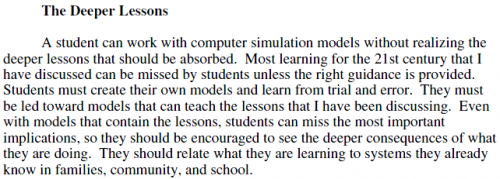
That paper is Jay Forrester’s 1994 Learning Through System Dynamics as Preparation for the 21st Century. There’s a lot of good thinking in it. Unfortunately, the pdf is protected, so I have to give you a screenshot:

Forrester 4434 excerpt

The “important implications” that might be missed are things like, “we cause our own problems,” the notion that cause and effect are separated in time and space, and the differences between high- and low-leverage policies. (Go read the original for more.)

I see the blog and paper as complementary. Forrester’s deeper learnings are things that emerge from understanding the way things work, and that understanding – he argues – is developed through experimentation. This is also the rationale for management flight simulators and other games that teach systems principles. I think the guidance toward important implications that Forrester advocates is not much different than the kind of reporting the blog seeks – coverage that illuminates system structure and its consequences.

I don’t think stories per se are the problem. Sometimes they do degenerate into the equivalent of a bad history textbook – a litany of he-said-she-said opinions and events without any organizing structure. However,  a story can be crafted to reveal the way things work, and systems thinkers often advocate the use of stories to present system insights. Perhaps we should be more cautious about that.

I think it’s very natural to drop from an operational description of a system to stories that are so much about people and events that they lose track of structure. For example, the article on the steam engine at howstuffworks, which ought to be structural if anything is, starts off with, “They were first invented by Thomas Newcomen in 1705, and James Watt (who we remember each time we talk about “60-watt light bulbs” and the such) made big improvements to steam engines in 1769.” If it’s hard for steam engines, which are well-understood, imagine how hard it is for a reporter to get beyond the words of a controversial topic like health care, where even experts are likely to ambiguous and conflicting mental models.

The cautionary aspect of stories reminded me of a section in The Fifth Discipline, about what happens when you don’t convey systemic understanding:

Unfortunately, much more common are leaders who have a sense of purpose and genuine vision, but little ability to foster systemic understanding. Many greate “charismatic” leaders, despite having a deep sense of purpose and vision, manage almost exclusively at the level of events. Such leaders deal in visions and crises, and little in between. They foster a lofty sense of purpose and mission. They create tremendous energy and enthusiasm. But, under their leadership, an organization caroms from crisis to crisis. Eventually, the worldview of people in the organization becomes dominated by events and reactiveness. People experience being jerked continually from one crisis to another; they have no control over their time, let alone their destiny. Eventually, this will breed deep cynicism about the vision, and about visions in general. The soil within which a vision must take root – the belief that we can influence our future – becomes poisoned.

Such “visionary crisis managers” often become tragic figures. Their tragedy stems from the depth and genuineness of their vision. They often are truly committed to noble aspirations. But noble aspirations are not enough to overcome systemic forces contrary to the vision. As the ecologists say, “Nature bats last.” Systemic forces will win out over the most noble vision if we do not learn how to recognize, work with, and gently mold those forces.

Subversive modeling

This is a technical post, so Julian Assange fans can tune out. I’m actually writing about source code management for Vensim models.

Occasionally procurements try to treat model development like software development. That can end in tragedy, because modeling isn’t the same as coding. However, there are many common attributes, and therefore software tools can be useful for modeling.

One typical challenge in model development is version control. Model development is iterative, and I typically go through fifty or more named model versions in the course of a project. C-ROADS is at v142 of its second life. It takes discipline to keep track of all those model iterations, especially if you’d like to be able to document changes along the way and recover old versions. Having a distributed team adds to the challenge.

The old school way

Continue reading “Subversive modeling”

Storytelling and playing with systems

This journalist gets it:

Maybe journalists shouldn’t tell stories so much. Stories can be a great way of transmitting understanding about things that have happened. The trouble is that they are actually a very bad way of transmitting understanding about how things work. Many of the most important things people need to know about aren’t stories at all.

Our work as journalists involves crafting rewarding media experiences that people want to engage with. That’s what we do. For a story, that means settings, characters, a beginning, a muddle and an end. That’s what makes a good story.

But many things, like global climate change, aren’t stories. They’re issues that can manifest as stories in specific cases.

… the way that stories transmit understanding is only one way of doing so. When it comes to something else – a really big, national or world-spanning issue, often it’s not what happened that matters, so much as how things work.

…When it comes to understanding a system, though, the best way is to interact with it.

Play is a powerful way of learning. Of course the systems I’ve listed above are so big that people can’t play with them in reality. But as journalists we can create models that are accurate and instructive as ways of interactively transmitting understanding.

I use the word ‘play’ in its loosest sense here; one can ‘play’ with a model of a system the same way a mechanic ‘plays’ around with an engine when she’s not quite sure what might be wrong with it.

The act of interacting with a system – poking and prodding, and finding out how the system reacts to your changes – exposes system dynamics in a way nothing else can.

If this grabs you at all, take a look at the original – it includes some nice graphics and an interesting application to class in the UK. The endpoint of the forthcoming class experiment is something like a data visualization tool. It would be cool if they didn’t stop there, but actually created a way for people to explore the implications of different models accounting for the dynamics of class, as Climate Colab and Climate Interactive do with climate models.

Changes afoot

I’m looking forward to some changes in my role at Ventana Systems. From the recent Vensim announcement:

Dear Vensim Community,

We would like to alert you to some exciting changes to the Vensim team.

Bob Eberlein, who has been head of development since almost the beginning of Vensim, has decided to embark on a new chapter of his life, starting in January. While we are sad to see him go, we greatly appreciate all of his efforts and accomplishments over the past 22 years, and wish him the very best in his new adventures.

Vensim is extremely important to our efforts here at Ventana Systems and we know that it is also important to many of you in the System Dynamics community. We are fully committed to maintaining Vensim as the leading System Dynamics software platform and to extending its features and capabilities. We have increased our investment in Vensim with the following team:

Tom Fiddaman has taken on an additional role as Vensim Product Manager. He will make sure that new releases of Vensim address market requirements and opportunities. He will facilitate information flow between the community, our user base, and the Vensim design team.

• Tony Kennedy from Ventana Systems UK will lead the Customer Services functions, including order fulfillment, bug resolution, and the master training schedule. He will also support the Distributor network. Tony has been working with UK Vensim customers for over 10 years.

• Larry Yeager has recently joined Ventana Systems to head the future development of Vensim. Larry has led the development of many software products and applications, including the Jitia System Dynamics software for PA Consulting.

• We have formed a steering team that will provide guidance and expertise to our future product development. This team includes Alan Graham, Tony Kennedy, Tom Fiddaman, Marios Kagarlis, and David Peterson.

We are very excited about the future and look forward to continuing our great relationships with you, our clients and friends.

Most sincerely,

Laura Peterson

President & CEO

Ventana Systems, Inc.

Statistics >> Calculus ?

Another TED talk argues for replacing calculus with statistics at the pinnacle of mathematics education.

There’s an interesting discussion at Wild About Math!.

I’m a bit wary of the idea. First, I don’t think there needs to be a pinnacle – math can be a Bactrian camel. Second, some of the concepts are commingled anyway (limits and convergence, for example), so it hardly makes sense to treat them as competitors. Third, both are hugely important to good decision making (which is ultimately what we want out of education). Fourth, the world is a dynamic, stochastic system, so you need to understand a little of each.

Where the real opportunity lies, I think, is in motivating the teaching of both experientially. Start calculus with stocks and flows and physical systems, and start statistics with games of chance and estimation. Use both to help people learn how to make better inferences about a complex world. Then do the math as it gets interesting and necessary. Whether you come at the problem from the angle of dynamics or uncertainty first hardly matters.

Economists in the bathtub

Env-Econ is one of several econ sites to pick up on standupeconomist Yoram Bauman’s assessment, Grading Economics Textbooks on Climate Change.

Most point out the bad, but there’s also a lot of good. On Bauman’s curve, there are 4 As, 3 Bs, 5 Cs, 3 Ds, and one F. Still, the bad tends to be really bad. Bauman writes about one,

Overall, the book is not too bad if you ignore that it’s based on climate science that is almost 15 years out of date and that it has multiple errors that would make Wikipedia blush. The fact that this textbook has over 20 percent of the market shakes my faith in capitalism.

The interesting thing is that the worst textbooks go astray more on the science than on the economics. The worst cherry-pick outdated studies, distort the opinions of scientists, and toss in red herrings like “For Greenland, a warming climate is good economic news.”

I find the most egregious misrepresentation in Schiller’s The Economy Today (D+):

The earth’s climate is driven by solar radiation. The energy the sun absorbs must be balanced by outgoing radiation from the earth and the atmosphere. Scientists fear that a flow imbalance is developing. Of particular concern is a buildup of carbon dioxide (CO2) that might trap heat in the earth’s atmosphere, warming the planet. The natural release of CO2 dwarfs the emissions from human activities. But there’s a concern that the steady increase in man-made CO2 emissions—principally from burning fossil fuels like gasoline and coal—is tipping the balance….

First, there’s no “might” about the fact that CO2 traps heat (infrared radiation); the only question is how much, when feedback effects come into play.  But the bigger issue is Schiller’s implication about the cause of atmospheric CO2 buildup. Here’s a picture of Schiller’s words, with arrow width scaled roughly to actual fluxes:

CO2flows1

Apparently, nature is at fault for increasing atmospheric CO2. This is like worrying that the world will run out of air, because people are inhaling it all (Schiller may be inhaling something else). The reality is that the natural flux, while large, is a two way flow:

CO2flows2

What goes into the ocean and biosphere generally comes out again. For the last hundred centuries, those flows were nearly equal (i.e. zero net flow). But now that humans are emitting a lot of carbon, the net flow is actually from the atmosphere into natural systems, like this:

CO2flows3

That’s quite a different situation. If an author can’t paint an accurate verbal picture of a simple stock-flow system like this, how can a text help students learn to manage resources, money or other stocks?