Firefighting and other project dynamics

The tipping loop, a positive feedback that drives sequential or concurrent projects into permanent firefighting mode, is actually just one of a number of positive feedbacks that create project management traps. Here are some others:

  • Rework – the rework cycle is central to project dynamics. Rework arises when things aren’t done right the first time. When errors are discovered, tasks have to be reworked, and there’s no guarantee that they’ll be done right the second time either. This creates a reinforcing loop that bloats project tasks beyond what’s expected with perfect execution.
  • Brooks’ Law – adding resources to a late project makes it later. There are actually several feedback loops involved:
    • Rookie effects: new resources take time to get up to speed. Until they do, they eat up the time of senior staff, decreasing output. Also, they’re likely to be more error prone, creating more rework to be dealt with downstream.
    • Diseconomies of scale from communication overhead.
  • Burnout – under schedule pressure, it’s tempting to work harder and longer. That works briefly, but sustained overtime is likely to be counterproductive, due to decreases in productivity, turnover, and increases in error rates.
  • Congestion – in construction or assembly, a delay in early phases may not delay the arrival of materials from suppliers. Unused materials stack up, congesting the work site and slowing progress further.
  • Dilution – trying to overcome stalled phases by tackling too many tasks in parallel thins resources to the point that overhead consumes all available time, and progress grinds to a halt.
  • Hopelessness – death marches are no fun, and the mere fact that a project is going astray hurts morale, leading to decreased productivity and loss of resources as rats leave the sinking ship.

Any number of things can contribute to schedule pressure that triggers these traps. Often the trigger is external, such as late-breaking change orders or regulatory mandates. However, it can also arise internally through scope creep. As long as it appears that a project is on schedule (a supposition that’s likely to prove false in hindsight), it’s hard to resist additional feature requests and suppress gold-plating urges of developers.

Taylor & Ford integrate a number of these dynamics into a simple model of single-project tipping points. They generically characterize the “ripple effect” via a few parameters: one characterizes “the amount of impact that reworked portions of the project have on the total work required to complete the project” and another captures the effect of schedule pressure on generation of rework. They suggest a robust design approach that keeps projects out of trouble, by ensuring that the vicious cycles created by these loops do not become dominant.

Because projects are complicated nests of feedback, it’s not surprising that we manage them poorly. Cognitive biases and learned heuristics can exacerbate the effect of vicious cycles arising from the structure of the work itself. For example,

… many organizations reward and promote engineers based on their ability to save troubled projects. Consider, for example, one senior manager’s reflection on how developers in his organizations were rewarded:

Occasionally there is a superstar of an engineer or a manager that can take one of these late changes and run through the gauntlet of all the possible ways that it could screw up and make it a success. And then we make a hero out of that person. And everybody else who wants to be a hero says “Oh, that is what is valued around here.” It is not valued to do the routine work months in advance and do the testing and eliminate all the problems before they become problems. …

… allowing managers to “save” troubled projects, and therefore receive accolades and benefits, creates a situation in which, for those interested in advancement, there is little incentive to execute a project properly from start to finish. While allowing such heroics may help in the short run, the long run health of the development system is better served by not rewarding them.

Repenning, Gonçalves & Black (2001) CMR

… much of the complexity of concurrent development—and the implementation failures that plague many organizations—arises from interactions between the technical and behavioral dimensions. We use a dynamic project model that explicitly represents these interactions to investigate how a ‘‘Liar’s Club’’—concealing known rework requirements from managers and colleagues—can aggravate the ‘‘90% syndrome,’’ a common form of schedule failure, and disproportionately degrade schedule performance and project quality.

Sterman & Ford (2003) Concurrent Engineering

Once caught in a downward spiral, managers must make some attribution of cause. The psychology literature also contains ample evidence suggesting that managers are more likely to attribute the cause of low performance to the attitudes and dispositions of people working within the process rather than to the structure of the process itself …. Thus, as performance begins to decline due to the downward spiral of fire fighting, managers are not only unlikely to learn to manage the system better, they are also likely to blame participants in the process. To make matters even worse, the system provides little evidence to discredit this hypothesis. Once fire fighting starts, system performance continues to decline even if the workload returns to its initial level. Further, managers will observe engineers spending a decreasing fraction of their time on up-front activities like concept development, providing powerful evidence confirming the managers’ mistaken belief that engineers are to blame for the declining performance.

Finally, having blamed the cause of low performance on those who work within the process, what actions do managers then take? Two are likely. First, managers may be tempted to increase their control over the process via additional surveillance, more detailed reporting requirements, and increasingly bureaucratic procedures. Second, managers may increase the demands on the development process in the hope of forcing the staff to be more efficient. The insidious feature of these actions is that each amounts to increasing resource utilization and makes the system more prone to the downward spiral. Thus, if managers incorrectly attribute the cause of low performance, the actions they take both confirm their faulty attribution and make the situation worse rather than better. The end result of this dynamic is a management team that becomes increasingly frustrated with an engineering staff that they perceive as lazy, undisciplined, and unwilling to follow a pre-specified development process, and an engineering staff that becomes increasingly frustrated with managers that they feel do not understand the realities of the system and, consequently, set unachievable objectives.

Repenning (2001) JPIM

There’s a long history of the use of SD models to solve these problems, or to resolve conflicts over attribution after the fact.

The secret to successful system dynamics modeling

Whenever a student wandered in late to a lecture at MIT, Jim Hines would announce, “… and that’s the secret to system dynamics.” If you were one of those perpetually late students, who’s struggled without the secret ever since, I will now reveal it.

”The key to successful modeling is to keep one’s understanding of the model and what it says about the problem ahead of its size.” – Geoff Coyle, via JJ Lauble at the Vensim forum.

Maintaining understanding is really a matter of balancing model testing and critique against creation of new structure, which requires a little discipline in your modeling process. A few suggestions:

Dynamics of firefighting

SDM has a new post about failure modes in DoD procurement. One of the key dynamics is firefighting:

For example, McNew was working on a radar system attached to the belly of airplanes so they could track enemy ground movements for targeting by both ground and air fighters. “The contractor took used 707s,” McNew explains, “tore them down to the skin and stringers, determined their structural soundness, fixed what needed fixing, and then replaced the old systems and attached the new radar system.” But when the plane got to the last test station, some structural problems still had not been fixed, meaning the systems that had been installed had to be ripped out to fix the problems, and then the systems had to be reinstalled. In order to get that last airplane out the door on time, firefighting became the order of the day. “We had most of the people in the plant working on that one plane while other planes up the line were falling farther and farther behind schedule.”

Says McNew, putting on his systems thinking hat, “You think you’re going to get a one-to-one ratio of effort-to-result but you don’t. There’s no linear correlation. The project you’re firefighting isn’t helped as much as you think it will be, and the other project falls farther behind as it’s operating with fewer resources. In other words, you’ve doubled the dysfunction.

This has been well-characterized by a bunch of modeling work at MIT’s SD group. It’s hard to find at the moment, because Sloan seems to have vandalized its own web site. Here’s a sampling of what I could lay my hands on:

From Laura Black & Nelson Repenning in the SDR, Why Firefighting Is Never Enough: Preserving High-Quality Product Development:

… we add to insights already developed in single-project models about insufficient resource allocation and the “firefighting” and last-minute rework that often result by asking why dysfunctional resource allocation persists from project to project. …. The main insight of the analysis is that under-allocating resources to the early phases of a given project in a multi-project environment can create a vicious cycle of increasing error rates, overworked engineers, and declining performance in all future projects. Policy analysis begins with those that were under consideration by the organization described in our data set. Those policies turn out to offer relatively low leverage in offsetting the problem. We then test a sequence of new policies, each designed to reveal a different feature of the system’s structure and conclude with a strategy that we believe can significantly offset the dysfunctional dynamics we discuss. ….

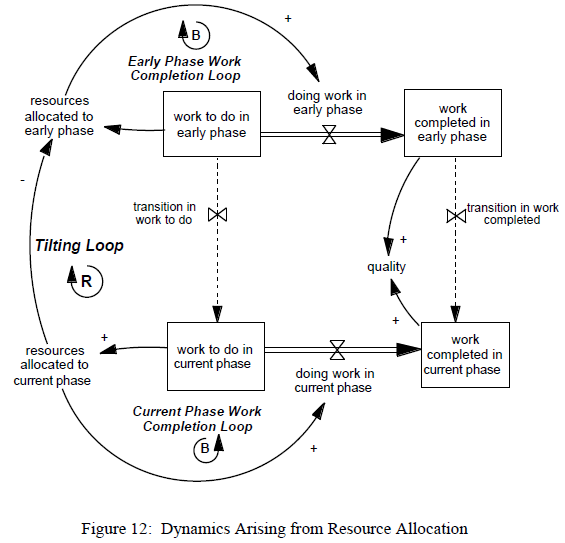
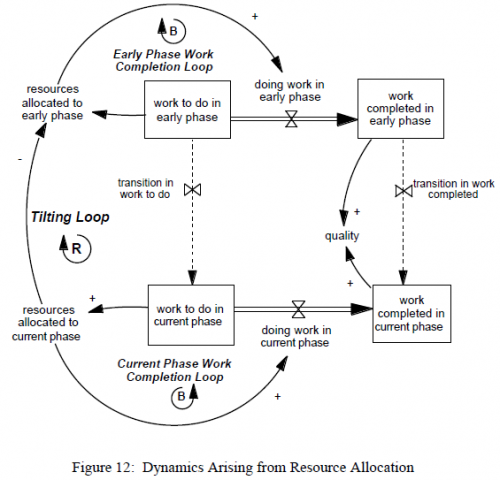
The key dynamic is what they term tilting – a positive feedback that arises from the interactions among early and late phase projects. When a late phase project is in trouble, allocating more resources to it is the natural response (put out the fire; part of the balancing late phase work completion loop). The perverse side effect is that, with finite resources, firefighting steals from early phase projects that are tomorrow’s late phase projects. That means that, down the road, those projects – starved for resources earlier in their life – will be in even more trouble, and steal more resources from the next generation of early phase projects. Thus the descent into permanent firefighting begins …
blackrepenning

The positive feedback of tilting creates a trap that can snare incautious organizations. In the presence of such traps, well-intentioned policies can turn vicious.

… testing plays a paradoxical role in multi-project development environments. On the one hand, it is absolutely necessary to preserve the integrity of the final product. On the other hand, in an environment where resources are scarce, allocating additional resources to testing or to addressing the problems that testing identifies leaves fewer resources available to do the up-front work that prevents problems in the first place in subsequent projects. Thus, while a decision to increase the amount of testing can yield higher quality in the short run, it can also ignite a cycle of greater-than-expected resource requirements for projects in downstream phases, fewer resources allocated to early upstream phases, and increasingly delayed discovery of major problems.

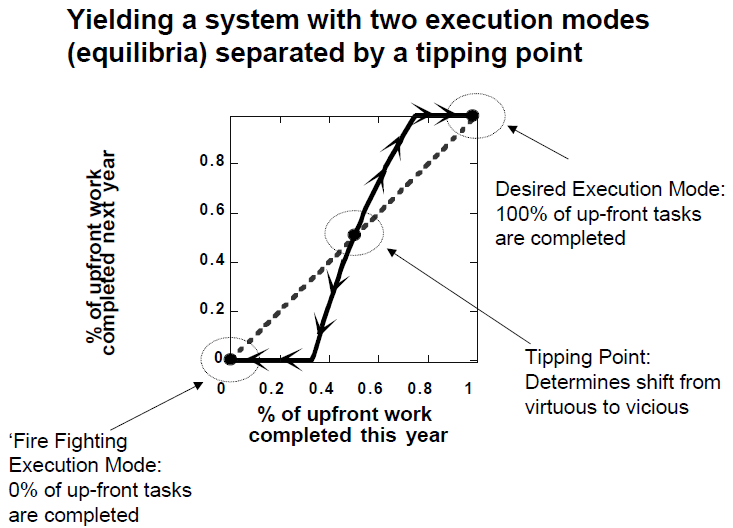
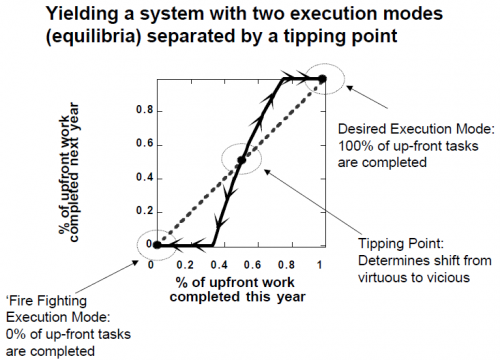
In related work with a similar model, Repenning characterizes the tilting dynamic with a phase plot that nicely illustrates the point:
executionModes

To read the phase plot, start at any point on the horizontal axis, read up to the solid black line and then over to the vertical axis. So, for example, suppose that, in a given model year, the organization manages to accomplish about 60 percent of its planned concept development work, what happens next year? Reading up and over suggests that, if it accomplishes 60 percent of the up-front work this year, the dynamics of the system are such that about 70 percent of the up-front work will get done next year. Determining what happens in a subsequent model year requires simply returning to the horizontal axis and repeating; accomplishing 70 percent this year leads to almost 95 percent being accomplished in the year that follows. Continuing this mode of analysis shows that, if the system starts at any point to the right of the solid black circle in the center of the diagram, over time the concept development completion fraction will continue to increase until it reaches 100%. Here, the positive loop works as a virtuous cycle: Each year a little more up front work is done, decreasing errors and, thereby, reducing the need for resources in the downstream phase. …

In contrast, however, consider another example. Imagine this time that the organization starts to the left of the solid black dot and accomplishes only 40 percent of its planned concept development activities. Now, reading up and over, shows that instead of completing more early phase work in the next year, the organization completes less—in this case only about 25 percent. In subsequent years, the completion fraction declines further, creating a vicious cycle of declining attention to upfront activities and increasing error rates in design work. In this case, the system converges to a mode in which concept development work is ignored in favor of fixing problems in the downstream project.

The phase plot thus reveals two important features of the system. First, note from the discussion above that anytime the plot crosses the forty-five degree line … the execution mode in question will repeat itself. Formally, at these points the system is said to be in equilibrium. Practically, equilibria represent the possible “steady states” in the system, the execution modes that, once reached, are self-sustaining. As the plot highlights, this system has three equilibria (highlighted by the solid black circles), two at the corners and one in the center of the diagram.

Second, also note that the equilibria do not have identical characteristics. The equilibria at the two corners are stable, meaning that small excursions will be counteracted. If, for example, the system starts in the desired execution mode … and is slightly perturbed, perhaps pushing the completion fraction down to 60%, then, as the example above highlights, over time the system will return to the point from which it started  …. Similarly, if the system starts at f(s)=0 and receives an external shock, perhaps moving it to a completion fraction of 40%, then it will also eventually return to its starting point. The arrows on the plot line highlight the “direction” or trajectory of the system in disequilibrium situations. In contrast to those at the corners, the equilibrium at the center of the diagram is unstable (the arrows head “away” from it), meaning small excursions are not counteracted. Instead, once the system leaves this equilibrium, it does not return and instead heads toward one of the two corners. …

Formally, the unstable equilibrium represents the boundary between two basins of attraction. …. This boundary, or tipping point, plays a critical role in determining the system’s behavior because it is the point at which the positive loop changes direction. If the system starts in the desirable execution mode and then is perturbed, if the shock is large enough to push the system over the tipping point, it does not return to its initial equilibrium and desired execution mode. Instead, the system follows a new downward trajectory and eventually becomes trapped in the fire fighting equilibrium.

You’ll have to read the papers to get the interesting prescriptions for improvement, plus some additional dynamics of manager perceptions that accentuate the trap.

Stay tuned for a part II on this topic.
Math >> Calculating

This TED talk by Conrad Wolfram, of Wolfram Research, will really resonate with anyone who follows system dynamics and learner-directed learning.

He asks, “what is math?” and decomposes it into four steps:

  1. Posing the right questions
  2. Translating the real world problem into a mathematical formulation
  3. Computation
  4. Map the mathematical answer back to the real world, and verify it

He argues that 80% of conventional education is expended on step 3, which is boring if you do it by itself. Instead, he says, we should use increasingly-ubiquitous computers for step 3, and focus on the fun parts – 1, 2 & 4.

This is basically a generalization of the modeling process and the SD approach to education. I do millions of calculations per day, but not more than a few by hand or mind. The real wrangling is with steps 1,2 & 4 – real world problems that Conrad describes as knotty and horrible, with hair all over them.

There's more than one way to aggregate cats

After getting past the provocative title, Robert Axtell’s presentation on the pitfalls of aggregation proved to be very interesting. The slides are posted here:

http://winforms.chapter.informs.org/presentation/Pathologies_of_System_Dynamics_Models-Axtell-20101021.pdf

A comment on my last post on this summed things up pretty well:

… the presentation really focused on the challenges that aggregation brings to the modeling disciplines. Axtell presents some interesting mathematical constructs that could and should form the basis for conversations, thinking, and research in the SD and other aggregate modeling arenas.

It’s worth a look.

Also, as I linked before, check out Hazhir Rahmandad’s work on agent vs. aggregate models of an infection process. His models and articles with John Sterman are here. His thesis is here.

Hazhir’s work explores two extremes – an aggregate model of infection (which is the analog of typical Bass diffusion models in marketing science) compared to agent based versions of the same process. The key difference is that the aggregate model assumes well-mixed victims, while the agent versions explicitly model contacts across various network topologies. The well-mixed assumption is often unrealistic, because it matters who is infected, not just how many. In the real world, the gain of an infection process can vary with the depth of penetration of the social network, and only the agent model can capture this in all circumstances.

However, in modeling there’s often a middle road: an aggregation approach that captures the essence of a granular process at a higher level. That’s fortunate, because otherwise we’d always be building model-maps as big as the territory. I just ran across an interesting example.

A new article in PLoS Computational Biology models obesity as a social process:

Many behavioral phenomena have been found to spread interpersonally through social networks, in a manner similar to infectious diseases. An important difference between social contagion and traditional infectious diseases, however, is that behavioral phenomena can be acquired by non-social mechanisms as well as through social transmission. We introduce a novel theoretical framework for studying these phenomena (the SISa model) by adapting a classic disease model to include the possibility for ‘automatic’ (or ‘spontaneous’) non-social infection. We provide an example of the use of this framework by examining the spread of obesity in the Framingham Heart Study Network. … We find that since the 1970s, the rate of recovery from obesity has remained relatively constant, while the rates of both spontaneous infection and transmission have steadily increased over time. This suggests that the obesity epidemic may be driven by increasing rates of becoming obese, both spontaneously and transmissively, rather than by decreasing rates of losing weight. A key feature of the SISa model is its ability to characterize the relative importance of social transmission by quantitatively comparing rates of spontaneous versus contagious infection. It provides a theoretical framework for studying the interpersonal spread of any state that may also arise spontaneously, such as emotions, behaviors, health states, ideas or diseases with reservoirs.

The very idea of modeling obesity as an infectious social process is interesting in itself. But from a technical standpoint, the interesting innovation is that they capture some of the flavor of a disaggregate representation of the population by introducing an approximation, Continue reading “There's more than one way to aggregate cats”

Positively pathological

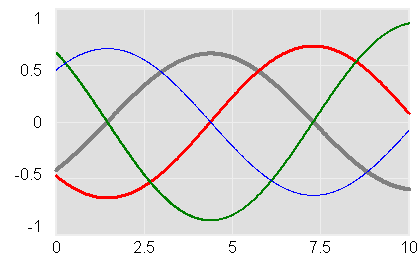
When I see oscillatory behavior, I instinctively think “delayed negative feedback.” Normally, that’s a good guess, but not always. Sometimes it’s a limit cycle or chaos, involving nonlinearity and a blend of positive and negative feedback, but today it’s something simpler, yet weirder.

oscillation

Mohammad Mojtahedzadeh just sent me a classic model, replicated from Alan Graham’s thesis on Principles on the Relationship Between Structure and Behavior of Dynamic Systems. It’s a single positive feedback loop that doesn’t yield exponential growth, but oscillates.

What’s the trick? The loop is composed of pure integrations. The rate of change of each stock is the value of the previous stock in the loop multiplied by a constant. The pure integrations each add 90 degrees of phase lag (i.e. delay), so by the time a disturbance transits the loop, it arrives at its origin ready for a repeat performance.

The same thing occurs in a frictionless spring-mass system (think of an idealized hanging slinky), which oscillates because it is an undamped second order negative feedback loop. The states in the loop are position and momentum of the mass. Position is the integral of velocity, and momentum integrates the force that is a linear function of position. Each link is a pure integration (as long as there’s no friction, which adds a minor first-order negative loop).

So far so good, but the 4th order system is still a positive loop, so why doesn’t it grow? The trick is to initialize the system in such a way as to suppress the growth mode. To do that, we just have to initialize the system in a state that contains no component of the eigenvector corresponding with the growth mode, which is the positive real eigenvalue.

Continue reading “Positively pathological”

Market Growth

John Morecroft’s implementation of Jay Forrester’s Market Growth model, replicated by an MIT colleague whose name is lost to the mists of time, from:

Morecroft, J. D. W. (1983). System Dynamics: Portraying Bounded Rationality. Omega, 11(2), 131-142.

This paper examines the linkages between system dynamics and the Carnegie school in their treatment of human decision making. It is argued that the structure of system dynamics models implicitly assumes bounded rationality in decision making and that recognition of this assumption would aid system dynamicists in model construction and in communication to other social science disciplines. The paper begins by examining Simon’s “Principle of Bounded Rationality” which draws attention to the cognitive limitations on the information gathering and processing powers of human decision makers. Forrester’s “Market Growth Model” is used to illustrate the central theme that system dynamics models are portrayals of bounded rationality. Close examination of the model formulation reveals decision functions involving simple rules of thumb and limited information content. …

Continue reading “Market Growth”

Oscillation from a purely positive loop

Replicated by Mohammad Mojtahedzadeh from Alan Graham’s thesis, or created anew with the same inspiration. He created these models in the course of his thesis work on structural analysis through pathway participation matrices.

Alan Graham, 1977. Principles on the Relationship Between Structure and Behavior of Dynamic Systems. MIT Thesis. Page 76+

These models are pure positive feedback loops that don’t exhibit exponential growth (under the right initial conditions). See my blog post for a discussion of the details.

These are generic models, and therefore don’t have units. All should run with Vensim PLE, except the generic gain matrix version which uses arrays and therefore requires an advanced version or the Model Reader.

The original 4th order model, replicated from Alan’s thesis: PurePosOscill4.vpm – note that this includes a .cin file with an alternate stable initialization.

My slightly modified version, permitting initialization with different gains at each level: PurePosOscill4alt.vpm

Loops of different orders: 3.vpm 6.vpm 8.vpm 12.vpm (I haven’t spent much time with these. It appears that the high-order versions transition to growth rather quickly – my guess is that this is an artifact of numerical precision, i.e. any tiny imprecision in the initialization introduces a bit of the growth eigenvector, which quickly swamps the oscillatory signal. It would be interesting to try these in double precision Vensim to see if I’m right.)

Stable initializations: 2stab.vpm 12stab.vpm

A generic version, representing a system as a generic gain matrix, so you can use it to explore any linear unforced variant: Generic.vpm

A billion prices

Econbrowser has an interesting article on the Billion Prices Project, which looks for daily price movements on items across the web. This yields a price index that’s free of quality change assumptions, unlike hedonic CPI measures, but introduces some additional issues due to the lack of control over the changing portfolio of measured items.

A couple of years ago we built the analytics behind the RPX index of residential real estate prices, and grappled with many of the same problems. The competition was the CSI – the Case-Shiller indes, which uses the repeat-sales method. With that approach, every house serves as its own control, so changes in neighborhoods or other quality aspects wash out. However, the clever statistical control introduces some additional problems. First, it reduces the sample of viable data points, necessitating a 3x longer reporting lag. Second, the processing steps reduce transparency. Third, one step in particular involves downweighting of homes with (possibly implausibly) large price movements, which may have the side effect of reducing sensitivity to real extreme events. Fourth, users may want to see effects of a changing sales portfolio.

For the RPX, we chose instead a triple power law estimate, ignoring quality and mix issues entirely. The TPL is basically a robust measure of the central tendency of prices. It’s not too different from the median, except that it provides some diagnostics of data quality issues from the distribution of the tails. The payoff is a much more responsive index, which can be reported daily with a short lag. We spent a lot of time comparing the RPX to the CSI, and found that, while changes in quality and mix of sales could matter in principle, in practice the two approaches yield essentially the same answer, even over periods of years. My (biased)  inclination, therefore, is to prefer the RPX approach. Your mileage may vary.

One interesting learning for me from the RPX project was that traders don’t want models. We went in thinking that sophisticated dynamics coupled to data would be a winner. Maybe it is a winner, but people want their own sophisticated dynamics. They wanted us to provide only a datastream that maximized robustness and transparency, and minimized lag. Those are sensible design principles. But I have to wonder whether a little dynamic insight would have been useful as well since, after all, many data consumers evidently did not have an adequate model of the housing market.