The Smithsonian symposium on Limits to Growth is live now (archived later) at http://si.edu/consortia/limitstogrowth2012 Dennis Meadows is on in 15 minutes.
Author: Tom
Shocking stats from the WSJ
The WSJ has an article on the Chinese electric power sector that’s anecdotally interesting. It notes that increasing electricity prices would spur investment, creating a win-win for energy intensity and system reliability. Maybe so, but the supporting graph is an interesting example of statistics that are uninformative because they fail to account for bathtub dynamics. Here it is:
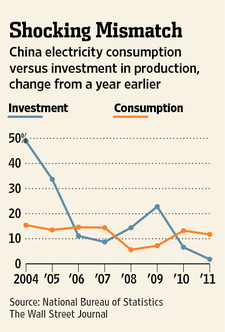 It seems plausible to compare investment and consumption, until you look at the system structure:
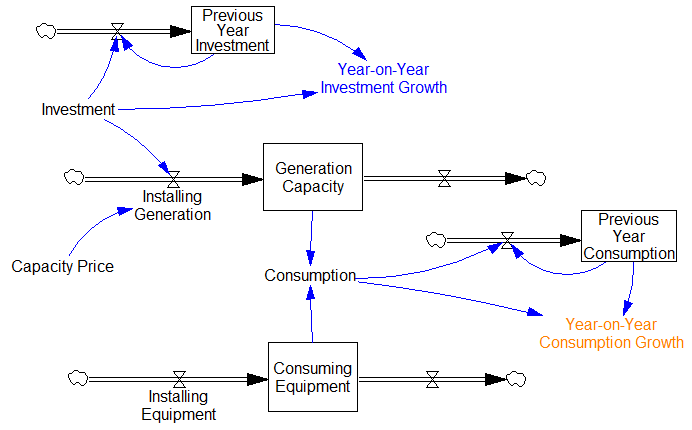 This indicates four problems with drawing conclusions from the plot:
- Investment is not necessarily the same thing as installation of capacity, unless you assume constant price.
- Consumption is essentially a direct function of stocks of consuming equipment and generating capacity, while investment is a flow. While there’s reason to expect growth rates of stocks and flows to match along a steady state growth path, this only applies in the very long term; in the short run, noise and disequilibrium will destroy any correspondence.
- The thing we do care about is the match between generating capacity and consuming equipment, but that depends on outflows (retirements of capacity) as well as inflows, so again the stock-flow comparison tells us nothing.
- There’s an additional level of indirection because we don’t see investment and consumption directly; the graph shows year-on-year changes. But that means that we’re seeing the slopes of investment and consumption, which tell us nothing about their absolute levels. So, it’s possible that investment growth is falling because it was much too high, and that consumption is growing because there’s excess generating capacity.
The best you can say about this graph is that it doesn’t contradict the article; otherwise it’s almost completely uninformative about the true state of the Chinese power system. It would be far better to have a direct comparison of generating and consuming capacity, or perhaps the growth rate of consumption (which is the net flow of consuming equipment) vs. investment in absolute terms.
Gas – a bridge to nowhere?
NPR has a nice piece on the US natural gas boom.
Henry Jacoby, an economist at the Center for Energy and Environmental Policy Research at MIT, says cheap energy will help pump up the economy.
“Overall, this is a great boon to the United States,” he says. “It’s not a bad thing to have this new and available domestic resource.” He says cheap energy can boost the economy, and he notes that natural gas is half as polluting as coal when it’s burned for electricity.
“But we have to keep our eye on the ball long-term,” Jacoby says. He’s concerned about how cheap gas will affect much cleaner sources of energy. Wind and solar power are more expensive than natural gas, and though those prices have been coming down, they’re chasing a moving target that has fallen fast: natural gas.
“It makes the prospects for large-scale expansion of those technologies more chancy,” Jacoby says.
From an environmental perspective, natural gas could help transition our economy from fossil fuels to clean energy. It’s often portrayed as a bridge fuel to help us through the transition, because it’s so much cleaner than coal and it’s abundant. But Jacoby says that bridge could be in trouble if cheap gas kills the incentive to develop renewable industry.
“You’d better be thinking about a landing of the bridge at the other end. If there’s no landing at the other end, it’s just a bridge to nowhere,” he says.
(For those who don’t know, Jake Jacoby is not a warm-fuzzy greenie; he’s a hard line economist who leads a big general equilibrium modeling project, but also takes climate science seriously).

For me, the key takeaways are:
- Gas beats coal, and may have other useful roles to play. For example, gas backup might be a low-capital-cost complement to variable renewables, with minor emissions consequences.
- It’s better to have more resources than less.
- Whether the opportunity of greater resources translates into a benefit depends on whether the price of gas accounts for full costs.
The last item is a problem. In the US, the price of greenhouse emissions from gas (or anything else) is approximately zero. The effective prices of other environmental consequences – air quality, pollution from fracking, etc. – are also low. Depletion rents for gas are probably also too low, because the abundance of gas is overhyped, and public resources were suboptimally over-allocated decades ago. Low depletion rents encourage a painful boom/bust of gas supply.
Not only physical assets are mispriced. Another part of the story is learning-by-doing, deliberate R&D, and economies of scale – positive feedbacks that grow the market for low-emissions technologies. Firms producing new tech like PV or wind turbines are only able to appropriate part of the profits of their innovations. The rest spills over to benefit society more generally. Too-cheap gas undercuts these reinforcing mechanisms, so gas substitutes aren’t available when scarcity inevitably returns, hence the “bridge to nowhere” dynamic.
Long-term renewable deployment in the U.S. is going to depend primarily on policy. Is there enough concern about environmental consequences to put in place incentives for renewable energy?
– Trevor Houser, energy analyst, Rhodium Group
They key is, what kind of policy? Currently, we rely primarily on performance standards and subsidies. These aren’t getting the job done, for structural reasons. For example, subsidies are self-extinguishing, because they get too expensive to sustain when the target gets too big (think solar feed-in-tariffs in Europe). They’re also politically vulnerable to apparently-cheap alternatives:
“If those prices hang around for another three or four years, then I think you’ll definitely see reduced political will for renewable energy deployment, ” Houser says
The basic problem is that the mindset of subsidizing or requiring “good” technologies makes them feel like luxuries for rich altruists, even though the apparently-cheap alternatives may be merely penny-wise and pound-foolish. The essential alternative is to price the bads, with the logic that people who want to use technologies that harm others ought to at least pay for the privilege. If we can’t manage to do that, I don’t think there’s much hope of getting gas or climate policy right.
The static reserve life index rears its ugly head in the State of the Union
The President said, in the State of the Union Address,
We have a supply of natural gas that can last America nearly one hundred years, and my Administration will take every possible action to safely develop this energy.
The 100 year figure presumably comes straight from EIA:
According to the EIA Annual Energy Outlook 2011, the United States possesses 2,543 trillion cubic feet (Tcf) of potential natural gas resources. Natural gas from shale resources, considered uneconomical just a few years ago, accounts for 862 Tcf of this resource estimate. At the 2010 rate of U.S. consumption (about 24.1 Tcf per year), 2,543 Tcf of natural gas is enough to supply over 100 years of use.
100 years is the static reserve life index (SRLI). It’s well known that the SRLI is a misleading metric (this figured prominently in Limits to Growth, for example). Exponential growth in consumption violates the basic assumption of the SRLI, which is that consumption remains constant. Even a small amount of growth greatly erodes the actual lifetime of a resource:
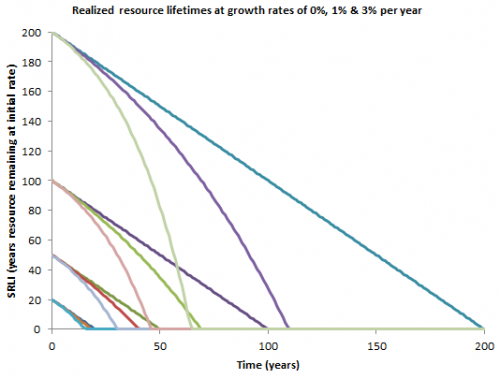 Growth at 3% per year reduces the SRLI of gas from 100 years to a realized lifetime of 45 years, which is not nearly so comfortable. This ought to be intuitive even if you can’t integrate exponentials in your head, because gas consumption would have to roughly double to replace coal (and that doubling would have to happen quickly to meet job claims), so clearly “100 years at current rates” isn’t going to happen.
Update: EIA just lowered shale gas resource estimates by nearly half, taking another big bite out of the SRLI:
In the AEO2012 Reference case, the estimated unproved technically recoverable resource (TRR) of shale gas for the United States is 482 trillion cubic feet, substantially below the estimate of 827 trillion cubic feet in AEO2011.
Disinfographics
I cringed when I saw the awful infographics in a recent GreenBiz report, highlighted in a Climate Progress post. A site that (rightly) criticizes the scientific illiteracy of the GOP field shouldn’t be gushing over chartjunk that would make USA Today blush. Climate Progress dumped my mildly critical comment into eternal moderation queue purgatory, so I have to rant about this a bit.
Here’s one of the graphics, with my overlay of the data plotted correctly (in green):
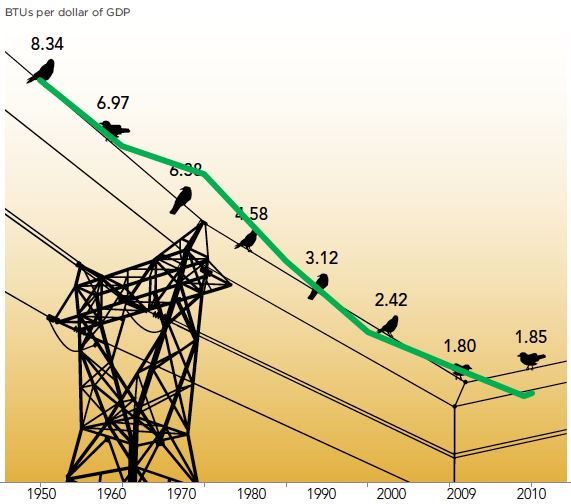
“What We Found: The energy consumed per dollar of gross domestic product grew slightly in 2010, the first increase after steady declines for more than half a century.”
Notice that:
- No, there really wasn’t a great cosmic coincidence that caused energy intensity to progress at a uniform rate from 1950-1970 and 1980-2009, despite the impression given by the arrangements of points on the wire.
- The baseline of the original was apparently some arbitrary nonzero value.
- The original graphic vastly overstates the importance of the last two data points by using a nonuniform time axis.
The issues are not merely aesthetic; the bad graphics contribute to distorted interpretations of reality, as the caption above indicates. From another graphic (note the short horizon and nonzero baseline), CP extracts the headline, “US carbon intensity is flat lining.”
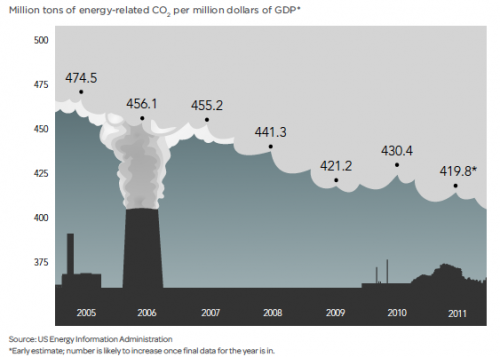
From any reasonably long sample of the data it should be clear that the 2009-2011 “flat lining” is just a blip, having little to do with the long term emission trends we need to modify to achieve deep emissions reductions.
The other graphics in the article are each equally horrific in their own special way.
My advice to analysts is simple. If you want to communicate information, find someone numerate who’s read Tufte to make your plots. If you must have a pretty picture for eye candy, use it as a light background to an accurate plot. If you want pretty pictures to persuade people without informing them, skip the data and use a picture of a puppy. Here, you can even use my puppy:

Why learn calculus?
A young friend asked, why bother learning calculus, other than to get into college?
The answer is that calculus holds the keys to the secrets of the universe. If you don’t at least have an intuition for calculus, you’ll have a harder time building things that work (be they machines or organizations), and you’ll be prey to all kinds of crank theories. Of course, there are lots of other ways to go wrong in life too. Be grumpy. Don’t brush your teeth. Hang out in casinos. Wear white shoes after Labor Day. So, all is not lost if you don’t learn calculus. However, the world is less mystifying if you do.
The amazing thing is, calculus works. A couple of years ago, I found my kids busily engaged in a challenge, using a sheet of tinfoil of some fixed size to make a boat that would float as many marbles as possible. They’d managed to get 20 or 30 afloat so far. I surreptitiously went off and wrote down the equation for the volume of a rectangular prism, subject to the constraint that its area not exceed the size of the foil, and used calculus to maximize. They were flabbergasted when I managed to float over a hundred marbles on my first try.
The secrets of the universe come in two flavors. Mathematically, those are integration and differentiation, which are inverses of one another.
Sandpiles & Systems

Sand piles are sometimes used as a counterpoint to systems, where a system is a bunch of interconnected components that interact in some interesting way, while a sand pile is just a bunch of boring stuff. Ironically, sand piles are actually pretty interesting – they self organize. Avalanches regulate the angle of repose of the pile. In aggregate, one can think of this as a negative feedback process – when the pile is too steep, it avalanches, building up the base and lowering the top. There’s more to the picture when you look at it from a disaggregate perspective; the resulting state is an example of self-organized criticality, and if you keep adding to the pile, you get avalanches at all scales (i.e. a power law distribution).
Overnight, nature left me a nice example of a snow pile system on our front stair railing. At some point, the accumulated snow on the handrail partially avalanched, leaving bare wood on its lower half. Evidently the railing is at just the right angle for the ongoing snowfall, fine grains due to the cold, to make a kind of cellular automaton, resulting in this surprisingly regular pattern, reminiscent of a Sierpinski triangle or one of Wolfram’s elementary systems.

Is social networking making us dumber?
Another great conversation at the Edge weaves together a number of themes I’ve been thinking about lately, like scientific revolutions, big data, learning from models, filter bubbles and the balance between content creation and consumption. I can’t embed, or do it full justice, so go watch the video or read the transcript (the latter is a nice rarity these days).
Pagel’s fundamental hypothesis is humans as social animals are wired for imitation more than innovation, for the very good reason that imitation is easy, while innovation is hard, error-prone and sometimes dangerous. Better communication intensifies the advantage to imitators, as it has become incredibly cheap to observe our fellows in large networks like Facebook. There are a variety of implications of this, including the possibility that, more than ever, large companies have strong incentives to imitate through acquisition of small innovators rather than to risk innovating themselves. This resonates very much with Ventana colleague David Peterson’s work on evolutionary simulation of the origins of economic growth and creativity.
Self-generated Seasonal Cycles
Why is Black Friday the biggest shopping day of the year? Back in 1961, Jay Forrester identified an endogenous cause in Appendix N of Industrial Dynamics, Self-generated Seasonal Cycles:
Industrial policies adopted in recognition of seasonal sales patterns may often accentuate the very seasonality from which they arise. A seasonal forecast can lead to action that may cause fulfillment of the forecast. In closed-loop systems this is a likely possibility. … any effort toward statistical isolation of a seasonal sales component will find some seasonality in the random disturbances. Should the seasonality so located lead to decisions that create actual seasonality, the process can become self-regenerative.
I think there are actually quite a few reinforcing feedback mechanisms, some of which cross consumer-business stovepipes and therefore are difficult to address.
Before heading to the mall, it’s a good day to think about stuff.
Update: another interesting take.
Brinicle
This “icy finger of death” is an interesting dynamic system, but I’m just posting it because it’s cool:
http://youtu.be/LMhBuSBemRk
Background story here. h/t Stoat. Too bad we Americans won’t see the last episode of this series.