R&D – crack for techno-optimists

I like R&D. Heck, I basically do R&D. But the common argument, that people won’t do anything hard to mitigate emissions or reduce energy use, so we need lots of R&D to find solutions, strikes me as delusional.

The latest example to cross my desk (via the NYT) is the new American Energy Innovation Council’s recommendations,

Create an independent national energy strategy board.
Invest $16 billion per year in clean energy innovation.
Create Centers of Excellence with strong domain expertise.
Fund ARPA-E at $1 billion per year.
Establish and fund a New Energy Challenge Program to build large-scale pilot projects.

Let’s look at the meat of this – $16 billion per year in energy innovation funding. Historic funding looks like this:
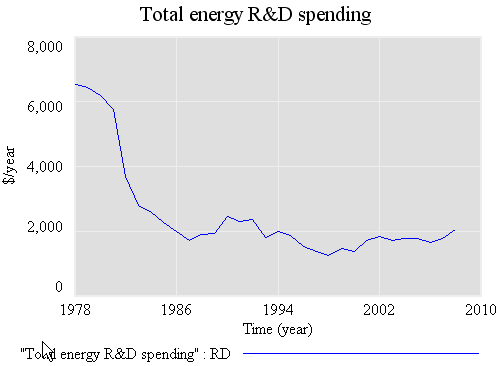
R&D funding

Total public energy R&D, compiled from Gallagher, K.S., Sagar, A, Segal, D, de Sa, P, and John P. Holdren, “DOE Budget Authority for Energy Research, Development, and Demonstration Database,” Energy Technology Innovation Project, John F. Kennedy School of Government, Harvard University, 2007. I have a longer series somewhere, but no time to dig it up. Basically, spending was negligible (or not separately accounted for) before WWII, and ramped up rapidly after 1973.

The data above reflects public R&D; when you consider private spending, the jump to $16 billion represents maybe a factor of 3 or 4 increase. What does that do for you?

Consider a typical model of technical progress, the two-factor learning curve:

cost = (cumulative R&D)^A*(cumulative experience)^B

The A factor represents improvement from deliberate R&D, while the B factor reflects improvement from production experience like construction and installation of wind turbines. A and B are often expressed as learning rates, the multiple on cost that occurs per doubling of the relevant cumulative input. In other words, A,B = ln(learning rate)/ln(2). Typical learning rates reported are .6 to .95, or cost reductions of 40% to 5% per doubling, corresponding with A/B values of -.7 to -.15, respectively. Most learning rate estimates are on the high end (smaller reductions per doubling), particularly when the two-factor function is used (as opposed to just one component).

Let’s simplify so that

cost = (cumulative R&D)^A

and use an aggressive R&D learning rate (.7), for A=-0.5. In steady state, with R&D growing at the growth rate of the economy (call it g), cost falls at the rate A*g (because the integral of exponentially growing spending grows at the same rate, and exp(g*t)^A = exp(A*g*t)).

That’s insight number one: a change in R&D allocation has no effect on the steady-state rate of progress in cost. Obviously one could formulate alternative models of technology where that is not true, but compelling argument for this sort of relationship is that the per capita growth rate of GDP has been steady for over 250 years. A technology model with a stronger steady-state spending->cost relationship would grow super-exponentially.

Insight number two is what the multiple in spending (call it M) does get you: a shift in the steady-state growth trajectory to a new, lower-cost path, by M^A. So, for our aggressive parameter, a multiple of 4 as proposed reduces steady-state costs by a factor of about 2. That’s good, but not good enough to make solar compatible with baseload coal electric power soon.

Given historic cumulative public R&D, 3%/year baseline growth in spending, a 0.8 learning rate (a little less aggressive), a quadrupling of R&D spending today produces cost improvements like this:
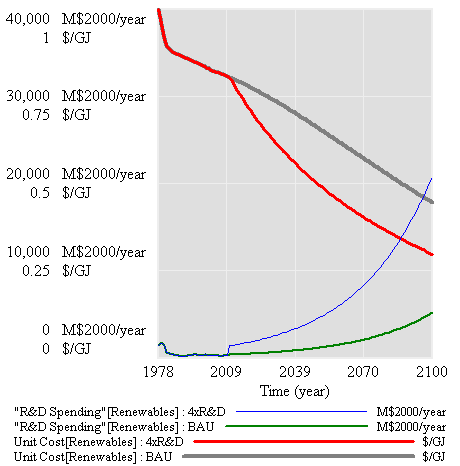
R&D future 4x

Those are helpful, but not radical. In addition, even if R&D produces something more miraculous than it has historically, there are still big nontechnical lock-in humps to overcome (infrastructure, habits, …). Overcoming those humps is a matter of deployment more than research. The Energy Innovation Council is definitely enthusiastic about deployment, but without internalizing the externalities associated with energy production and use, how is that going to work? You’d either need someone to pick winners and implement them with a mishmash of credits and subsidies, or you’d have to hope for/wait for cleantech solutions to exceed the performance of conventional alternatives.

The latter approach is the “stone age didn’t end because we ran out of stones” argument. It says that cleantech (iron) will only beat conventional (stone) when it’s unequivocally better, not just for the environment, but also convenience, cost, etc. What does that say about the prospects for CCS, which is inherently (thermodynamically) inferior to combustion without capture? The reality is that cleantech is already better, if you account for the social costs associated with energy. If people aren’t willing to internalize those social costs, so be it, but let’s not pretend we’re sure that there’s a magic technical bullet that will yield a good outcome in spite of the resulting perverse incentives.

Gallagher, K.S., Sagar, A, Segal, D, de Sa, P, and John P. Holdren, “DOE Budget Authority for Energy Research, Development, and Demonstration Database,” Energy Technology Innovation Project, John F. Kennedy School of Government, Harvard University, 2007.

A modest proposal for the IPCC

Make it shorter. The Fifth Assessment, that is.

There’s a fairly endless list of suggestions for ways to amend IPCC processes, plus an endless debate over mostly-miniscule improprieties and errors buried in the depths of the report, fueled by the climategate emails.

I find the depth of the report useful personally, but I’m an outlier – how much is really needed? Do any policy makers really read 3000 pages of stuff, every 5 years?

Maybe the better part of valor would be to agree on a page limit – perhaps 350 per working group (the size of the 1990 report), and relegate all the more granular material to a wiki-like lit review and live summary, that could evolve more fluidly.

A shorter report would be easier to edit and read, and less likely to devote ink to details that are fundamentally very uncertain.

Workshop on Modularity and Integration of Climate Models

The MIT Center for Collective Intelligence is organizing a workshop at this year’s Conference on Computational Sustainability entitled “Modularity and Integration of Climate Models.” Check out the  Agenda.

Traditionally, computational models designed to simulate climate change and its associated impacts (climate science models, integrated assessment models, and climate economics models) have been developed as standalone entities. This limits possibilities for collaboration between independent researchers focused on sub-­?problems, and is a barrier to more rapid advances in climate modeling science because work is not distributed effectively across the community. The architecture of these models also precludes running a model with modular sub -­? components located on different physical hardware across a network.

In this workshop, we hope to examine the possibility for widespread development of climate model components that may be developed independently and coupled together at runtime in a “plug and play” fashion. Work on climate models and modeling frameworks that are more modular has begun, (e.g. Kim, et al., 2006) and substantial progress has been made in creating open data standards for climate science models, but many challenges remain.

A goal of this workshop is to characterize issues like these more precisely, and to brainstorm about approaches to addressing them. Another desirable outcome of this workshop is the creation of an informal working group that is interested in promoting more modular climate model development.

C-ROADS & climate leadership workshop

In Boston, Oct. 18-20, Climate Interactive and Seed Systems will be running a workshop on C-ROADS and climate leadership.

Attend to develop your capacities in:

  • Systems thinking: Causal loop and stock-flow diagramming.
  • Leadership and learning: Vision, reflective conversation, consensus building.
  • Computer simulation: Using and leading policy-testing with the C-ROADS/C-Learn simulation.
  • Policy savvy:  Attendees will play the “World Climate” exercise.
  • Climate, energy, and sustainability strategy: Reflections and insights from international experts.
  • Business success stories: What’s working in the new low Carbon Economy and implications for you.
  • Build your network of people sharing your aspirations for Climate progress.

Save the date.

EIA projections – peak oil or snake oil?

Econbrowser has a nice post from Steven Kopits, documenting big changes in EIA oil forecasts. This graphic summarizes what’s happened:

kopits_eia_forecasts_jun_10
Click through for the original article.

As recently as 2007, the EIA saw a rosy future of oil supplies increasing with demand. It predicted oil consumption would rise by 15 mbpd to 2020, an ample amount to cover most eventualities. By 2030, the oil supply would reach nearly 118 mbpd, or 23 mbpd more than in 2006. But over time, this optimism has faded, with each succeeding year forecast lower than the year before. For 2030, the oil supply forecast has declined by 14 mbpd in only the last three years. This drop is as much as the combined output of Saudi Arabia and China.

In its forecast, the EIA, normally the cheerleader for production growth, has become amongst the most pessimistic forecasters around. For example, its forecasts to 2020 are 2-3 mbpd lower than that of traditionally dour Total, the French oil major. And they are below our own forecasts at Douglas-Westwood through 2020. As we are normally considered to be in the peak oil camp, the EIA’s forecast is nothing short of remarkable, and grim.

Is it right? In the last decade or so, the EIA’s forecast has inevitably proved too rosy by a margin. While SEC-approved prospectuses still routinely cite the EIA, those who deal with oil forecasts on a daily basis have come to discount the EIA as simply unreliable and inappropriate as a basis for investments or decision-making. But the EIA appears to have drawn a line in the sand with its new IEO and placed its fortunes firmly with the peak oil crowd. At least to 2020.

Since production is still rising, I think you’d have to call this “inflection point oil,” but as a commenter points out, it does imply peak conventional oil:

It’s also worth note that most of the liquids production increase from now to 2020 is projected to be unconventional in the IEO. Most of this is biofuels and oil sands. They REALLY ARE projecting flat oil production.

Since I’d looked at earlier AEO projections in the past, I wondered what early IEO projections looked like. Unfortunately I don’t have time to replicate the chart above and overlay the earlier projections, but here’s the 1995 projection:

Oil - IEO 1995

The 1995 projections put 2010 oil consumption at 87 to 95 million barrels per day. That’s a bit high, but not terribly inconsistent with reality and the new predictions (especially if the financial bubble hadn’t burst). Consumption growth is 1.5%/year.

And here’s 2002:

Oil - IEO 2002

In the 2002 projection, consumption is at 96 million barrels in 2010 and 119 million barrels in 2020 (waaay above reality and the 2007-2010 projections), a 2.2%/year growth rate.

I haven’t looked at all the interim versions, but somewhere along the way a lot of optimism crept in (and recently, crept out). In 2002 the IEO oil trajectory was generated by a model called WEPS, so I downloaded WEPS2002 to take a look. Unfortunately, it’s a typical open-loop spreadsheet horror show. My enthusiasm for a detailed audit is low, but it looks like oil demand is purely a function of GDP extrapolation and GDP-energy relationships, with no hint of supply-side dynamics (not even prices, unless they emerge from other models in a sneakernet portfolio approach). There’s no evidence of resources, not even synchronized drilling. No wonder users came to “discount the EIA as simply unreliable and inappropriate as a basis for investments or decision-making.”

Newer projections come from a new version, WEPS+. Hopefully it’s more internally consistent than the 2002 spreadsheet, and it does capture stock/flow dynamics and even includes resources. EIA appears to be getting better. But it appears that there’s still a fundamental problem with the paradigm: too much detail. There just isn’t any point in producing projections for dozens of countries, sectors and commodities two decades out, when uncertainty about basic dynamics renders the detail meaningless. It would be far better to work with simple models, capable of exploring the implications of structural uncertainty, in particular relaxing assumptions of equilibrium and idealized behavior.

Update: Michael Levi at the CFR blog points out that much of the difference in recent forecasts can be attributed to changes in GDP projections. Perhaps so. But I think this reinforces my point about detail, uncertainty, and transparency. If the model structure is basically consumption = f(GDP, price, elasticity) and those inputs have high variance, what’s the point of all that detail? It seems to me that the detail merely obscures the fundamentals of what’s going on, which is why there’s no simple discussion of reasons for the change in forecast.

Greenwash labeling

I like green labeling, but I’m not convinced that, by itself,  it’s theoretically a viable way to get the economy to a good environmental endpoint. In practice, it’s probably even worse. Consider Energy Star. It’s supposed to be “helping us all save money and protect the environment through energy efficient products and practices.” The reality is that it gives low-quality information a veneer of authenticity, misleading consumers. I have no doubt that it has some benefits, especially through technology forcing, but it’s soooo much less than it could be.

The fundamental signal Energy Star sends is flawed. Because it categorizes appliances by size and type, a hog gets a star as long as it’s also big and of less-efficient design (like a side-by-side refrigerator/freezer). Here’s the size-energy relationship of the federal energy performance standard (which Energy Star fridges must exceed by 20%):

standard

Notice that the standard for a 20 cubic foot fridge is anywhere from 470 to 660 kWh/year.

Continue reading “Greenwash labeling”

When rebates go bad

rebate

There’s a long-standing argument over the extent to which rebound effects eat up the gains of energy-conserving technologies, and whether energy conservation programs are efficient. I don’t generally side with the hardline economists who argue that conservation programs fail a cost benefit test, because I think there really are some $20 bills scattered about, waiting to be harvested by an intelligent mix of information and incentives. At the same time, some rebate and credit programs look pretty fishy to me.

On the plus side, I just bought a new refrigerator, using Montana’s $100 stimulus credit. There’s no rebound, because I have to hand over the old one for recycling. There is some rebound potential in general, because I could have used the $100 to upgrade to a larger model. Energy Star segments the market, so a big side-by-side fridge can pass while consuming more energy than a little top-freezer. That’s just stupid. Fortunately, most people have space constraints, so the short run price elasticity of fridge size is low.

On the minus side, consider tax credits for hybrid vehicles. For a super-efficient Prius or Insight, I can sort of see the point. But a $2600 credit for a Toyota Highlander getting 26mpg? What a joke! Mercifully that foolishness has been phased out. But there’s plenty more where that came from.

Consider this Bad Boy:

credit

The Zero-Emission Agricultural Utility Terrain Vehicle (Agricultural UTV) Rebate Program will credit $1950 in the hope of fostering greener farms. But this firm knows who it’s really marketing to:

turkey

Is there really good control over the use of the $, or is public funding just mechanizing outdoor activities where people ought to use the original low-emissions vehicle, their feet? When will I get a rebate for my horse?