I like this: The Unofficial List of Pundits/Experts Who Were Wrong on the Housing Bubble
Category: Aside
Lindzen & Choi critique
A critique of Lindzen & Choi’s 2009 paper has just been published, debunking the notion of strong negative temperature feedback in the tropics. I had noticed that its statistical method of identifying intervals in a time series was flawed, and that models cited appeared to sometimes lack volcanic forcings, rendering correlations meaningless. I’m happy to see those observations confirmed, and a few other problems raised. (I’m happy that I was right, not that climate sensitivity is higher than Lindzen & Choi suggest, which would be good for the planet.) I haven’t read the details of the critiques, so I can’t say whether this really closes the book on the question, but it at least indicates that the original work was a bit sloppy. Since Lindzen is one of the few contrarians who knows what he’s doing, and it’s useful to have such people around, I wish he would focus less on WSJ editorials and more on scholarship.
From Beijing to Copenhagen
Check out my guest post at Inside-Out China.
The end is near
There’s really no sense having any kind of long term policy, because the LHC is going to kill us all.
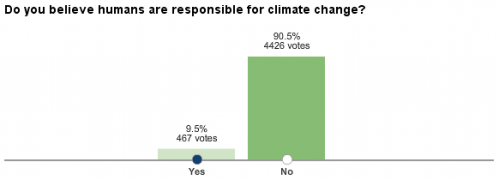
WSJ: Do you believe humans are responsible for climate change?
Snow & Eagles

Individuals matter after all
From arXiv:
From bird flocks to fish schools, animal groups often seem to react to environmental perturbations as if of one mind. Most studies in collective animal behaviour have aimed to understand how a globally ordered state may emerge from simple behavioural rules. Less effort has been devoted to understanding the origin of collective response, namely the way the group as a whole reacts to its environment. Yet collective response is the adaptive key to survivor, especially when strong predatory pressure is present. Here we argue that collective response in animal groups is achieved through scale-free behavioural correlations. By reconstructing the three-dimensional position and velocity of individual birds in large flocks of starlings, we measured to what extent the velocity fluctuations of different birds are correlated to each other. We found that the range of such spatial correlation does not have a constant value, but it scales with the linear size of the flock. This result indicates that behavioural correlations are scale-free: the change in the behavioural state of one animal affects and is affected by that of all other animals in the group, no matter how large the group is. Scale-free correlations extend maximally the effective perception range of the individuals, thus compensating for the short-range nature of the direct inter-individual interaction and enhancing global response to perturbations. Our results suggest that flocks behave as critical systems, poised to respond maximally to environmental perturbations.
Fizzle
Hackers have stolen zillions of emails from CRU. The climate skeptic world is in such a froth that the climateaudit servers have slowed to a crawl. Patrick Michaels has declared it a “mushroom cloud.”
I rather think that this will prove to be a dud. We’ll find out that a few scientists are human, and lots of things will be taken out of context. At the end of the day, climate science will still rest on diverse data from more than a single research center. We won’t suddenly discover that it’s all a hoax and climate sensitivity is Lindzen’s 0.5C, nor will we know any better whether it’s 1.5 or 6C.
We’ll still be searching for a strategy that works either way.
GAMS Rant
I’ve just been looking into replicating the DICE-2007 model in Vensim (as I’ve previously done with DICE and RICE). As usual, it’s in GAMS, which is very powerful for optimization and general equilibrium work. However, it has to be the most horrible language I’ve ever seen for specifying dynamic models – worse than Excel, BASIC, you name it. The only contender for the title of time series horror show I can think of is SQL. I was recently amused when a GAMS user in China, working with a complex, unfinished Vensim model, heavy on arrays and interface detail, 50x the size of DICE, exclaimed, “it’s so easy!” I’d rather go to the dentist than plow through yet another pile of GAMS code to figure out what gsig(T)=gsigma*EXP(-dsig*10*(ORD(T)-1)-dsig2*10*((ord(t)-1)**2));sigma(“1”)=sig0;LOOP(T,sigma(T+1)=(sigma(T)/((1-gsig(T+1))));); means. End rant.
Copenhagen Expectations
Danes
Piet Hein
(translated by a friend)
Denmark seen from foreign land
Looks but like a grain of sand
Denmark as we Danes conceive it
Is so big you won’t believe it.
Why not let us compromise
About Denmark’s proper size
Which will surely please us all
Since it’s greater than it’s small
Maybe this is a good way to think about COP15 prospects?