John Sterman at the MIT Museum, reflecting on bathtub dynamics, public perceptions and political conflict over climate change:
Don't just do something, stand there! Reflections on the counterintuitive behavior of complex systems, seen through the eyes of System Dynamics, Systems Thinking and simulation.
John Sterman at the MIT Museum, reflecting on bathtub dynamics, public perceptions and political conflict over climate change:
The System Dynamics Society reports that SD pioneer Geoff Coyle has passed away.
We report the sad news that longtime system dynamicist R. Geoffrey Coyle died on November 19, 2012. Geoff was 74. He started his career as a mining engineer. Having completed a PhD in Operations Research, he came to Cambridge, Massachusetts from the UK in the late 1960’s, and studied with Jay Forrester to learn system dynamics. Upon his return to the UK, he started to develop system dynamics in England. He was the founder of the first system dynamics group in the UK, at the University of Bradford in 1970. This group grew terrifically and produced some of the most important people in our field. Geoff and his students have made enormously important contributions to the field and the next generation of their students have as well, all following in Geoff’s footsteps and under his tutelage.
Geoff and the Bradford group also founded the first system dynamics journal, Dynamica. They created DYSMAP, the first system dynamics software that had built-in optimization and built-in dimensional consistency technique.
Geoff authored a number of very important books in the field including: Management in System Dynamics (1977), System Dynamics Modelling: A Practical Approach (1996) and Practical Strategy: Tools and Techniques (2004). In 1998, he was the first recipient of the Lifetime Achievement Award of the System Dynamics Society. More recently he returned to his first academic love and wrote a highly acclaimed history of mining in the UK: The riches beneath our feet (2010). This is a wonderful legacy in the field of system dynamics and beyond.
I realized that, while I’ve always enjoyed his irascibly interesting presentations, I’ve only read a few of his works. So, I’ve collected a Coyle reading list: Continue reading “A Geoff Coyle reading list”
The inimitable Vi Hart serves up a matherole:
Try the direction field of a 2D limit cycle, or seek your own inspiration in the universe.
Be sure to serve it with Borromean onion rings.
Socialism. Communism. “Nazism.” American Exceptionalism. Indoctrination. Buddhism. Meditation. “Americanism.” These are not words or terms one would typically expect to hear in a Winston-Salem/Forsyth County School Board meeting. But in the Board’s last meeting on October 9th, they peppered the statements of public commenters and Board Members alike.
The object of this invective? Systems thinking. You really have to read part 1 and part 2 of Camel City Dispatch’s article to get an appreciation for the school board’s discussion of the matter.
I know that, as a systems thinker, I should look for the unstated assumptions that led board members to their critiques, and establish a constructive dialog. But I just can’t do it – I have to call out the fools. While there are some voices of reason, several of the board members and commenters apparently have no understanding of the terms they bandy about, and have no business being involved in the education of anyone, particularly children.
The low point of the exchange:
Jeannie Metcalf said she “will never support anything that has to do with Peter Senge… I don’t care what [the teachers currently trained in System’s Thinking] are teaching. I don’t care what lessons they are doing. He’s is trying to sell a product. Once it insidiously makes its way into our school system, who knows what he’s going to do. Who knows what he’s going to do to carry out his Buddhist way of thinking and his hatred of Capitalism. I know y’all are gonna be thinkin’ I’m a crazy person, but I’ve been around a long time.”
Yep, you’re crazy all right. In your imaginary parallel universe, “hatred of capitalism” must be a synonym for writing one of the most acclaimed business books ever, sitting at one of the best business schools in the world, and consulting at the highest levels of many Fortune 50 companies.
The common thread among the ST critics appears to be a total failure to actually observe classrooms combined with shoot-the-messenger reasoning from consequences. They see, or imagine, a conclusion that they don’t like, something that appears vaguely environmental or socialist, and assume that it must be part of the hidden agenda of the curriculum. In fact, as supporters pointed out, ST is a method, which could as easily be applied to illustrate the benefits of individualism, markets, or whatnot, as long as they are logically consistent. Of course, if one’s pet virtue has limits or nuances, ST may also reveal those – particularly when simulation is used to formalize arguments. That is what the critics are really afraid of.
Nate Silver of 538 deserves praise for calling the election in all 50 states, using a fairly simple statistical model and lots of due diligence on the polling data. When the dust settles, I’ll be interested to see a more detailed objective evaluation of the forecast (e.g., some measure of skill, like likelihoods).
Many have noted that his approach stands in stark contrast to big-ego punditry:
Another impressive model-based forecasting performance occurred just days before the election, with successful prediction of Hurricane Sandy’s turn to landfall on the East Coast, almost a week in advance.
On October 22, you blogged that there was a possibility it could hit the East Coast. How did you know that?
There are a few rather reliable global models. They’re models that run all the time, all year long, so they don’t focus on any one storm. They run for the entire globe, not just for North America. There are two types of runs these models can be configured to do. One is called a deterministic run and that’s where you get one forecast scenario. Then the other mode, and I think this is much more useful, especially at longer ranges where things become much more uncertain, is ensemble—where 20 or 40 or 50 runs can be done. They are not run at as high of a resolution as the deterministic run, otherwise it would take forever, but it’s still incredibly helpful to look at 20 runs.
Because you have variation? Do the ensemble runs include different winds, currents, and temperatures?
You can tweak all sorts of things to initialize the various ensemble members: the initial conditions, the inner-workings of the model itself, etc. The idea is to account for observational error, model error, and other sources of uncertainty. So you come up with 20-plus different ways to initialize the model and then let it run out in time. And then, given the very realistic spread of options, 15 of those ensemble members all recurve the storm back to the west when it reaches the East coast, and only five of them take it northeast. That certainly has some information content. And then, one run after the next, you can watch those. If all of the ensemble members start taking the same track, it doesn’t necessarily make them right, but it does mean it’s more likely to be right. You have much more confidence forecasting a track if the model guidance is in in good agreement. If it’s a 50/50 split, that’s a tough call.
On October 22, you blogged that there was a possibility it could hit the East Coast. How did you know that?
There are a few rather reliable global models. They’re models that run all the time, all year long, so they don’t focus on any one storm. They run for the entire globe, not just for North America. There are two types of runs these models can be configured to do. One is called a deterministic run and that’s where you get one forecast scenario. Then the other mode, and I think this is much more useful, especially at longer ranges where things become much more uncertain, is ensemble—where 20 or 40 or 50 runs can be done. They are not run at as high of a resolution as the deterministic run, otherwise it would take forever, but it’s still incredibly helpful to look at 20 runs.
Because you have variation? Do the ensemble runs include different winds, currents, and temperatures?
You can tweak all sorts of things to initialize the various ensemble members: the initial conditions, the inner-workings of the model itself, etc. The idea is to account for observational error, model error, and other sources of uncertainty. So you come up with 20-plus different ways to initialize the model and then let it run out in time. And then, given the very realistic spread of options, 15 of those ensemble members all recurve the storm back to the west when it reaches the East coast, and only five of them take it northeast. That certainly has some information content. And then, one run after the next, you can watch those. If all of the ensemble members start taking the same track, it doesn’t necessarily make them right, but it does mean it’s more likely to be right. You have much more confidence forecasting a track if the model guidance is in in good agreement. If it’s a 50/50 split, that’s a tough call.
On October 22, you blogged that there was a possibility it could hit the East Coast. How did you know that?
There are a few rather reliable global models. They’re models that run all the time, all year long, so they don’t focus on any one storm. They run for the entire globe, not just for North America. There are two types of runs these models can be configured to do. One is called a deterministic run and that’s where you get one forecast scenario. Then the other mode, and I think this is much more useful, especially at longer ranges where things become much more uncertain, is ensemble—where 20 or 40 or 50 runs can be done. They are not run at as high of a resolution as the deterministic run, otherwise it would take forever, but it’s still incredibly helpful to look at 20 runs.
Because you have variation? Do the ensemble runs include different winds, currents, and temperatures?
You can tweak all sorts of things to initialize the various ensemble members: the initial conditions, the inner-workings of the model itself, etc. The idea is to account for observational error, model error, and other sources of uncertainty. So you come up with 20-plus different ways to initialize the model and then let it run out in time. And then, given the very realistic spread of options, 15 of those ensemble members all recurve the storm back to the west when it reaches the East coast, and only five of them take it northeast. That certainly has some information content. And then, one run after the next, you can watch those. If all of the ensemble members start taking the same track, it doesn’t necessarily make them right, but it does mean it’s more likely to be right. You have much more confidence forecasting a track if the model guidance is in in good agreement. If it’s a 50/50 split, that’s a tough call.
Hard on the heels of commitment comes another interesting, small social dynamics model on Arxiv. This one’s about the dynamics of the Arab Spring.
The self-immolation of Mohamed Bouazizi on December 17, 2011 in the small Tunisian city of Sidi Bouzid, set off a sequence of events culminating in the revolutions of the Arab Spring. It is widely believed that the Internet and social media played a critical role in the growth and success of protests that led to the downfall of the regimes in Egypt and Tunisia. However, the precise mechanisms by which these new media affected the course of events remain unclear. We introduce a simple compartmental model for the dynamics of a revolution in a dictatorial regime such as Tunisia or Egypt which takes into account the role of the Internet and social media. An elementary mathematical analysis of the model identifies four main parameter regions: stable police state, meta-stable police state, unstable police state, and failed state. We illustrate how these regions capture, at least qualitatively, a wide range of scenarios observed in the context of revolutionary movements by considering the revolutions in Tunisia and Egypt, as well as the situation in Iran, China, and Somalia, as case studies. We pose four questions about the dynamics of the Arab Spring revolutions and formulate answers informed by the model. We conclude with some possible directions for future work.
The model has two levels, but since non revolutionaries = 1 – revolutionaries, they’re not independent, so it’s effectively first order. This permits thorough analytical exploration of the dynamics.
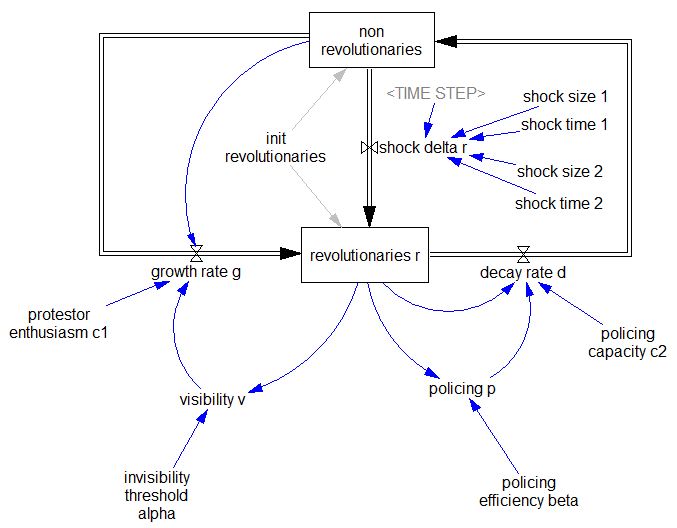
This model differs from typical SD practice in that the formulations for visibility and policing use simple discrete logic – policing either works or it doesn’t, for example. There are also no explicit perception processes or delays. This keeps things simple for analysis, but also makes the behavior somewhat bang-bang. An interesting extension of this model would be to explore more operational, behavioral decision rules.
The model can be used as is to replicate the experiments in Figs. 8 & 9. Further experiments in the paper – including parameter changes that reflect social media – should also be replicable, but would take a little extra structure or Synthesim overrides.
This model runs with any recent Vensim version.
I’d especially welcome comments on the model and analysis from people who know the history of events better than I do.
I don’t know if Thor Heyerdahl had Polynesian origins or Rapa Nui right, but he did nail the stovepiping of thinking in organizations:
“And there’s another thing,” I went on.
“Yes,” said he. “Your way of approaching the problem. They’re specialists, the whole lot of them, and they don’t believe in a method of work which cuts into every field of science from botany to archaeology. They limit their own scope in order to be able to dig in the depths with more concentration for details. Modern research demands that every special branch shall dig in its own hole. It’s not usual for anyone to sort out what comes up out of the holes and try to put it all together.
…
Carl was right. But to solve the problems of the Pacific without throwing light on them from all sides was, it seemed to me, like doing a puzzle and only using the pieces of one color.
Thor Heyerdahl, Kon-Tiki
This reminds me of a few of my consulting experiences, in which large firms’ departments jealously guarded their data, making global understanding or optimization impossible.
This is also common in public policy domains. There’s typically an abundance of micro research that doesn’t add up to much, because no one has bothered to build the corresponding macro theory, or to target the micro work at the questions you need to answer to build an integrative model.
An example: I’ve been working on STEM workforce issues – for DOE five years ago, and lately for another agency. There are a few integrated models of workforce dynamics – we built several, the BHEF has one, and I’ve heard of efforts at several aerospace firms and agencies like NIH and NASA. But the vast majority of education research we’ve been able to find is either macro correlation studies (not much causal theory, hard to operationalize for decision making) or micro examination of a zillion factors, some of which must really matter, but in a piecemeal approach that makes them impossible to integrate.
An integrated model needs three things: what, how, and why. The “what” is the state of the system – stocks of students, workers, teachers, etc. in each part of the system. Typically this is readily available – Census, NSF and AAAS do a good job of curating such data. The “how” is the flows that change the state. There’s not as much data on this, but at least there’s good tracking of graduation rates in various fields, and the flows actually integrate to the stocks. Outside the educational system, it’s tough to understand the matrix of flows among fields and economic sectors, and surprisingly difficult even to get decent measurements of attrition from a single organization’s personnel records. The glaring omission is the “why” – the decision points that govern the aggregate flows. Why do kids drop out of science? What attracts engineers to government service, or the finance sector, or leads them to retire at a given age? I’m sure there are lots of researchers who know a lot about these questions in small spheres, but there’s almost nothing about the “why” questions that’s usable in an integrated model.
I think the current situation is a result of practicality rather than a fundamental philosophical preference for analysis over synthesis. It’s just easier to create, fund and execute standalone micro research than it is to build integrated models.
The bad news is that vast amounts of detailed knowledge goes to waste because it can’t be put into a framework that supports better decisions. The good news is that, for people who are inclined to tackle big problems with integrated models, there’s lots of material to work with and a high return to answering the key questions in a way that informs policy.
An interesting paper on Arxiv caught my eye the other day. It uses a simple model of a bipolar debate to explore policies that encourage moderation.
Some of the most pivotal moments in intellectual history occur when a new ideology sweeps through a society, supplanting an established system of beliefs in a rapid revolution of thought. Yet in many cases the new ideology is as extreme as the old. Why is it then that moderate positions so rarely prevail? Here, in the context of a simple model of opinion spreading, we test seven plausible strategies for deradicalizing a society and find that only one of them significantly expands the moderate subpopulation without risking its extinction in the process.

This is a very simple and stylized model, but in the best tradition of model-based theorizing, it yields provocative counter-intuitive results and raises lots of interesting questions. Technology Review’s Arxiv Blog has a nice qualitative take on the work.
See also: Dynamics of Scientific Revolutions, Bifurcations & Filter Bubbles
The model runs in discrete time, but I’ve added implicit rate constants for dimensional consistency in continuous time.
commitment2.mdl & commitment2.vpm
These should be runnable with any Vensim version.
If you add the asymmetric generalizations in the paper’s Supplemental Material, add your name to the model diagram, forward a copy back to me, and I’ll post the update.
The FuturICT Knowledge Accelerator, a grand unified model of everything, is back in the news.
What if global scale computing facilities were available that could analyse most of the data available in the world? What insights could scientists gain about the way society functions? What new laws of nature would be revealed? Could society discover a more sustainable way of living? Developing planetary scale computing facilities that could deliver answers to such questions is the long term goal of FuturICT.
I’ve been rather critical of this effort before, but I think there’s also much to like.
But I still think the value of the project is more about creating an infrastructure, within which interesting models can emerge, than it is in creating an oracle that decision makers and their constituents will consult for answers to life’s pressing problems.
I don’t think you need to look any further than the climate debate and the history of Limits to Growth to conclude that models are a long way from catalyzing a sustainable world.
If I had a billion Euros to spend on modeling, I think less of it would go into a single platform and more would go into distributed efforts that are working incrementally. It’s easier to evolve a planetary computing platform than to design one.
With the increasing accessibility of computing and visualization, we could be on the verge of a model-induced renaissance. Or, we could be on the verge of an explosion of fun and pretty but vacuous, non-transparent and unvalidated model rubbish that lends itself more to propaganda than thinking. So, I’d be plowing a BIG chunk of that billion into infrastructure and incentives for model and data quality.