Oct 19-21, 2010 — Boston Mass USA
Climate Interactive and SEED Systems are offering a powerful three-day workshop for innovative climate, energy, and sustainability leaders from business, non-profit, government, and university sectors, led by Drew Jones and Sara Schley.
Attend to develop your capacities in:
• Systems thinking: Causal loop and stock-flow diagramming.
• Leadership: Vision, reflective conversation, consensus building.
• Computer simulation: Using and leading policy-testing with the C-ROADS/C-Learn simulation.
• Policy development: Attendees will play the World Climate exercise.
• Climate, energy, and sustainability strategy: Reflections and insights from international experts.
• Business success stories: What’s working in the new low carbon economy and implications for you.
• Building your network of people sharing aspirations for climate progress.
We will stay connected and collaborate to accelerate progress.
For more information and to register please visit http://climateinteractive.org/events
The emerging climate technology delusion
What do you do when feasible policies aren’t popular, and popular policies aren’t feasible?
Let’s start with a joke:
Lenin, Stalin, Khrushchev and Brezhnev are travelling together on a train. Unexpectedly the train stops. Lenin suggests: “Perhaps, we should call a subbotnik, so that workers and peasants fix the problem.” Kruschev suggests rehabilitating the engineers, and leaves for a while, but nothing happens. Stalin, fed up, steps out to intervene. Rifle shots are heard, but when he returns there is still no motion. Brezhnev reaches over, pulls the curtain, and says, “Comrades, let’s pretend we’re moving.” (Apologies to regulars for the repeat.)
The Soviet approach would be funny, if it weren’t the hottest new trend in climate policy. The latest installment is a Breakthrough article, The emerging climate technology consensus. An excerpt: Continue reading “The emerging climate technology delusion”
Models and copyrights
Or, Friends don’t let friends work for hire.

Image Copyright 2004 Lawrence Liang, Piet Zwart Institute, licensed under a Creative Commons License
Photographers and other media workers hate work for hire, because it’s often a bad economic tradeoff, giving up future income potential for work that’s underpaid in the first place. But at least when you give up rights to a photo, that’s the end of it. You can take future photos without worrying about past ones.
For models and software, that’s not the case, and therefore work for hire makes modelers a danger to themselves and to future clients. The problem is that models draw on a constrained space of possible formulations of a concept, and tend to incorporate a lot of prior art. Most of the author’s prior art is probably, in turn, things learned from other modelers. But when a modeler reuses a bit of structure – say, a particular representation of a supply chain or a consumer choice decision – under a work for hire agreement, title to those equations becomes clouded, because the work-for-hire client owns the new work, and it’s hard to distinguish new from old.
The next time you reuse components that have been used for work-for-hire, the previous client can sue for infringement, threatening both you and future clients. It doesn’t matter if the claim is legitimate; the lawsuit could be debilitating, even if you could ultimately win. Clients are often much bigger, with deeper legal pockets, than freelance modelers. You also can’t rely on a friendly working relationship, because bad things can happen in spite of good intentions: a hostile party might acquire copyright through a bankruptcy, for example.
The only viable approach, in the long run, is to retain copyright to your own stuff, and grant clients all the license they need to use, reproduce, produce derivatives, or whatever. You can relicense a snippet of code as often as you want, so no client is ever threatened by another client’s rights or your past agreements.
Things are a little tougher when you want to collaborate with multiple parties. One apparent option, joint ownership of copyright to the model, is conceptually nice but actually not such a hot idea. First, there’s legal doctrine to the effect that individual owners have a responsibility not to devalue joint property, which is a problem if one owner subsequently wants to license or give away the model. Second, in some countries, joint owners have special responsibilities, so it’s hard to write a joint ownership contract that works worldwide.
Again, a viable approach is cross-licensing, where creators retain ownership of their own contributions, and license contributions to their partners. That’s essentially the approach we’ve taken within the C-ROADS team.
One thing to avoid at all costs is agreements that require equation-level tracking of ownership. It’s fairly easy to identify individual contributions to software code, because people tend to work in containers, contributing classes, functions or libraries that are naturally modular. Models, by contrast, tend to be fairly flat and tightly interconnected, so contributions can be widely scattered and difficult to attribute.
Part of the reason this is such a big problem is that we now have too much copyright protection, and it lasts way too long. That makes it hard for copyright agreements to recognize where we see far because we stand on the shoulders of giants, and distorts the balance of incentives intended by the framers of the constitution.
In the academic world, model copyright issues have historically been ignored for the most part. That’s good, because copyright is a hindrance to progress (as long as there are other incentives to create knowledge). That’s also bad, because it means that there are a lot of models out there that have not been placed in the public domain, but which are treated as if they were. If people start asserting their copyrights to those, things could get messy in the future.
A solution to all of this could be open source or free software. Copyleft licenses like the GPL and permissive licenses like Apache facilitate collaboration and reuse of models. That would enable the field to move faster as a whole through open extension of prior work. C-ROADS and C-LEARN and component models are going out under an open license, and I hope to do more such experiments in the future.
Update: I’ve posted some examples.
Will the real emissions target please stand up?
The post-Copenhagen climate negotiations seem to be diverging, at least on the question of targets. Brackets, denoting disagreement, have if anything proliferated in the draft texts. The latest from Bonn:
AD HOC WORKING GROUP ON LONG-TERM COOPERATIVE ACTION UNDER THE CONVENTION
Eleventh session Bonn, 2–6 August 2010
Item 3 of the provisional agenda Preparation of an outcome to be presented to the Conference of the Parties for adoption at its sixteenth session to enable full, effective and sustained implementation of the Convention through long-term cooperative action now, up to and beyond 2012
Text to facilitate negotiations among Parties
…
4. Parties should collectively reduce global emissions by [50][85][95] per cent from 1990 levels by 2050 and should ensure that global emissions continue to decline thereafter. Developed country Parties as a group should reduce their greenhouse gas emissions by [[75-85][at least 80-95][more than 95] per cent from 1990 levels by 2050] [more than 100 per cent from 1990 levels by 2040].
…
18. These commitments are made with a view to reducing the aggregate greenhouse gas emissions of developed country Parties by [at least] [25–40] [in the order of 30] [40] [45] [50] [X* per cent from [1990] [or 2005] levels by [2017][2020] [and by [at least] [YY] per cent by 2050 from the [1990] [ZZ] level].
Hat tip: Travis Franck.
The RGGI budget raid and cap & trade credibility
I haven’t been watching the Regional Greenhouse Gas Initiative very closely, but some questions from a colleague prompted me to do a little sniffing around. I happened to run across this item:
Warnings realized in RGGI budget raid
The Business and Industry Association of New Hampshire was not surprised that the Legislature on Wednesday took $3.1 million in Regional Greenhouse Gas Initiative funds to help balance the state budget.
“We warned everybody two years ago that this is a big pot of money that is ripe for the plucking, and that’s exactly what happened,” said David Juvet, the organization’s vice president.
Indeed, the raid happened without any real debate at all. In fact, the only other RGGI-related proposal – backed by Republicans – was to take even more money from the fund.
… New York state lawmakers grabbed $90 million in RGGI funds last December. Shortly afterwards, New Jersey followed suit taking $65 million in the last budget year. And “the governor left the door wide open for next year. They are taking it all,” said Matt Elliott of Environment New Jersey. …
This is a problem because it confirms the talking point of “cap & tax” opponents, that emissions revenue streams will be commandeered for government largesse. There is a simple solution, I think, which is to redistribute the proceeds transparently, so that it’s obvious that a raid on revenues is a raid on pocketbooks. The BC carbon tax did that initially, though it’s apparently falling off the wagon.
The Law of Attraction
No, not that silly one.
Controlling Growth by Controlling Attractiveness
In Woodstock, Vermont, everyone’s mad about a highway. In other places the issue is a sewer system or a school. The real issue, of course, is growth. According to Jay Forrester’s Attractiveness Principle (Forrester is a professor of systems analysis at MIT) there’s only one way to control growth — control attractiveness.
…
In a free society if any place is unusually attractive, folks will — no surprise — be attracted there. The most mobile people (the young, the rich, the educated) will get there first. The place will grow until its attractiveness has been reduced by crowded highways, or unemployment, or scarce housing, or pollution, or just plain visual blight. (The most mobile people have moved on by then). When the place is no more attractive than anywhere else, then and only then will it stop growing. What else can stop it?
…
The attractiveness of a place is a complex combination of climate, economy, amenities, scenery. No one can define attractiveness exactly, but people make up their minds about it every day by deciding to move from Hartford or Boston or Westchester County to Vermont (that’s the direction they’re moving at the moment). Millions of human judgements weigh Vermont’s clean air against Boston’s job market and Manhattan’s cost of living. The very different mixes of attractiveness and unattractiveness in those places may seem incommensurable, but people make their comparisons, and eventually attractiveness evens out everywhere.
…
The normal instinct of public officials, including those of Woodstock, is to fix problems and make their community perfect. The more perfect they make it, the more new people show up. What Woodstock needs to do, Forrester would say, is decide what kinds of imperfection it’s willing to live with.
A crowded, unsafe highway? If that’s unacceptable, then choose something else. Super-restrictive zoning, perhaps, or an absolute limit on new curb cuts, or higher property taxes (I know, they’re already too high, but not high enough to stop people from moving in). Bad schools. Bad air. No jobs. Developments so ugly you might as well live in New Jersey. Some sort of whopping surcharge on those developers. Either Woodstock chooses its form of unattractiveness, or the growth process itself chooses.
It takes awhile to absorb the implications of the Attractiveness Principle, because it turns conventional thinking upside down (Forrester is good at doing that). Its implications are not good news for the sort of people who live in Woodstock. The Principle says you can’t live in a privileged bubble of attractiveness, unless you are perpetually young, rich, educated, and on the move at the head of the attractiveness wave. It says that growth is your problem wherever it occurs. It says the only way to be sure of living in an attractive place is to be committed to the attractiveness of every place.
From the Donella Meadows Archive
Enabling an R&D addiction
I actually mean that in a good way. A society addicted to learning and innovation would be pretty cool.
However, it’s not all about money. Quoting the OSTP Science of Science Policy Roadmap,
Investment in science and technology, however, is only one of the policy instruments available to science policy makers; others include fostering the role of competiton and openness in the promotion of discovery, the construction of intellectual property systems, tax policy, and investment in a STEM workforce. However, the probable impact of these various policies and interventions is largely unknown. This lack of knowledge can lead to serious and unintended consequences.
In other words, to spend $16 billion/year wisely, you have to get a number of moving parts coordinated, including:
- Prices & tax policy. If prices of natural resources, national security, clean air, health, etc. don’t reflect their true values to society, innovation policy will be pushing against the tide. Innovations will be DOA in the marketplace. The need for markets for products is matched by the need for markets for innovators:
- Workforce management. Just throwing money at a problem can create big dislocations in researcher demographics. Put it all into academic research, and you create a big glut of graduates who have no viable career path in science. Put it all into higher education, and your pipeline of talent will be starved by poor science preparation at lower levels. Put it all into labs and industry, and it’ll turn into pay raises for a finite pool of workers. Balance is needed.
- Intellectual property law. This needs to reflect the right mix of incentives for private investment and recognition that creations are only possible to the extent that we stand on the shoulders of giants and live in a society with rule of law. Currently I suspect that law has swung too far toward eternal protection that actually hinders innovation.
At the end of the day, #1 is most important. Regardless of the productivity of the science enterprise, someone will probably figure out how to make graphene cables or an aspen tree that bears tomatoes. The key question, then, is how society puts those things to use, to solve its problems and improve welfare. That requires a delicate balancing act, between preserving diversity and individual freedom to explore new ways of doing things, and preventing externalities from harming everyone else.
Hail of a day
Very big hail on Wednesday … I managed to duck into a gas station, so my car only got 2 dents and a windshield crack; others weren’t so lucky. These are the little ones:

Big ones took out windows at the law office I was visiting. The hospital treated 10 people for injuries.
R&D – crack for techno-optimists
I like R&D. Heck, I basically do R&D. But the common argument, that people won’t do anything hard to mitigate emissions or reduce energy use, so we need lots of R&D to find solutions, strikes me as delusional.
The latest example to cross my desk (via the NYT) is the new American Energy Innovation Council’s recommendations,


Let’s look at the meat of this – $16 billion per year in energy innovation funding. Historic funding looks like this:
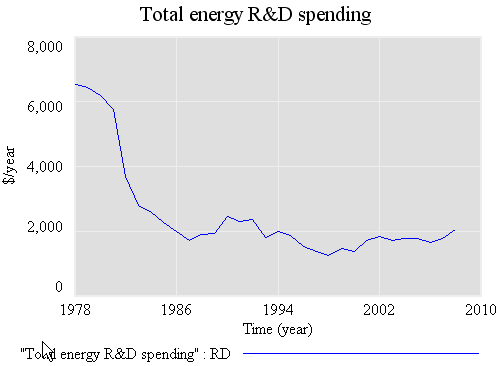
Total public energy R&D, compiled from Gallagher, K.S., Sagar, A, Segal, D, de Sa, P, and John P. Holdren, “DOE Budget Authority for Energy Research, Development, and Demonstration Database,” Energy Technology Innovation Project, John F. Kennedy School of Government, Harvard University, 2007. I have a longer series somewhere, but no time to dig it up. Basically, spending was negligible (or not separately accounted for) before WWII, and ramped up rapidly after 1973.
The data above reflects public R&D; when you consider private spending, the jump to $16 billion represents maybe a factor of 3 or 4 increase. What does that do for you?
Consider a typical model of technical progress, the two-factor learning curve:
cost = (cumulative R&D)^A*(cumulative experience)^B
The A factor represents improvement from deliberate R&D, while the B factor reflects improvement from production experience like construction and installation of wind turbines. A and B are often expressed as learning rates, the multiple on cost that occurs per doubling of the relevant cumulative input. In other words, A,B = ln(learning rate)/ln(2). Typical learning rates reported are .6 to .95, or cost reductions of 40% to 5% per doubling, corresponding with A/B values of -.7 to -.15, respectively. Most learning rate estimates are on the high end (smaller reductions per doubling), particularly when the two-factor function is used (as opposed to just one component).
Let’s simplify so that
cost = (cumulative R&D)^A
and use an aggressive R&D learning rate (.7), for A=-0.5. In steady state, with R&D growing at the growth rate of the economy (call it g), cost falls at the rate A*g (because the integral of exponentially growing spending grows at the same rate, and exp(g*t)^A = exp(A*g*t)).
That’s insight number one: a change in R&D allocation has no effect on the steady-state rate of progress in cost. Obviously one could formulate alternative models of technology where that is not true, but compelling argument for this sort of relationship is that the per capita growth rate of GDP has been steady for over 250 years. A technology model with a stronger steady-state spending->cost relationship would grow super-exponentially.
Insight number two is what the multiple in spending (call it M) does get you: a shift in the steady-state growth trajectory to a new, lower-cost path, by M^A. So, for our aggressive parameter, a multiple of 4 as proposed reduces steady-state costs by a factor of about 2. That’s good, but not good enough to make solar compatible with baseload coal electric power soon.
Given historic cumulative public R&D, 3%/year baseline growth in spending, a 0.8 learning rate (a little less aggressive), a quadrupling of R&D spending today produces cost improvements like this:
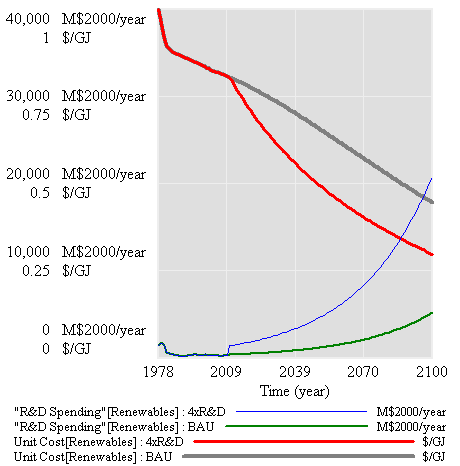
Those are helpful, but not radical. In addition, even if R&D produces something more miraculous than it has historically, there are still big nontechnical lock-in humps to overcome (infrastructure, habits, …). Overcoming those humps is a matter of deployment more than research. The Energy Innovation Council is definitely enthusiastic about deployment, but without internalizing the externalities associated with energy production and use, how is that going to work? You’d either need someone to pick winners and implement them with a mishmash of credits and subsidies, or you’d have to hope for/wait for cleantech solutions to exceed the performance of conventional alternatives.
The latter approach is the “stone age didn’t end because we ran out of stones” argument. It says that cleantech (iron) will only beat conventional (stone) when it’s unequivocally better, not just for the environment, but also convenience, cost, etc. What does that say about the prospects for CCS, which is inherently (thermodynamically) inferior to combustion without capture? The reality is that cleantech is already better, if you account for the social costs associated with energy. If people aren’t willing to internalize those social costs, so be it, but let’s not pretend we’re sure that there’s a magic technical bullet that will yield a good outcome in spite of the resulting perverse incentives.
Gallagher, K.S., Sagar, A, Segal, D, de Sa, P, and John P. Holdren, “DOE Budget Authority for Energy Research, Development, and Demonstration Database,” Energy Technology Innovation Project, John F. Kennedy School of Government, Harvard University, 2007.
Would you fly in a plane designed by lawyers?
No? So why do we let lawyers design control systems for our economic and social systems, without much input from people trained in dynamic systems?