Complexity is not the enemy

Following its misguided attack on complex CLDs, a few of us wrote a letter to the NYTimes. Since they didn’t publish, here it is:

Dear Editors, Systemic Spaghetti Slide Snookers Scribe. Powerpoint Pleases Policy Players

“We Have Met the Enemy and He Is PowerPoint” clearly struck a deep vein of resentment against mindless presentations. However, the lead “spaghetti” image, while undoubtedly too much to absorb quickly, is in fact packed with meaning for those who understand its visual lingo. If we can’t digest a mere slide depicting complexity, how can we successfully confront the underlying problem?

The diagram was not created in Powerpoint. It is a “causal loop diagram,” one of a several ways to describe relationships that influence the evolution of messy problems like the war in the Middle East. It’s a perfect illustration of General McMaster’s observation that, “Some problems in the world are not bullet-izable.” Diagrams like this may not be intended for public consumption; instead they serve as a map that facilitates communication within a group. Creating such diagrams allows groups to capture and improve their understanding of very complex systems by sharing their mental models and making them open to challenge and modification. Such diagrams, and the formal computer models that often support them, help groups to develop a more robust understanding of the dynamics of a problem and to develop effective and elegant solutions to vexing challenges.

It’s ironic that so many call for a return to pure verbal communication as an antidote for Powerpoint. We might get a few great speeches from that approach, but words are ill-suited to describe some data and systems. More likely, a return to unaided words would bring us a forgettable barrage of five-pagers filled with laundry-list thinking and unidirectional causality.

The excess supply of bad presentations does not exist in a vacuum. If we want better presentations, then we should determine why organizational pressures demand meaningless propaganda, rather than blaming our tools.

Tom Fiddaman of Ventana Systems, Inc. & Dave Packer, Kristina Wile, and Rebecca Niles Peretz of The Systems Thinking Collaborative

Other responses of note:

We have met an ally and he is Storytelling (Chris Soderquist)

Why We Should be Suspect of Bullet Points and Laundry Lists (Linda Booth Sweeney)

Java Vensim helper

MIT’s Climate Collaboratorium has posted java code that it used to wrap C-LEARN as a web service using the multicontext .dll. If you’re doing something similar, you may find the code useful, particularly the VensimHelper class. The liberal MIT license applies. However, be aware that you’ll need a license for the Vensim multicontext .dll to go with it.

Copenhagen – the breaking point

Der Spiegel has obtained audio of the heads of state negotiating in the final hours of COP15. Its fascinating stuff. The headline reads, How China and India Sabotaged the UN Climate Summit. This point was actually raised back in December by Mark Lynas at the Guardian (there’s a nice discussion and event timeline at Inside-Out China). On the surface the video supports the view that China and India were the material obstacle to agreement on a -50% by 2050 target. However, I think it’s still hard to make attributions about motive. We don’t know, for example, whether China is opposed because it anticipates raising emissions to levels that would make 50% cuts physically impossible, or because it sees the discussion of cuts as fundamentally linked to the unaddressed question of responsibility, as hinted by He Yafei near the end of the video. Was the absence of Wen Jiabao obstruction or a defensive tactic?  We have even less information about India, merely that it objected to “prejudging options,” whatever that means.

What the headline omits is the observation in the final pages of the article, that the de facto US position may not have been so different from China’s:

Part 3: Obama Stabs the Europeans in the Back

But then Obama stabbed the Europeans in the back, saying that it would be best to shelve the concrete reduction targets for the time being. “We will try to give some opportunities for its resolution outside of this multilateral setting … And I am saying that, confident that, I think China still is as desirous of an agreement, as we are.”

‘Other Business to Attend To’

At the end of his little speech, which lasted 3 minutes and 42 seconds, Obama even downplayed the importance of the climate conference, saying “Nicolas, we are not staying until tomorrow. I’m just letting you know. Because all of us obviously have extraordinarily important other business to attend to.”

Some in the room felt queasy. Exactly which side was Obama on? He couldn’t score any domestic political points with the climate issue. The general consensus was that he was unwilling to make any legally binding commitments, because they would be used against him in the US Congress. Was he merely interested in leaving Copenhagen looking like an assertive statesman?

It was now clear that Obama and the Chinese were in fact in the same boat, and that the Europeans were about to drown.

This article and video almost makes up for Spiegel’s terrible coverage of the climate email debacle.


Related analysis of developed-developing emissions trajectories:

You can’t fix emissions inequity with more emissions

The AWG-LCA draft agreement

The AOSIS draft agreement

Danish text – emissions trajectories

Cumulative Normal Distribution

Vensim doesn’t have a function for the cumulative normal distribution, but it’s easy to implement via a macro. I used to use a polynomial cited in Numerical Recipes (error function, Ch. 6.2):

:MACRO: NCDF(x)
NCDF = 1-Complementary Normal CDF
~	dmnl
~		|
Complementary Normal CDF=
ERFCy/2
~	dmnl
~		|
ERFCy = IF THEN ELSE(y>=0,ans,2-ans)
~	dmnl
~	http://www.library.cornell.edu/nr/bookcpdf/c6-2.pdf
|
y = x/sqrt(2)
~	dmnl
~		|
ans=t*exp(-z*z-1.26551+t*(1.00002+t*(0.374092+t*(0.0967842+
t*(-0.186288+t*(0.278868+t*(-1.1352+t*(1.48852+
t*(-0.822152+t*0.170873)))))))))
~	dmnl
~		|
t=1/(1+0.5*z)
~	dmnl
~		|
z = ABS(y)
~	dmnl
~		|
:END OF MACRO:

I recently discovered a better approximation here, from algorithm 26.2.17 in Abromowitz and Stegun, Handbook of Mathematical Functions:

:MACRO: NCDF2(x)
NCDF2 =  IF THEN ELSE(x >= 0,
(1 - c * exp( -x * x / 2 ) * t *
( t *( t * ( t * ( t * b5 + b4 ) + b3 ) + b2 ) + b1 )),  ( c * exp( -x * x / 2 ) * t *
( t *( t * ( t * ( t * b5 + b4 ) + b3 ) + b2 ) + b1 ))
)
~     dmnl
~     From http://www.sitmo.com/doc/Calculating_the_Cumulative_Normal_Distribution
Implements algorithm 26.2.17 from Abromowitz and Stegun, Handbook of Mathematical 
Functions. It has a maximum absolute error of 7.5e^-8.
http://www.math.sfu.ca/
|
c  =  0.398942
~     dmnl
~           |
t = IF THEN ELSE( x >= 0, 1/(1+p*x), 1/(1-p*x))
~     dmnl
~           |
b5 =  1.33027
~     dmnl
~           |
b4 = -1.82126
~     dmnl
~           |
b3 =  1.78148
~     dmnl
~           |
b2 = -0.356564
~     dmnl
~           |
b1 =  0.319382
~     dmnl
~           |
p  =  0.231642
~     dmnl
~           |
:END OF MACRO:

In advanced Vensim versions, paste the macro into the header of your model (View>As Text). Otherwise, you can implement the equations inside the macro directly in your model.

Stop talking, start studying?

Roger Pielke Jr. poses a carbon price paradox:

The carbon price paradox is that any politically conceivable price on carbon can do little more than have a marginal effect on the modern energy economy. A price that would be high enough to induce transformational change is just not in the cards. Thus, carbon pricing alone cannot lead to a transformation of the energy economy.

Put another way:

Advocates for a response to climate change based on increasing the costs of carbon-based energy skate around the fact that people react very negatively to higher prices by promising that action won’t really cost that much. … If action on climate change is indeed “not costly” then it would logically follow the only reasons for anyone to question a strategy based on increasing the costs of energy are complete ignorance and/or a crass willingness to destroy the planet for private gain. … There is another view. Specifically that the current ranges of actions at the forefront of the climate debate focused on putting a price on carbon in order to motivate action are misguided and cannot succeed. This argument goes as follows: In order for action to occur costs must be significant enough to change incentives and thus behavior. Without the sugarcoating, pricing carbon (whether via cap-and-trade or a direct tax) is designed to be costly. In this basic principle lies the seed of failure. Policy makers will do (and have done) everything they can to avoid imposing higher costs of energy on their constituents via dodgy offsets, overly generous allowances, safety valves, hot air, and whatever other gimmick they can come up with.

His prescription (and that of the Breakthrough Institute)  is low carbon taxes, reinvested in R&D:

We believe that soon-to-be-president Obama’s proposal to spend $150 billion over the next 10 years on developing carbon-free energy technologies and infrastructure is the right first step. … a $5 charge on each ton of carbon dioxide produced in the use of fossil fuel energy would raise $30 billion a year. This is more than enough to finance the Obama plan twice over.

… We would like to create the conditions for a virtuous cycle, whereby a small, politically acceptable charge for the use of carbon emitting energy, is used to invest immediately in the development and subsequent deployment of technologies that will accelerate the decarbonization of the U.S. economy.

Stop talking, start solving

As the nation begins to rely less and less on fossil fuels, the political atmosphere will be more favorable to gradually raising the charge on carbon, as it will have less of an impact on businesses and consumers, this in turn will ensure that there is a steady, perhaps even growing source of funds to support a process of continuous technological innovation.

This approach reminds me of an old joke:

Lenin, Stalin, Khrushchev and Brezhnev are travelling together on a train. Unexpectedly the train stops. Lenin suggests: “Perhaps, we should call a subbotnik, so that workers and peasants fix the problem.” Kruschev suggests rehabilitating the engineers, and leaves for a while, but nothing happens. Stalin, fed up, steps out to intervene. Rifle shots are heard, but when he returns there is still no motion. Brezhnev reaches over, pulls the curtain, and says, “Comrades, let’s pretend we’re moving.”

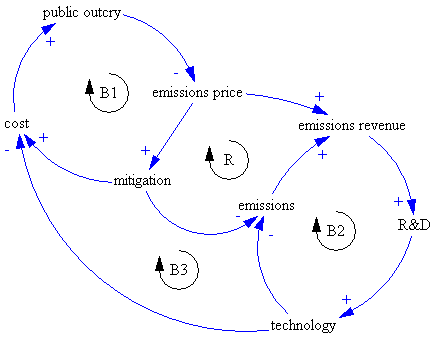
I translate the structure of Pielke’s argument like this:

Pielke Loops

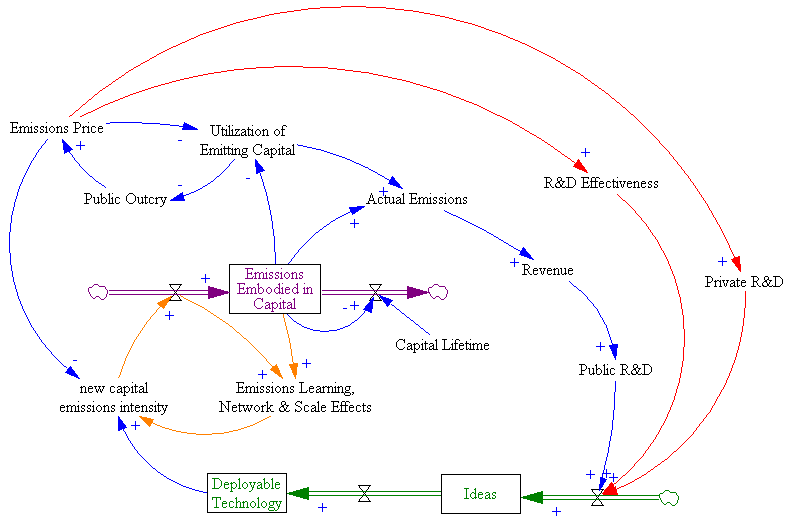
Implementation of a high emissions price now would be undone politically (B1). A low emissions price triggers a virtuous cycle (R), as revenue reinvested in technology lowers the cost of future mitigation, minimizing public outcry and enabling the emissions price to go up. Note that this structure implies two other balancing loops (B2 & B3) that serve to weaken the R&D effect, because revenues fall as emissions fall.

If you elaborate on the diagram a bit, you can see why the technology-led strategy is unlikely to work:

PielkeLoopsSF

First, there’s a huge delay between R&D investment and emergence of deployable technology (green stock-flow chain). R&D funded now by an emissions price could take decades to emerge. Second, there’s another huge delay from the slow turnover of the existing capital stock (purple) – even if we had cars that ran on water tomorrow, it would take 15 years or more to turn over the fleet. Buildings and infrastructure last much longer. Together, those delays greatly weaken the near-term effect of R&D on emissions, and therefore also prevent the virtuous cycle of reduced public outcry due to greater opportunities from getting going. As long as emissions prices remain low, the accumulation of commitments to high-emissions capital grows, increasing public resistance to a later change in direction. Continue reading “Stop talking, start studying?”

The model that ate Europe

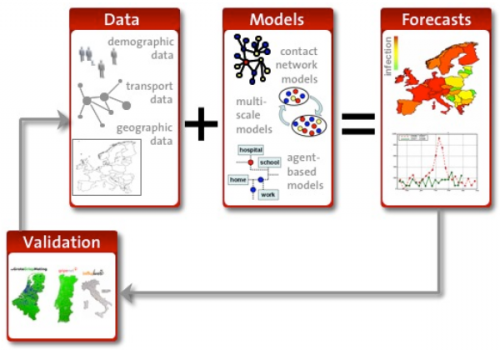
arXiv covers modeling on an epic scale in Europe’s Plan to Simulate the Entire Earth: a billion dollar plan to build a huge infrastructure for global multiagent models. The core is a massive exaflop “Living Earth Simulator” – essentially the socioeconomic version of the Earth Simulator.

FuturIcT

I admire the audacity of this proposal, and there are many good ideas captured in one place:

  • The goal is to take on emergent phenomena like financial crises (getting away from the paradigm of incremental optimization of stable systems).
  • It embraces uncertainty and robustness through scenario analysis and Monte Carlo simulation.
  • It mixes modeling with data mining and visualization.
  • The general emphasis is on networks and multiagent simulations.

I have no doubt that there might be many interesting spinoffs from such a project. However, I suspect that the core goal of creating a realistic global model will be an epic failure, for three reasons. Continue reading “The model that ate Europe”

John Sterman on solving our biggest problems


The key message is that climate, health, and other big messy problems don’t have purely technical fixes. Therefore Manhattan Project approaches to solving them won’t work. Creating and deploying solutions to these problems requires public involvement and widespread change with distributed leadership. The challenge is to get public understanding of climate to carry the same sense of urgency that drove the civil rights movement. From a series at the IBM Almaden Institute conference.

Diagrams vs. Models

Following Bill Harris’ comment on Are causal loop diagrams useful? I went looking for Coyle’s hybrid influence diagrams. I didn’t find them, but instead ran across this interesting conversation in the SDR:

The tradition, one might call it the orthodoxy, in system dynamics is that a problem can only be analysed, and policy guidance given, through the aegis of a fully quantified model. In the last 15 years, however, a number of purely qualitative models have been described, and have been criticised, in the literature. This article briefly reviews that debate and then discusses some of the problems and risks sometimes involved in quantification. Those problems are exemplified by an analysis of a particular model, which turns out to bear little relation to the real problem it purported to analyse. Some qualitative models are then reviewed to show that they can, indeed, lead to policy insights and five roles for qualitative models are identified. Finally, a research agenda is proposed to determine the wise balance between qualitative and quantitative models.

… In none of this work was it stated or implied that dynamic behaviour can reliably be inferred from a complex diagram; it has simply been argued that describing a system is, in itself, a useful thing to do and may lead to better understanding of the problem in question. It has, on the other hand, been implied that, in some cases, quantification might be fraught with so many uncertainties that the model’s outputs could be so misleading that the policy inferences drawn from them might be illusory. The research issue is whether or not there are circumstances in which the uncertainties of simulation may be so large that the results are seriously misleading to the analyst and the client. … This stream of work has attracted some adverse comment. Lane has gone so far as to assert that system dynamics without quantified simulation is an oxymoron and has called it ‘system dynamics lite (sic)’. …

Coyle (2000) Qualitative and quantitative modelling in system dynamics: some research questions

Jack Homer and Rogelio Oliva aren’t buying it:

Geoff Coyle has recently posed the question as to whether or not there may be situations in which computer simulation adds no value beyond that gained from qualitative causal-loop mapping. We argue that simulation nearly always adds value, even in the face of significant uncertainties about data and the formulation of soft variables. This value derives from the fact that simulation models are formally testable, making it possible to draw behavioral and policy inferences reliably through simulation in a way that is rarely possible with maps alone. Even in those cases in which the uncertainties are too great to reach firm conclusions from a model, simulation can provide value by indicating which pieces of information would be required in order to make firm conclusions possible. Though qualitative mapping is useful for describing a problem situation and its possible causes and solutions, the added value of simulation modeling suggests that it should be used for dynamic analysis whenever the stakes are significant and time and budget permit.

Homer & Oliva (2001) Maps and models in system dynamics: a response to Coyle

Coyle rejoins:

This rejoinder clarifies that there is significant agreement between my position and that of Homer and Oliva as elaborated in their response. Where we differ is largely to the extent that quantification offers worthwhile benefit over and above analysis from qualitative analysis (diagrams and discourse) alone. Quantification may indeed offer potential value in many cases, though even here it may not actually represent ‘‘value for money’’. However, even more concerning is that in other cases the risks associated with attempting to quantify multiple and poorly understood soft relationships are likely to outweigh whatever potential benefit there might be. To support these propositions I add further citations to published work that recount effective qualitative-only based studies, and I offer a further real-world example where any attempts to quantify ‘‘multiple softness’’ could have lead to confusion rather than enlightenment. My proposition remains that this is an issue that deserves real research to test the positions of Homer and Oliva, myself, and no doubt others, which are at this stage largely based on personal experiences and anecdotal evidence.

Coyle (2001) Rejoinder to Homer and Oliva

My take: I agree with Coyle that qualitative models can often lead to insight. However, I don’t buy the argument that the risks of quantification of poorly understood soft variables exceeds the benefits. First, if the variables in question are really too squishy to get a grip on, that part of the modeling effort will fail. Even so, the modeler will have some other working pieces that are more physical or certain, providing insight into the context in which the soft variables operate. Second, as long as the modeler is doing things right, which means spending ample effort on validation and sensitivity analysis, the danger of dodgy quantification will reveal itself as large uncertainties in behavior subject to the assumptions in question. Third, the mere attempt  to quantify the qualitative is likely to yield some insight into the uncertain variables, which exceeds that derived from the purely qualitative approach. In fact, I would argue that the greater danger lies in the qualitative approach, because it is quite likely that plausible-looking constructs on a diagram will go unchallenged, yet harbor deep conceptual problems that would be revealed by modeling.

I see this as a cost-benefit question. With infinite resources, a model always beats a diagram. The trouble is that in many cases time, money and the will of participants are in short supply, or can’t be justified given the small scale of a problem. Often in those cases a qualitative approach is justified, and diagramming or other elicitation of structure is likely to yield a better outcome than pure talk. Also, where resources are limited, an overzealous modeling attempt could lead to narrow focus, overemphasis on easily quantifiable concepts, and implementation failure due to too much model and not enough process. If there’s a risk to modeling, that’s it – but that’s a risk of bad modeling, and there are many of those.

Are causal loop diagrams useful?

Reflecting on the Afghanistan counterinsurgency diagram in the NYTimes, Scott Johnson asked me whether I found causal loop diagrams (CLDs) to be useful. Some system dynamics hardliners don’t like them, and others use them routinely.

Here’s a CLD:

Chicken CLD

And here’s it’s stock-flow sibling:

Chicken Stock Flow

My bottom line is:

  • CLDs are very useful, if developed and presented with a little care.
  • It’s often clearer to use a hybrid diagram that includes stock-flow “main chains”. However, that also involves a higher burden of explanation of the visual language.
  • You can get into a lot of trouble if you try to mentally simulate the dynamics of a complex CLD, because they’re so underspecified (but you might be better off than talking, or making lists).
  • You’re more likely to know what you’re talking about if you go through the process of building a model.
  • A big, messy picture of a whole problem space can be a nice complement to a focused, high quality model.

Here’s why:

Continue reading “Are causal loop diagrams useful?”

Visualizing biological time

A new paper on arXiv shows an interesting approach to visualizing time in systems with circadian or other rhythms. I haven’t figured out if it’s useful for oscillatory dynamic systems more generally, but it makes some neat visuals:

scheme

The method makes it possible to see changes in behavior in time series with waaay to many oscillations to explore on a normal 2D time-value plot:

cardiac

Read more on arXiv.