(Dry) Lake Mead

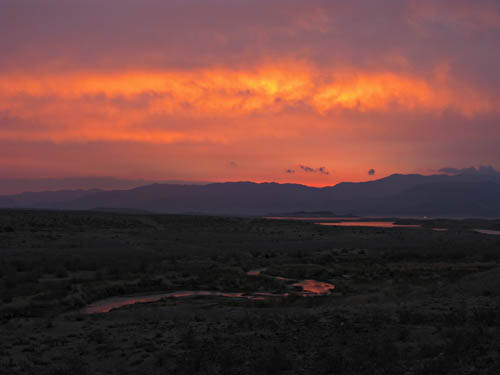
I’m just back from two weeks camping in the desert. Ironically, we had a lot of rain. Apart from the annoyance of cooking in the rain, water in the desert is a wonderful sight.

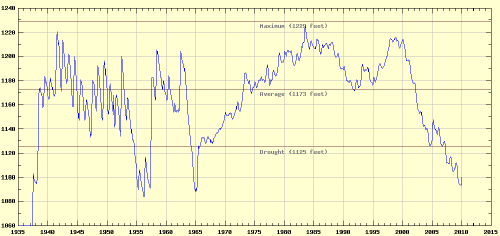
We spent one night in transit at Las Vegas Bay campground on Lake Mead. We were surprised to discover that it’s not a bay anymore – it’s a wash. The lake has been declining for a decade and is now 100 feet below its maximum.

Lake Mead water level

It turned out that this is not unprecedented – it happened in 1965, for example. After that relatively brief drought, it took a decade to claw back to “normal” levels.

The recent decline looks different to me, though – it’s not a surprising, abrupt decline, it’s a long, slow ramp, suggesting a persistent supply-demand imbalance. Bizarrely, it’s easy to get lake level data, but hard to find a coherent set of basin flow measurements. Would you invest in a company with a dwindling balance sheet, if they couldn’t provide you with an income statement?

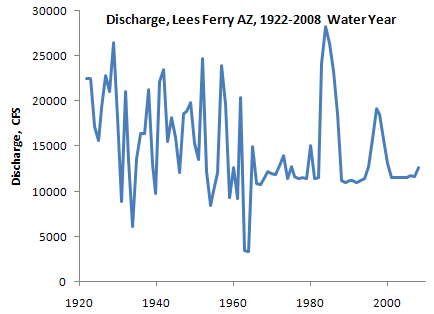
It appears to me that the Colorado River system is simply overallocated, and their hasn’t been any feedback between reality (actual water availability) and policy (water use, governed by the Law of the River). It also appears that the problem is not with the inflow to Lake Mead. Here’s discharge past the Lees Ferry guage, which accounts for the bulk of the lake’s supply:

Lees Ferry flow

Notice that the post-2000 flows are low (probably reflecting mainly the statutory required discharge from Glenn Canyon dam upstream), but hardly unprecedented. My hypothesis is that the de facto policy for managing water levels is to wait for good years to restore the excess withdrawals of bad years, and that demand management measures in the interim are toothless. That worked back when river flows were not fully subscribed. The trouble is, supply isn’t stationary, and there’s no reason to assume that it will return to levels that prevailed in the early years of river compacts. At the same time, demand isn’t stationary either, as population growth in the west drives it up. To avoid Lake Mead drying up, the system is going to have to get a spine, i.e. there’s going to have to be some feedback between water availability and demand.

I’m sure there’s a much deeper understanding of water dynamics among various managers of the Colorado basin than I’ve presented here. But if there is, they’re certainly not sharing it very effectively, because it’s hard for an informed tinkerer like me to get the big picture. Colorado basin managers should heed Krys Stave’s advice:

Water managers increasingly are faced with the challenge of building public or stakeholder support for resource management strategies. Building support requires raising stakeholder awareness of resource problems and understanding about the consequences of different policy options.

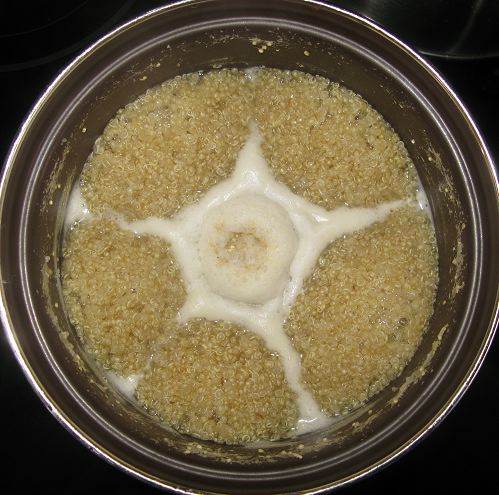
Hadley cells for lunch

quinoa convection

At lunch today we were amazed by these near-perfect convection cells that formed in a pot of quinoa. You can DIY at NOAA. I think this is an instance of Benard-Marangoni convection, because the surface is free, though the thinness assumptions are likely violated, and quinoa is not quite an ideal liquid. Anyway, it’s an interesting phenomenon because the dynamics involve a surface tension gradient, not just heat transfer. See this and this.

Fun with Processing

Processing is a very clean, Java-based environment targeted at information visualization and art. I got curious about it, so I built a simple interactive game that demonstrates how dynamic complexity makes system control difficult. Click through to play:

dragdot

I think there’s a lot of potential for elegant presentation with Processing. There are several physics libraries and many simulations with a physical, chemical, or mathematical basis at OpenProcessing.org:

OpenProcessing

If you like code, it’s definitely worth a look.

Dynamics of … er … flatulence

I sat down over lunch to develop a stock-flow diagram with my kids. This is what happens when you teach system dynamics to young boys:

dynamics of flatulence

Notice that there’s no outflow for the unpleasantries, because they couldn’t agree on whether the uptake mechanism was chemical reaction or physical transport.

Along the way, we made a process observation. We started off quiet, but gradually talked louder and louder until we were practically shouting at each other. The boys were quick to identify the dynamic:

loud & louder

Jay Forrester always advocates tackling the biggest problems, because they’re no harder to solve than trivial ones, but sometimes it’s refreshing to lighten up and take on systems of limited importance.

The side effects of parachuting cats

I ran across a nice factual account of the fantastic “cat drop” story of ecological side effects immortalized in Alan Atkisson’s song.

It reminded me of another great account of the complex side effects of ecosystem disturbance, from the NYT last year, supplemented with a bit of wikipedia:

  • In 1878, rabbits were introduced to Macquarie Island
  • Also in the 19th century, mice were inadvertently introduced
  • Cats were subsequently introduced, to reduce mouse depredation of supplies stored on the island
  • The rabbits multiplied, as they do
  • In 1968, myxoma virus was released to control rabbits, successfully decimating them
  • The now-hungry cats turned to the seabird population for food
  • A successful campaign eradicated the cats in 1985
  • The rabbits, now predator-free, rebounded explosively
  • Rabbit browsing drastically changed vegetation; vegetation changes caused soil instability, wiping out seabird nesting sites
  • Other rodents also rebounded, turning to seabird chicks for food

An expensive pan-rodent eradication plan is now underway.

But this time, administrators are prepared to make course corrections if things do not turn out according to plan.“This study clearly demonstrates that when you’re doing a removal effort, you don’t know exactly what the outcome will be,” said Barry Rice, an invasive species specialist at the Nature Conservancy. “You can’t just go in and make a single surgical strike. Every kind of management you do is going to cause some damage.”

Climate bill messaging

Interesting insights from pollster Frank Luntz, via Reuters:

“If you really want to scare Americans it’s not about glaciers that are melting or the struggle of the polar bear,” said the pollster and political adviser Frank Luntz, most known for his work with Republicans.

“What scares Americans is the idea that this great technological industry will be developed in China or India rather than America,” said Luntz, who once advised former President George W. Bush’s administration to emphasize that there was a lack of scientific certainty about climate change.

Luntz said polls his company conducted late last year showed that a combined 65 percent of respondents stated that climate change exists and action needs to be taken, or that the science was not settled but people should explore ways to cut emissions and adopt clean energy. “This is true of Republicans and Democrats alike,” he said.

Backers of the cap-and-trade bill have emphasized climate science too much, and the potential positive results from a clean-energy bill — domestic jobs, a healthier environment, and potentially less money sent to the Middle East for oil — too little, Luntz said.

Wording is important in drumming up support for the bill, he added. Backers should emphasize it would create “American” jobs rather than “green” jobs, while Americans want “reliable” technology more than “smart” technology, he said.

Poll respondents who were Democrats or Republicans believed the most important environmental and economic goal for the United States should be cutting dependence on foreign fuel and halting pollution of the air and water. Ending climate change came in last of the 10 priorities in that category.

Hat tip to Travis Franck.

California EPA's LEED platinum HQ

I’m usually quick to point out the limitations of technology for reducing environmental and other problems. But that doesn’t mean it’s not important. Yesterday I took a tour that hilighted how big the opportunities can be when technology and slight lifestyle changes team up. The tour was of CalEPA’s LEED platinum skyscraper – evidently the first of its kind, but now a few years old. Interestingly, it was initially designed as an ordinary building, and design changes were introduced late in the game, which gives hope that most of the same innovations could be implemented as retrofits on older buildings.

When you walk up to the building, there’s no indication that there’s anything unusual about it. If anything, it’s massive (salvaged) stone decorative features lead one to think it could easily be an extravagant energy hog. That impression continues on the inside, with elegant and tasteful lighting and finishes. No hairy unwashed treehuggers freezing in the dark here.

Yet, the building uses a third the energy (per sq ft) of its peers nearby, even with a big datacenter on one floor that consumes a third of the energy in the 25-story structure. The big heroes are an efficient skin, with low-e windows and detailing to reduce solar gain on the south and west sides, coupled with an advanced HVAC system. Climate control combines 10,000 sensors with three different sizes of chiller unit and variable-speed motor controls. That way, equipment always operates near its optimum load. Soon, a retrofit will use groundwater (which has to be pumped out anyway) to aid cooling. Heating and cooling costs are lower, yet comfort is improved by the advanced controls.

The occupants certainly contribute a lot to efficiency. Over 80% use bikes or transit to commute, aided by a beautiful bicycle parking garage in the basement (complete with air compressor and lockers). Most prefer motion-sensitive task lights, so area lighting stays off. They adopted double-side network printers to reduce paper waste, and recycle assiduously. Worm-bin composting is a popular office activity. As a result the building managers have to haul trash only twice a month instead of the typical twice a week. Because staff don’t have to spend as much time with regular garbage, they have more energy to figure out how to recycle used computers and other unusual materials.

Sometimes the benefits are unexpected. To reduce nighttime lighting loads, most of the leaning in the building happens during the day. Side effects include greatly reduced reports of theft and workers’ comp claims, better cooperation on cleaning and recycling (aided by the low waste flow), and greater occupant satisfaction. It turns out that it’s easier to like someone you see on a daily basis. Materials have side benefits too. Zero-VOC paints mean that occasional repairs don’t stink up the place and needn’t be confined to weekends. Low-volatile, recyclable carpet tiles turn out to be extremely durable and repairable, and permit creative design.

The amazing thing is that most of the features paid for themselves in under two years, with correspondingly huge ROIs. None takes a radical change in workstyle, but there’s lots of synergy among them. It wasn’t easy to pull this off, in the sense that it took a lot of thinking, but if you think thinking is fun, then you wouldn’t call it hard either.