Author: Tom
Snow & Eagles

Biofuel Indirection
A new paper in Science on biofuel indirect effects indicates significant emissions, and has an interesting perspective on how to treat them:
The CI of fuel was also calculated across three time periods [] so as to compare with displaced fossil energy in a LCFS and to identify the GHG allowances that would be required for biofuels in a cap-and-trade program. Previous CI estimates for California gasoline [] suggest that values less than ~96 g CO2eq MJ–1 indicate that blending cellulosic biofuels will help lower the carbon intensity of California fuel and therefore contribute to achieving the LCFS. Entries that are higher than 96 g CO2eq MJ–1 would raise the average California fuel carbon intensity and thus be at odds with the LCFS. Therefore, the CI values for case 1 are only favorable for biofuels if the integration period extends into the second half of the century. For case 2, the CI values turn favorable for biofuels over an integration period somewhere between 2030 and 2050. In both cases, the CO2 flux has approached zero by the end of the century when little or no further land conversion is occurring and emissions from decomposition are approximately balancing carbon added to the soil from unharvested components of the vegetation (roots). Although the carbon accounting ends up as a nearly net neutral effect, N2O emissions continue. Annual estimates start high, are variable from year to year because they depend on climate, and generally decline over time.
Variable Case 1 Case 2
Time period 2000–2030 2000–2050 2000–2100 2000–2030 2000–2050 2000–2100 Direct land C 11 27 0 –52 –24 –7 Indirect land C 190 57 7 181 31 1 Fertilizer N2O 29 28 20 30 26 19 Total 229 112 26 158 32 13 One of the perplexing issues for policy analysts has been predicting the dynamics of the CI over different integration periods []. If one integrates over a long enough period, biofuels show a substantial greenhouse gas advantage, but over a short period they have a higher CI than fossil fuel []. Drawing on previous analyses [], we argue that a solution need not be complex and can avoid valuing climate damages by using the immediate (annual) emissions (direct and indirect) for the CI calculation. In other words, CI estimates should not integrate over multiple years but rather simply consider the fuel offset for the policy time period (normally a single year). This becomes evident in case 1. Despite the promise of eventual long-term economic benefits, a substantial penalty—in fact, possibly worse than with gasoline—in the first few decades may render the near-term cost of the carbon debt difficult to overcome in this case.
You can compare the carbon intensities in the table to the indirect emissions considered in California standards, at roughly 30 to 46 gCO2eq/MJ.
|
|
ReportsIndirect Emissions from Biofuels: How Important?Jerry M. Melillo,1,* John M. Reilly,2 David W. Kicklighter,1 Angelo C. Gurgel,2,3 Timothy W. Cronin,1,2 Sergey Paltsev,2 Benjamin S. Felzer,1,4 Xiaodong Wang,2,5 Andrei P. Sokolov,2 C. Adam Schlosser2 A global biofuels program will lead to intense pressures on land supply and can increase greenhouse gas emissions from land-use changes. Using linked economic and terrestrial biogeochemistry models, we examined direct and indirect effects of possible land-use changes from an expanded global cellulosic bioenergy program on greenhouse gas emissions over the 21st century. Our model predicts that indirect land use will be responsible for substantially more carbon loss (up to twice as much) than direct land use; however, because of predicted increases in fertilizer use, nitrous oxide emissions will be more important than carbon losses themselves in terms of warming potential. A global greenhouse gas emissions policy that protects forests and encourages best practices for nitrogen fertilizer use can dramatically reduce emissions associated with biofuels production.
1 The Ecosystems Center, Marine Biological Laboratory (MBL), 7 MBL Street, Woods Hole, MA 02543, USA. * To whom correspondence should be addressed. E-mail: jmelillo@mbl.edu Expanded use of bioenergy causes land-use changes and increases in terrestrial carbon emissions (1, 2). The recognition of this has led to efforts to determine the credit toward meeting low carbon fuel standards (LCFS) for different forms of bioenergy with an accounting of direct land-use emissions as well as emissions from land use indirectly related to bioenergy production (3, 4). Indirect emissions occur when biofuels production on agricultural land displaces agricultural production and causes additional land-use change that leads to an increase in net greenhouse gas (GHG) emissions (2, 4). The control of GHGs through a cap-and-trade or tax policy, if extended to include emissions (or credits for uptake) from land-use change combined with monitoring of carbon stored in vegetation and soils and enforcement of such policies, would eliminate the need for such life-cycle accounting (5, 6). There are a variety of concerns (5) about the practicality of including land-use change emissions in a system designed to reduce emissions from fossil fuels, and that may explain why there are no concrete proposals in major countries to do so. In this situation, fossil energy control programs (LCFS or carbon taxes) must determine how to treat the direct and indirect GHG emissions associated with the carbon intensity of biofuels. The methods to estimate indirect emissions remain controversial. Quantitative analyses to date have ignored these emissions (1), considered those associated with crop displacement from a limited area (2), confounded these emissions with direct or general land-use emissions (6–8), or developed estimates in a static framework of today’s economy (3). Missing in these analyses is how to address the full dynamic accounting of biofuel carbon intensity (CI), which is defined for energy as the GHG emissions per megajoule of energy produced (9), that is, the simultaneous consideration of the potential of net carbon uptake through enhanced management of poor or degraded lands, nitrous oxide (N2O) emissions that would accompany increased use of fertilizer, environmental effects on terrestrial carbon storage [such as climate change, enhanced carbon dioxide (CO2) concentrations, and ozone pollution], and consideration of the economics of land conversion. The estimation of emissions related to global land-use change, both those on land devoted to biofuel crops (direct emissions) and those indirect changes driven by increased demand for land for biofuel crops (indirect emissions), requires an approach to attribute effects to separate land uses. We applied an existing global modeling system that integrates land-use change as driven by multiple demands for land and that includes dynamic greenhouse gas accounting (10, 11). Our modeling system, which consists of a computable general equilibrium (CGE) model of the world economy (10, 12) combined with a process-based terrestrial biogeochemistry model (13, 14), was used to generate global land-use scenarios and explore some of the environmental consequences of an expanded global cellulosic biofuels program over the 21st century. The biofuels scenarios we focus on are linked to a global climate policy to control GHG emissions from industrial and fossil fuel sources that would, absent feedbacks from land-use change, stabilize the atmosphere’s CO2 concentration at 550 parts per million by volume (ppmv) (15). The climate policy makes the use of fossil fuels more expensive, speeds up the introduction of biofuels, and ultimately increases the size of the biofuel industry, with additional effects on land use, land prices, and food and forestry production and prices (16). We considered two cases in order to explore future land-use scenarios: Case 1 allows the conversion of natural areas to meet increased demand for land, as long as the conversion is profitable; case 2 is driven by more intense use of existing managed land. To identify the total effects of biofuels, each of the above cases is compared with a scenario in which expanded biofuel use does not occur (16). In the scenarios with increased biofuels production, the direct effects (such as changes in carbon storage and N2O emissions) are estimated only in areas devoted to biofuels. Indirect effects are defined as the differences between the total effects and the direct effects. At the beginning of the 21st century, ~31.5% of the total land area (133 million km2) was in agriculture: 12.1% (16.1 million km2) in crops and 19.4% (25.8 million km2) in pasture (17). In both cases of increased biofuels use, land devoted to biofuels becomes greater than all area currently devoted to crops by the end of the 21st century, but in case 2 less forest land is converted (Fig. 1). Changes in net land fluxes are also associated with how land is allocated for biofuels production (Fig. 2). In case 1, there is a larger loss of carbon than in case 2, especially at mid-century. Indirect land use is responsible for substantially greater carbon losses than direct land use in both cases during the first half of the century. In both cases, there is carbon accumulation in the latter part of the century. The estimates include CO2 from burning and decay of vegetation and slower release of carbon as CO2 from disturbed soils. The estimates also take into account reduced carbon sequestration capacity of the cleared areas, including that which would have been stimulated by increased ambient CO2 levels. Smaller losses in the early years in case 2 are due to less deforestation and more use of pasture, shrubland, and savanna, which have lower carbon stocks than forests and, once under more intensive management, accumulate soil carbon. Much of the soil carbon accumulation is projected to occur in sub-Saharan Africa, an attractive area for growing biofuels in our economic analyses because the land is relatively inexpensive (10) and simple management interventions such as fertilizer additions can dramatically increase crop productivity (18).
Estimates of land devoted to biofuels in our two scenarios (15 to 16%) are well below the estimate of We also simulated the emissions of N2O from additional fertilizer that would be required to grow biofuel crops. Over the century, the N2O emissions become larger in CO2 equivalent (CO2eq) than carbon emissions from land use (Fig. 3). The net GHG effect of biofuels also changes over time; for case 1, the net GHG balance is –90 Pg CO2eq through 2050 (a negative sign indicates a source; a positive sign indicates a sink), whereas it is +579 through 2100. For case 2, the net GHG balance is +57 Pg CO2eq through 2050 and +679 through 2100. We estimate that by the year 2100, biofuels production accounts for about 60% of the total annual N2O emissions from fertilizer application in both cases, where the total for case 1 is 18.6 Tg N yr–1 and for case 2 is 16.1 Tg N yr–1. These total annual land-use N2O emissions are about 2.5 to 3.5 times higher than comparable estimates from an earlier study (8). Our larger estimates result from differences in the assumed proportion of nitrogen fertilizer lost as N2O (21) as well as differences in the amount of land devoted to food and biofuel production. Best practices for the use of nitrogen fertilizer, such as synchronizing fertilizer application with plant demand (22), can reduce N2O emissions associated with biofuels production.
The CI of fuel was also calculated across three time periods (Table 1) so as to compare with displaced fossil energy in a LCFS and to identify the GHG allowances that would be required for biofuels in a cap-and-trade program. Previous CI estimates for California gasoline (3) suggest that values less than ~96 g CO2eq MJ–1 indicate that blending cellulosic biofuels will help lower the carbon intensity of California fuel and therefore contribute to achieving the LCFS. Entries that are higher than 96 g CO2eq MJ–1 would raise the average California fuel carbon intensity and thus be at odds with the LCFS. Therefore, the CI values for case 1 are only favorable for biofuels if the integration period extends into the second half of the century. For case 2, the CI values turn favorable for biofuels over an integration period somewhere between 2030 and 2050. In both cases, the CO2 flux has approached zero by the end of the century when little or no further land conversion is occurring and emissions from decomposition are approximately balancing carbon added to the soil from unharvested components of the vegetation (roots). Although the carbon accounting ends up as a nearly net neutral effect, N2O emissions continue. Annual estimates start high, are variable from year to year because they depend on climate, and generally decline over time. |


 50% in a recent analysis (
Snowy path

Tracking climate initiatives
The launch of Climate Interactive’s scoreboard widget has been a hit – 10,500 views and 259 installs on the first day. Be sure to check out the video.
It’s a lot of work to get your arms around the diverse data on country targets that lies beneath the widget. Sometimes commitments are hard to translate into hard numbers because they’re just vague, omit key data like reference years, or are expressed in terms (like a carbon price) that can’t be translated into quantities with certainty. CI’s data is here.
There are some other noteworthy efforts:
- The Climate Analytics/Ecofys/PIK climateactiontracker
- Pew Climate tracks international, US federal and state and local initiatives
- Environment California has just launched an interactive map detailing state initiatives
- Terry Tamminen has a state climate policy tracker
- Last year, I took a look at state climate commitments and regional climate initiatives, with an eye for their use of models (see parts I, II, III)
- The Carbon Disclosure Project reports on thousands of companies
- DB reports on countries from an investor’s perspective
Update: one more from WRI
Update II: another from the UN
Fit to data, good or evil?
The following is another extended excerpt from Jim Thompson and Jim Hines’ work on financial guarantee programs. The motivation was a client request for comparison of modeling results to data. The report pushes back a little, explaining some important limitations of model-data comparisons (though it ultimately also fulfills the request). I have a slightly different perspective, which I’ll try to indicate with some comments, but on the whole I find this to be an insightful and provocative essay.
First and Foremost, we do not want to give credence to the erroneous belief that good models match historical time series and bad models don’t. Second, we do not want to over-emphasize the importance of modeling to the process which we have undertaken, nor to imply that modeling is an end-product.
In this report we indicate why a good match between simulated and historical time series is not always important or interesting and how it can be misleading Note we are talking about comparing model output and historical time series. We do not address the separate issue of the use of data in creating computer model. In fact, we made heavy use of data in constructing our model and interpreting the output — including first hand experience, interviews, written descriptions, and time series.
This is a key point. Models that don’t report fit to data are often accused of not using any. In fact, fit to numerical data is only one of a number of tests of model quality that can be performed. Alone, it’s rather weak. In a consulting engagement, I once ran across a marketing science model that yielded a spectacular fit of sales volume against data, given advertising, price, holidays, and other inputs – R^2 of .95 or so. It turns out that the model was a linear regression, with a “seasonality” parameter for every week. Because there were only 3 years of data, those 52 parameters were largely responsible for the good fit (R^2 fell to < .7 if they were omitted). The underlying model was a linear regression that failed all kinds of reality checks.
Climate Scoreboard widget goes live
This is a spinoff of our work with C-ROADS: a shareable tool that presents the outcome of current climate commitments in a simple way.
Dynamics of financial guarantee programs
Ever since the housing market fell apart, I’ve been meaning to write about some excellent work on federal financial guarantee programs, by colleagues Jim Hines (of TUI fame) and Jim Thompson.
Designing Programs that Work.
This document is part of a series reporting on a study of tederal financial guarantee programs. The study is concerned with how to design future guarantee programs so that they will be more robust, less prone to problems. Our focus has been on internal (that is. endogenous) weaknesses that might inadvertently be designed into new programs. Such weaknesses may be described in terms of causal loops. Consequently, the study is concerned with (a) identifying the causal loops that can give rise to problematic behavior patterns over time, and (b) considering how those loops might be better controlled.
Their research dates back to 1993, when I was a naive first-year PhD student, but it’s not a bit dated. Rather, it’s prescient. It considers a series of design issues that arise with the creation of government-backed entities (GBEs). From today’s perspective, many of the features identified were the seeds of the current crisis. Jim^2 identify a number of structural innovations that control the undesirable behaviors of the system. It’s evident that many of these were not implemented, and from what I can see won’t be this time around either.
There’s a sophisticated model beneath all of this work, but the presentation is a nice example of a nontechnical narrative. The story, in text and pictures, is compelling because the modeling provided internal consistency and insights that would not have been available through debate or navel rumination alone.
I don’t have time to comment too deeply, so I’ll just provide some juicy excerpts, and you can read the report for details:
The profit-lending-default spiral
The situation described here is one in which an intended corrective process is weakened or reversed by an unintended self-reinforcing process. The corrective process is one in which inadequate profits are corrected by rising income on an increasing portfolio. The unintended self-reinforcing process is one in which inadequate profits are met with reduced credit standards which cause higher defaults and a further deterioration in profits. Because the fee and interest income lrom a loan begins to be received immediately, it may appear at first that the corrective process dominates, even if the self-reinforcing is actually dominant. Managers or regulators initially may be encouraged by the results of credit loosening and portfolio building, only to be surprised later by a rising tide of bad news.
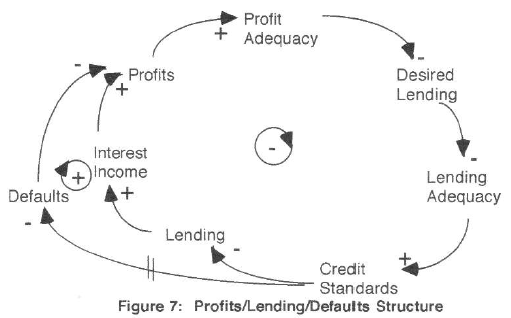
As is typical, some well-intentioned policies that could mitigate the problem behavior have unpleasant side-effects. For example, adding risk-based premiums for guarantees worsens the short-term pressure on profits when standards erode, creating a positive loop that could further drive erosion.
Individuals matter after all
From arXiv:
From bird flocks to fish schools, animal groups often seem to react to environmental perturbations as if of one mind. Most studies in collective animal behaviour have aimed to understand how a globally ordered state may emerge from simple behavioural rules. Less effort has been devoted to understanding the origin of collective response, namely the way the group as a whole reacts to its environment. Yet collective response is the adaptive key to survivor, especially when strong predatory pressure is present. Here we argue that collective response in animal groups is achieved through scale-free behavioural correlations. By reconstructing the three-dimensional position and velocity of individual birds in large flocks of starlings, we measured to what extent the velocity fluctuations of different birds are correlated to each other. We found that the range of such spatial correlation does not have a constant value, but it scales with the linear size of the flock. This result indicates that behavioural correlations are scale-free: the change in the behavioural state of one animal affects and is affected by that of all other animals in the group, no matter how large the group is. Scale-free correlations extend maximally the effective perception range of the individuals, thus compensating for the short-range nature of the direct inter-individual interaction and enhancing global response to perturbations. Our results suggest that flocks behave as critical systems, poised to respond maximally to environmental perturbations.
The Obscure Art of Datamodeling in Vensim
There are lots of good reasons for building models without data. However, if you want to measure something (i.e. estimate model parameters), produce results that are closely calibrated to history, or drive your model with historical inputs, you need data. Most statistical modeling you’ll see involves static or dynamically simple models and well-behaved datasets: nice flat files with uniform time steps, units matching (or, alarmingly, ignored), and no missing points. Things are generally much messier with a system dynamics model, which typically has broad scope and (one would hope) lots of dynamics. The diversity of data needed to accompany a model presents several challenges:
- disagreement among sources
- missing data points
- non-uniform time intervals
- variable quality of measurements
- diverse source formats (spreadsheets, text files, databases)
The mathematics for handling the technical estimation problems were developed by Fred Schweppe and others at MIT decades ago. David Peterson’s thesis lays out the details for SD-type models, and most of the functionality described is built into Vensim. It’s also possible, of course, to go a simpler route; even hand calibration is often effective and reasonably quick when coupled with Synthesim.
Either way, you have to get your data corralled first. For a simple model, I’ll build the data right into the dynamic model. But for complicated models, I usually don’t want the main model bogged down with units conversions and links to a zillion files. In that case, I first build a separate datamodel, which does all the integration and passes cleaned-up series to the main model as a fast binary file (an ordinary Vensim .vdf). In creating the data infrastructure, I try to maximize three things:
- Replicability. Minimize the number of manual steps in the process by making the data model do everything. Connect the datamodel directly to primary sources, in formats as close as possible to the original. Automate multiple steps with command scripts. Never use hand calculations scribbled on a piece of paper, unless you’re scrupulous about lab notebooks, or note the details in equations’ documentation field.
- Transparency. Often this means “don’t do complex calculations in spreadsheets.” Spreadsheets are very good at some things, like serving as a data container that gives good visibility. However, spreadsheet calculations are error-prone and hard to audit. So, I try to do everything, from units conversions to interpolation, in Vensim.
- Quality.#1 and #2 already go a long way toward ensuring quality. However, it’s possible to go further. First, actually look at the data. Take time to build a panel of on-screen graphs so that problems are instantly visible. Use a statistics or visualization package to explore it. Lately, I’ve been going a step farther, by writing Reality Checks to automatically test for discontinuities and other undesirable properties of spliced time series. This works well when the data is simply to voluminous to check manually.
This can be quite a bit of work up front, but the payoff is large: less model rework later, easy updates, and higher quality. It’s also easier generate graphics or statistics that help others to gain confidence in the model, though it’s sometimes important to help them recognize that goodness of fit is a weak test of quality.
It’s good to build the data infrastructure before you start modeling, because that way your drivers and quality control checks are in place as you build structure, so you avoid the pitfalls of an end-of-pipe inspection process. A frequent finding in our corporate work has been that cherished data is in fact rubbish, or means something quite different that what users have historically assumed. Ventana colleague Bill Arthur argues that modern IT practices are making the situation worse, not better, because firms aren’t retaining data as long (perhaps a misplaced side effect of a mania for freshness).
Continue reading “The Obscure Art of Datamodeling in Vensim”