Don't just do something, stand there! Reflections on the counterintuitive behavior of complex systems, seen through the eyes of System Dynamics, Systems Thinking and simulation.
We are pleased to announce the launch of the 2011 Climate CoLab Contest. This year, the question that the CoLab poses is:
How should the 21st century economy evolve bearing in mind the reality of climate change?
This year’s contest will feature two competition pools:
Global, whose proposals outline how a feature of the world economy should evolve,
Regional/national, whose proposals outline how a feature of a regional or national economy should evolve.
The contest will run for six months from May 16 to November 15. Winners will be selected based on voting by community members and review by the judges.
The winning teams will present their proposals at briefings at the United Nations in New York City and U.S. Congress in Washington, D.C. The Climate CoLab will sponsor one representative from each of the winning teams.
We encourage you to form teams with other CoLab members who share your regional or global interests. Fill out your profile and start debating and brainstorming. If you would like to join a team, please send me a message.
I just discovered the Harvard Natural Sciences Lecture Demonstrations – a catalog of ways to learn and play with science. It’s all fun, but a few of the videos provide nice demonstrations of dynamic phenomena.
Here’s a pretty array of pendulums of different lengths and therefore different natural frequencies:
This is a nice demonstration of how structure (length) causes behavior (period of oscillation). You can also see a variety of interesting behavior patterns, like beats, as the oscillations move in and out of phase with one another.
Synchronized metronomes:
These metronomes move in and out of sync as they’re coupled and uncoupled. This is interesting because it’s a fundamentally nonlinear process. Syncprovides a nice account of such things, and there’s a nifty interactive coupled pendulum demo here.
Mousetrap fission:
This is a physical analog of an infection model or the Bass diffusion model. It illustrates shifting loop dominance – initially, positive feedback dominates due to the chain reaction of balls tripping new traps, ejecting more balls. After a while, negative feedback takes over as the number of live traps is depleted, and the reaction slows.
There were three surprised when I recently ordered an Apple Macbook Pro. The first was how good the industrial design is compared to any PC laptop I’ve had. The second was getting a FedEx tracking number – straight from Shanghai. The third was how big the carbon footprint of this svelte machine is.
Here it is, perched on a massive granite stair that took prybars, Egyptian pyramid-building techniques, and considerable sweat to place (not to mention the negative contribution to my kids’ vocabulary). The two bigger blocks: about 370kg (over 800 pounds). The Mac’s lifecycle carbon footprint: 350kg (2/3 manufacturing & transport, 1/3 use).
Grist covers a detailed report on the rebound effect, which recently appeared at ElectricityPolicy.com (pdf from NRDC). The report discusses a wide range of rebound arguments, basically concluding that rebounds are not a big deal.
Some of the reasons derive from the microeconomic effects of efficiency improvements. For example, improving the efficiency of light bulbs makes light services cheaper. But user’s don’t immediately increase lighting in proportion to the cost reduction, because their demand for lighting is saturated: there are only so many fixtures in a house, hours in the day requiring light, etc. Similarly, the elasticity of dirty dish production with respect to the energy cost of running a dishwasher is pretty darn low. This is reminiscent of the dynamics of process improvement at Analog Devices, where TQM improved productivity, but the company had a hard time translating that to expansion of its market niche in the short term.
I think the report underweights the long term effects of efficiency though. Efficiency increases contribute to aggregate productivity growth in the economy (more than you’d expect, if you believe that agency problems and other market failures create a bias toward overuse of energy). With wealth comes an expansion of energy use, hence the boom in such energy hogs as undercounter freezers and wine chillers, countering Energy Star improvement in refrigeration. However, this is not really an efficiency problem; it’s a progress problem, and it brings welfare benefits along with the added energy (at least until you get to the absurd margin).
The report cites an Energy Policy survey of empirical estimates:
Improvements in energy efficiency make energy services cheaper, and therefore encourage increased consumption of those services. This so-called direct rebound effect offsets the energy savings that may otherwise be achieved. This paper provides an overview of the theoretical and methodological issues relevant to estimating the direct rebound effect and summarises the empirical estimates that are currently available. The paper focuses entirely on household energy services, since this is where most of the evidence lies and points to a number of potential sources of bias that may lead the effect to be overestimated. For household energy services in the OECD, the paper concludes that the direct rebound effect should generally be less than 30%. doi:10.1016/j.enpol.2008.11.026
Sadly, a press release for related studies from the same research group spins this as a catastrophe:
‘Rebound Effects’ Threaten Success of UK Climate Policy
This is really only a catastrophe for a politician foolish enough to try to set and hit a hard emissions target, with efficiency mandates as the only measure for achieving it. As soon as you have any course correction (i.e. negative feedback) built into your policies, like an adaptive carbon tax or cap & trade system (the latter being the less stable option), the catastrophe goes away. The real catastrophe is failing to price GHG emissions and other externalities due to misperceptions about efficiency.
The real bottom line for rebound effects should be, “who cares?” If rebound effects are large, efficiency programs have small energy effects, but potentially large welfare improvements (if you accept that there are energy market failures tending towards overconsumption), and emissions pricing has large energy effects, because high rebound implies high price elasticity. If rebound effects are small, efficiency programs work and emissions pricing is a good way to collect taxes. Neither condition is a reason to avoid efficiency or emissions pricing, though emissions pricing is the preferable way to proceed.
Eli Pariser argues that “filter bubbles” are bad for us and bad for democracy:
As web companies strive to tailor their services (including news and search results) to our personal tastes, there’s a dangerous unintended consequence: We get trapped in a “filter bubble” and don’t get exposed to information that could challenge or broaden our worldview.
Filter bubbles are close cousins of confirmation bias, groupthink, polarization and other cognitive and social pathologies.
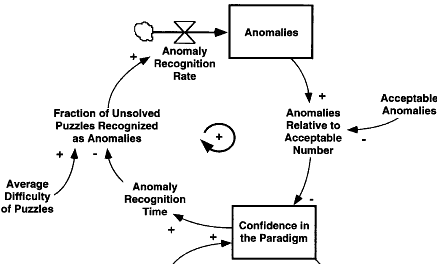
As confidence in an idea grows, the delay in recognition (or frequency of outright rejection) of anomalous information grows larger. As a result, confidence in the idea – flat earth, 100mpg carburetor – can grow far beyond the level that would be considered reasonable, if contradictory information were recognized.
The dynamics resulting from this and other positive feedbacks play out in many spheres. Wittenberg & Sterman give an example:
The dynamics generated by the model resemble the life cycle of intellectual fads. Often a promising new idea rapidly becomes fashionable through excessive optimism, aggressive marketing, media hype, and popularization by gurus. Many times the rapid influx of poorly trained practitioners, or the lack of established protocols and methods, causes expectations to outrun achievements, leading to a backlash and disaffection. Such fads are commonplace, especially in (quack) medicine and most particularly in the world of business, where “new paradigms” are routinely touted in the pages of popular journals of management, only to be displaced in the next issue by what many business people have cynically come to call the next “flavor of the month.”
Typically, a guru proposes a new theory, tool, or process promising to address persistent problems facing businesses (that is, a new paradigm claiming to solve the anomalies that have undermined the old paradigm.) The early adopters of the guru’s method spread the word and initiate some projects. Even in cases where the ideas of the guru have little merit, the energy and enthusiasm a team can bring to bear on a problem, coupled with Hawthorne and placebo effects and the existence of “low hanging fruit” will often lead to some successes, both real and apparent. Proponents rapidly attribute these successes to the use of the guru’s ideas. Positive word of mouth then leads to additional adoption of the guru’s ideas. (Of course, failures are covered up and explained away; as in science there is the occasional fraud as well.) Media attention further spreads the word about the apparent successes, further boosting the credibility and prestige of the guru and stimulating additional adoption.
As people become increasingly convinced that the guru’s ideas work, they are less and less likely to seek or attend to disconfirming evidence. Management gurus and their followers, like many scientists, develop strong personal, professional, and financial stakes in the success of their theories, and are tempted to selectively present favorable and suppress unfavorable data, just as scientists grow increasingly unable to recognize anomalies as their familiarity with and confidence in their paradigm grows. Positive feedback processes dominate the dynamics, leading to rapid adoption of those new ideas lucky enough to gain a sufficient initial following. …
The wide range of positive feedbacks identified above can lead to the swift and broad diffusion of an idea with little intrinsic merit because the negative feedbacks that might reveal that the tools don’t work operate with very long delays compared to the positive loops generating the growth. …
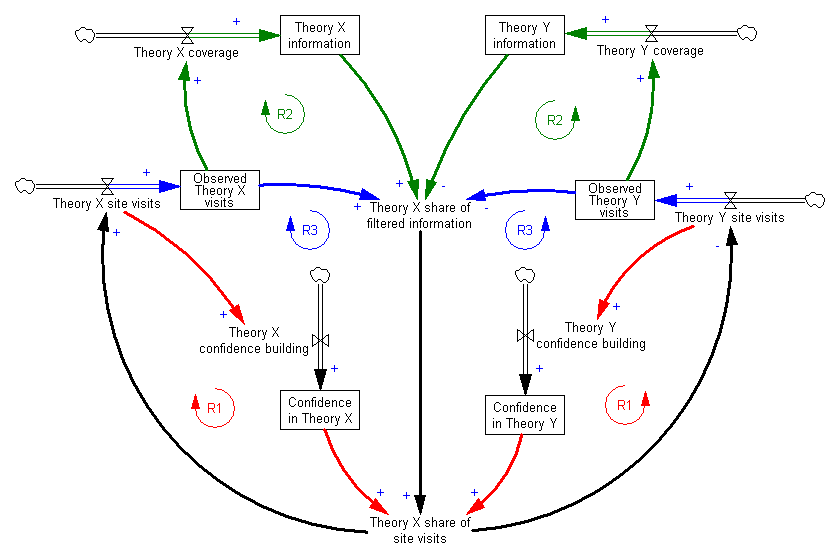
For filter bubbles, I think the key positive loops are as follows:
Loops R1 are the user’s well-worn path. We preferentially visit sites presenting information (theory x or y) in which we have confidence. In doing so, we consider only a subset of all information, building our confidence in the visited theory. This is a built-in part of our psychology, and to some extent a necessary part of the process of winnowing the world’s information fire hose down to a usable stream.
Loops R2involve the information providers. When we visit a site, advertisers and other observers (Nielsen) notice, and this provides the resources (ad revenue) and motivation to create more content supporting theory x or y. This has also been a part of the information marketplace for a long time.
R1 and R2 are stabilized by some balancing loops (not shown). Users get bored with an all-theory-y diet, and seek variety. Providers seek out controversy (real or imagined) and sensationalize x-vs-y battles. As Pariser points out, there’s less scope for the positive loops to play out in an environment with a few broad media outlets, like city newspapers. The front page of the Bozeman Daily Chronicle has to work for a wide variety of readers. If the paper let the positive loops run rampant, it would quickly lose half its readership. In the online world, with information customized at the individual level, there’s no such constraint.
Individual filtering introduces R3. As the filter observes site visit patterns, and preferentially serves up information consistent with past preferences. This introduces a third set of reinforcing feedback processes, as users begin to see what they prefer, they also learn to prefer what they see. In addition, on Facebook and other social networking sites every person is essentially a site, and people include one another in networks preferentially. This is another mechanism implementing loop R1 – birds of a feather flock together and share information consistent with their mutual preferences, and potentially following one another down conceptual rabbit holes.
The result of the social web and algorithmic filtering is to upset the existing balance of positive and negative feedback. The question is, were things better before, or are they better now?
I’m not exactly sure how to tell. Presumably one could observe trends in political polarization and duration of fads for an indication of the direction of change, but that still leaves open the question of whether we have more or less than the “optimal” quantity of pet rocks, anti-vaccine campaigns and climate skepticism.
My suspicion is that we now have too much positive feedback. This is consistent with Wittenberg & Sterman’s insight from the modeling exercise, that the positive loops are fast, while the negative loops are weak or delayed. They offer a prescription for that,
The results of our model suggest that the long-term success of new theories can be enhanced by slowing the positive feedback processes, such as word of mouth, marketing, media hype, and extravagant claims of efficacy by which new theories can grow, and strengthening the processes of theory articulation and testing, which can enhance learning and puzzle-solving capability.
In the video, Pariser implores the content aggregators to carefully ponder the consequences of filtering. I think that also implies more negative feedback in algorithms. It’s not clear that providers have an incentive to do that though. The positive loops tend to reward individuals for successful filtering, while the risks (e.g., catastrophic groupthink) accrue partly to society. At the same time, it’s hard to imagine a regulatory that does not flirt with censorship.
Absent a global fix, I think it’s incumbent on individuals to practice good mental hygiene, by seeking diverse information that stands some chance of refuting their preconceptions once in a while. If enough individuals demand transparency in filtering, as Pariser suggests, it may even be possible to gain some local control over the positive loops we participate in.
I’m not sure that goes far enough though. We need tools that serve the social equivalent of “strengthening the processes of theory articulation and testing” to improve our ability to think and talk about complex systems. One such attempt is the “collective intelligence” behind Climate Colab. It’s not quite Facebook-scale yet, but it’s a start. Semantic web initiatives are starting to help by organizing detailed data, but we’re a long way from having a “behavioral dynamic web” that translates structure into predictions of behavior in a shareable way.
This is a very interesting model, both because it tackles ‘soft’ dynamics of paradigm formation in ‘hard’ science, and because it is an aggregate approach to an agent problem. Unfortunately, until now, the model was only available in DYNAMO, which limited access severely. It turns out to be fairly easy to translate to Vensim using the dyn2ven utility, once you know how to map the DYNAMO array FOR loops to Vensim subscripts.
Path Dependence, Competition, and Succession in the Dynamics of Scientific Revolution
J. Wittenberg and J. D. Sterman, 1999
Abstract
What is the relative importance of structural versus contextual forces in the birth and death of scientific theories? We describe a dynamic model of the birth, evolution, and death of scientific paradigms based on Kuhn’s Structure of Scientific Revolutions. The model creates a simulated ecology of interacting paradigms in which the creation of new theories is stochastic and endogenous. The model captures the sociological dynamics of paradigms as they compete against one another for members. Puzzle solving and anomaly recognition are also endogenous. We specify various regression models to examine the role of intrinsic versus contextual factors in determining paradigm success. We find that situational factors attending the birth of a paradigm largely determine its probability of rising to dominance, while the intrinsic explanatory power of a paradigm is only weakly related to the likelihood of success. For those paradigms that do survive the emergence phase, greater explanatory power is significantly related to longevity. However, the relationship between a paradigm’s ‘strength’ and the duration of normal science is also contingent on the competitive environment during the emergence phase. Analysis of the model shows the dynamics of competition and succession among paradigms to be conditioned by many positive feedback loops. These self-reinforcing processes amplify intrinsically unobservable micro-level perturbations in the environment – the local conditions of science, society, and self faced by the creators of a new theory – until they reach macroscopic significance. Such dynamics are the hallmark of self-organizing evolutionary systems.
We consider the implications of these results for the rise and fall of new ideas in contexts outside the natural sciences such as management fads.
Cite as: J. Wittenberg and J. D. Sterman (1999) Path Dependence, Competition, and Succession in the Dynamics of Scientific Revolution. Organization Science, 10.
I believe that this version is faithful to the original, but it’s difficult to be sure because the model is stochastic, so the results differ due to differences in the random number streams. For the moment, this model should be regarded as a beta release.
It might be subtitled, “Better Lies,” a reference to modeling as the pursuit of better stories about the world, which remain never quite true (a variation on the famous Box quote, “All models are wrong but some are useful.”). A few nice points that I picked out along the way,
All thinking, even about the future, is retrospective.
Big Data is Big Dumb, because we’re collecting more and more detail about a limited subset of reality, and thus suffer from sampling and “if your only tool is a hammer …” bias.
A crucial component of a modeling approach is a “bullshit detector” – reality checks that identify problems at various levels on the ladder of inference.
Model design is more than software engineering.
Often the modeling process is a source of key insights, and you don’t even need to run the model.
Modeling is a social process.
Coming back to the comment,
I think one of the greatest values of a model is that it can bring you to the point where you say “There isn’t any way to build a model within this methodology that is not self-contradicting. Therefore everyone in this room is contradicting themselves before they even open their mouths.”
I think that’s close to what Dana Meadows was talking about when she placed paradigms and transcendence of paradigms on the list of places to intervene in systems.
It reminds me of Gödel’s incompleteness theorems. With that as a model, I’d argue that one can construct fairly trivial models that aren’t self-contradictory. They might contradict a lot of things we think we know about the world, but by virtue of their limited expressiveness remain at least true to themselves.
Going back to the elasticity example, if I assert that oilConsumption = oilPrice^epsilon, there’s no internal contradiction as long as I use the same value of epsilon for each proposition I consider. I’m not even sure what an internal contradiction would look like in such a simple framework. However, I could come up with a long list of external consistency problems with the model: dimensional inconsistency, lack of dynamics, omission of unobserved structure, failure to conform to data ….
In the same way, I would tend to argue that general equilibrium is an internally consistent modeling paradigm that just happens to have relatively little to do with reality, yet is sometimes useful. I suppose that Frank Ackerman might disagree with me, on the grounds that equilibria are not necessarily unique or stable, which could raise an internal contradiction by violating the premise of the modeling exercise (welfare maximization).
Once you step beyond models with algorithmically simple decision making (like CGE), the plot thickens. There’s Condorcet’s paradox and Arrow’s impossibility theorem, the indeterminacy of Arthur’s El Farol bar problem, and paradoxes of zero discount rates on welfare.
Maybe the challenge is that the universe is self-referential and full of paradoxes and irreconcilable paradigms. Therefore as soon as we attempt to formalize our understanding of such a mess, either with nontrivial models, or trivial models assisting complex arguments, we are dragged into the quagmire of self-contradiction.
Personally, I’m not looking for the cellular automaton that runs the universe. I’m just hoping for a little feedback control on things that might make life on earth a little better. Maybe that’s a paradoxical quest in itself.
If a global oil shock reduces supply 10%, the price of crude will rise to $20,000/barrel, with fuel expenditures consuming more than the entire GDP of importing nations.
At least that’s what you’d predict if you think the price elasticity of oil demand is about -0.02. I saw that number in a Breakthrough post, citing Kevin Drum, citing Early Warning, citing IMF. It’s puzzling that Breakthrough is plugging small price elasticities here, when their other arguments about the rebound effect require elasticities to have large magnitudes. Continue reading “Elasticity contradictions”
A future where everything goes right for nuclear power, with advancing technology driving down costs, making reactors a safe and ubiquitous energy source, and providing a magic bullet for climate change, might bring other surprises.
For example, technology might also make supersonic cruise missiles cheap and ubiquitous.
The Fukushima operators appear to be hanging in there. But imagine how they’d be coping if someone fired a missile at them once in a while.
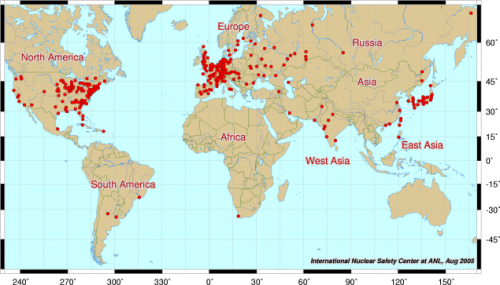
Fortunately, reactors today are mostly in places where peace and rule of law prevail.
But peace and good governance aren’t exactly the norm in places where emissions are rising rapidly, or the poor need energy.
Building lots of nuclear power plants is ultimately a commitment to peace, or at least acceptance of rather dreadful consequences of war (not necessarily war with nuclear weapons, but war with conventional weapons turning nuclear reactors into big dirty bombs).
One would hope that abundant, clean energy would reduce the motivation to blow things up, but how much are we willing to gamble on that?
Last week, on April 13, 2011, President Obama gave all Democrats and all progressives a remarkable gift. Most of them barely noticed. They looked at the President’s speech as if it were only about budgetary details. But the speech went well beyond the budget. It went to the heart of progressive thought and the nature of American democracy, and it gave all progressives a model of how to think and talk about every issue.
I’m definitely in the “barely noticed” category. The interesting thing, George argues, is that the speech is really about systems. Part concerns a system of values:
The policy topic happened to be the budget, but he called it “The Country We Believe In” for a reason. The real topic was how the progressive moral system defines the democratic ideals America was founded on, and how those ideals apply to specific issues.
More interesting to me, another key theme is systems in the “systems thinking” sense:
Systems Thinking
President Obama, in the same speech, laid the groundwork for another crucial national discussion: systems thinking, which has shown up in public discourse mainly in the form of “systemic risk” of the sort that led to the global economic meltdown. The president brought up systems thinking implicitly, at the center of his budget proposal. He observed repeatedly that budget deficits and “spending” do not occur in isolation. The choice of what to cut and what to keep is a matter of factors external to the budget per se. Long-term prosperity, economic recovery, and job creation, he argued, depend up maintaining “investments” — investments in infrastructure (roads, bridges, long-distance rail), education, scientific research, renewable energy, and so on. The maintenance of American values, he argued, is outside of the budget in itself, but is at the heart of the argument about what to cut. The fact is that the rich have gotten rich because of the government — direct corporate subsidies, access to publicly-owned resources, access to government research, favorable trade agreements, roads and other means of transportation, education that provides educated workers, tax loopholes, and innumerable government resources are taken advantage of by the rich, but paid for by all of us. What is called a ”tax break” for the rich is actually a redistribution of wealth from the poor and middle class—whose incomes have gone down—to those who have considerably more money than they need, money they have made because of tax investments by the rest of America.
The President provided a beautiful example of systems thinking. Under the Republican budget plan, the President would get a $200,000 a year tax break, which would be paid for by cutting programs for seniors, with the result that 33 seniors would be paying $6,000 more a year for health care to pay for his tax break. To see this, you have to look outside of the federal budget to the economic system at large, in which you can see what budget cuts will be balanced by increased in costs to others. A cut here in the budget is balanced by an increase outside the federal budget for real human beings.
…
When a system has causal effects, as in the above cases, we speak of “systemic causation.” “Systemic risks” are the risks created when there is systemic causation. Systemic causation contrasts with direct causation, as when, say, someone lifts something, or throws something, or shoots someone.
Linguists have discovered that every language studied has direct causation in its grammar, but no language has systemic causation in its grammar. Systemic causation is a harder concept and has to be learned either through socialization or education.
This got me interested in the original speech (transcript, video).
From our first days as a nation, we have put our faith in free markets and free enterprise as the engine of America’s wealth and prosperity. More than citizens of any other country, we are rugged individualists, a self-reliant people with a healthy skepticism of too much government.
But there has always been another thread running throughout our history – a belief that we are all connected; and that there are some things we can only do together, as a nation. We believe, in the words of our first Republican president, Abraham Lincoln, that through government, we should do together what we cannot do as well for ourselves.
There’s some feedback:
Ultimately, all this rising debt will cost us jobs and damage our economy. It will prevent us from making the investments we need to win the future. We won’t be able to afford good schools, new research, or the repair of roads and bridges – all the things that will create new jobs and businesses here in America. Businesses will be less likely to invest and open up shop in a country that seems unwilling or unable to balance its books. And if our creditors start worrying that we may be unable to pay back our debts, it could drive up interest rates for everyone who borrows money – making it harder for businesses to expand and hire, or families to take out a mortgage.
And recognition of systemic pressures for deficits:
But that starts by being honest about what’s causing our deficit. You see, most Americans tend to dislike government spending in the abstract, but they like the stuff it buys. Most of us, regardless of party affiliation, believe that we should have a strong military and a strong defense. Most Americans believe we should invest in education and medical research. Most Americans think we should protect commitments like Social Security and Medicare. And without even looking at a poll, my finely honed political skills tell me that almost no one believes they should be paying higher taxes.
Because all this spending is popular with both Republicans and Democrats alike, and because nobody wants to pay higher taxes, politicians are often eager to feed the impression that solving the problem is just a matter of eliminating waste and abuse –that tackling the deficit issue won’t require tough choices. Or they suggest that we can somehow close our entire deficit by eliminating things like foreign aid, even though foreign aid makes up about 1% of our entire budget.
There’s a bit of dynamics implicit in the discussion (e.g., the role of debt accumulation), but I think one thing is missing: straightforward grappling with worse-before-better behavior. The president proposes to go after waste (a favorite of all politicians) and tax breaks for the rich (far more sensible than the Ryan proposal), but doesn’t quite come to grips with the underlying question of how we can continue to feel prosperous and secure, when fundamentally we can’t (or at least shouldn’t) return to a previous pattern of unsustainable consumption in excess of our income funded by budget, trade and environmental deficits. What we really need, per yesterday’s post, is a reframing of what is now perceived as austerity as an opportunity to live with better health, relationships and security.
I part ways with Lakoff a bit on one topic:
Progressives tend to think more readily in terms of systems than conservatives. We see this in the answers to a question like, “What causes crime?” Progressives tend to give answers like economic hardship, or lack of education, or crime-ridden neighborhoods. Conservatives tend more to give an answer like “bad people — lock ‘em up, punish ‘em.” This is a consequence of a lifetime of thinking in terms of social connection (for progressives) and individual responsibility (for conservatives). Thus conservatives did not see the President’s plan, which relied on systemic causation, as a plan at all for directly addressing the deficit.
Differences in systemic thinking between progressives and conservatives can be seen in issues like global warming and financial reform. Conservatives have not recognized human causes of global warming, partly because they are systemic, not direct. When a huge snowstorm occurred in Washington DC recently, many conservatives saw it as disproving the existence of global warming — “How could warming cause snow?” Similarly, conservatives, thinking in terms of individual responsibility and direct causation, blamed homeowners for foreclosures on their homes, while progressives looked to systemic explanations, seeking reform in the financial system.
Certainly it is true that self-interested denial of feedback (or externalities, as an economist might describe some feedbacks) has found its home in the conservative and libertarian movements. But that doesn’t mean all conservative thought is devoid of systems thinking, and one can easily look back at history and find progressive or liberal policies that have also ignored systemic effects. Indeed, the conservative critique of progressive policies addressing crime and poverty issues has often been evolutionary arguments about the effects of incentives – a very systemic view. The problem is, words don’t provide enough formalism or connection to data to determine whose favorite feedback loops might dominate, so philosophical arguments about the merits of turn-the-other-cheek or an-eye-for-an-eye can go on forever. Models can assist with resolving these philosophical debates. However, at present public discourse is almost devoid of thinking, and often anti-intellectual, which makes it tough to contemplate sophisticated solutions to our problems.