The Ryan health care proposal

The Ryan budget proposal achieves the bulk of its savings by cutting health care outlays, particularly Medicare and Medicaid. The mechanism sounds a lot like a firm’s transition from a defined benefits pension plan to a defined contribution scheme. Medicaid becomes a system of block grants to states, and Medicare becomes a system of flat-rate vouchers. Along the way, it has some useful aspirations: to separate health insurance from employment and eliminate health’s favored tax status.

Reading some of the finer print, though, I don’t think it really fixes the fundamental flaws of the current system. It’s billed as “universal access” but that’s a misnomer. It guarantees universal access to a tax credit or voucher that can be used to purchase coverage, but not universal access to coverage. That’s because it doesn’t solve the adverse selection problem. As a result, any provider that doesn’t play the usual game of excluding anyone who’s really sick from coverage (using preexisting conditions and rotating plan changes) will suffer a variant of the utility death spiral: increasing costs drive the healthy out of the plan, leaving it to serve a diminishing set of members who had the misfortune to get sick, at an escalating cost.

Universal access to coverage is left to the states, who can create assigned risk pools or other methods to cover the uncoverable. Leaving things to the states strikes me as a reasonable strategy, because the health system is so complex that evolutionary learning is likely to beat the kind of deliberate design we’ll get out of congress. But it’s not clear to me that the proposal creates any real authority to raise money to support these assigned risk pools; without money, the state mechanisms will be rather perfunctory.

The real challenge seems to me to be to address three features of health:

  • Prevention beats cure by a long shot, in terms of both cost and quality of life. In the current system, patient churn through providers eliminates most of the provider-side incentive to address this. Patients have contributed by abdicating responsibility for their own health, and insurance exacerbates the problem by obscuring the costs of the quadruple bypass that follows from a life of Big Macs.
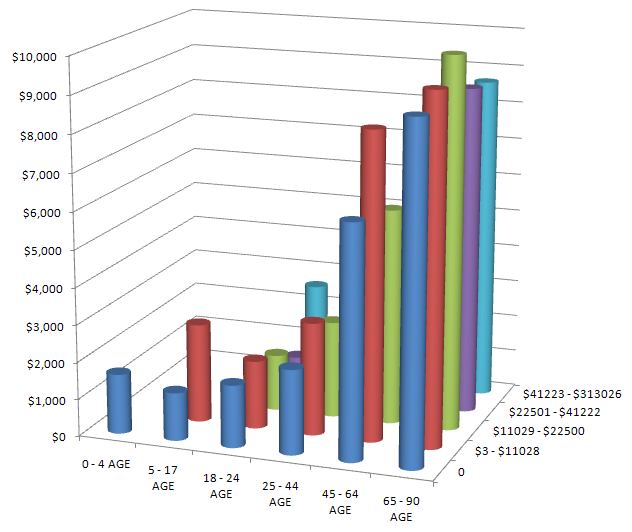
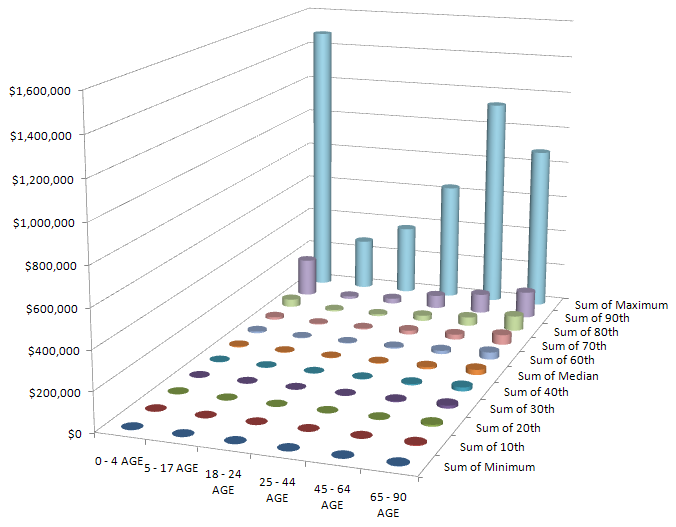
  • Health care expenditures are extremely skewed over one’s lifetime and within age cohorts. Good behavior can’t mitigate all risk, particularly the risk of getting old. (See below for a peek at the data.)
  • In some circumstances, the health care system is capable of expending an extremely large amount of resources on a person – sometimes for a miraculous outcome, and sometimes for rather marginal end-of-life extension.

What’s needed is a distributed way to share risk (which is why it’s called insurance), while preserving incentives for good behavior and matching total expenditures to resources. That’s a tall order. It’s not clear to me that the Ryan proposal tackles it in any serious way; it just extends the flaws of the current system to Medicare patients.

healthExpendAgeIncomeMEPSPer capita annual medical expenditures from the MEPS panel, by age and income. There’s surprisingly little variation by income, but a lot by age. The bill terminates the agency that collects this data.

healthExpendAgeDecileMEPSHealth expenditures by age and decile of cohort, showing the extreme concentration of expenditures at all ages.

The really fine print, the text of the bill itself, is daunting – 629 pages. This strikes me as simply unmanageable (like the deceased cap and trade legislation). There are simply too many opportunities for unintended consequences, and hidden agendas, in such a multifaceted approach, especially with the opaque analytic support available. Surely this could be tackled in a series of smaller bites – health, revenue, other expenditures. It calls to mind the criticism of the FAA’s repeated failure to redesign the air traffic control system, “you can’t design a system that evolved.” Well, maybe you can, but not with the kind of tools and discourse that now prevail.

A walk through the Ryan budget proposal

Since the budget deal was announced, I’ve been wondering what was in it. It’s hard to imagine that it really works like this:

“This is an agreement to invest in our country’s future while making the largest annual spending cut in our history,” Obama said.

However, it seems that there isn’t really much substance to the deal yet, so I thought I’d better look instead at one target: the Ryan budget roadmap. The CBO recently analyzed it, and put the $ conveniently in a spreadsheet.

Like most spreadsheets, this is very good at presenting the numbers, and lousy at revealing causality. The projections are basically open-loop, but they run to 2084. There’s actually some justification for open-loop budget projections, because many policies are open loop. The big health and social security programs, for example, are driven by demographics, cutoff ages and inflation adjustment formulae. The demographics and cutoff ages are predictable. It’s harder to fathom the possible divergence between inflation adjustments and broad inflation (which affects the health sector share) and future GDP growth. So, over long horizons, it’s a bit bonkers to look at the system without considering feedback, or at least uncertainty in the future trajectory of some key drivers.

There’s also a confounding annoyance in the presentation, with budgets and debt as percentages of GDP. Here’s revenue and “other” expenditures (everything but social security, health and interest):
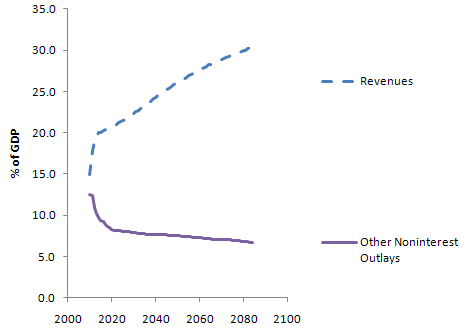
RevenueOtherTransientThere’s a huge transient in each, due to the current financial mess. (Actually this behavior is to some extent deliberately Keynesian – the loss of revenue in a recession is amplified over the contraction of GDP, because people fall into lower tax brackets and profits are more volatile than gross activity. Increased borrowing automatically takes up the slack, maintaining more stable spending.) The transient makes it tough to sort out what’s real change, and what is merely the shifting sands of the GDP denominator. This graph also points out another irritation: there’s no history. Is this plausible, or unprecedented behavior?

The Ryan team actually points out some of the same problems with budgets and their analyses:

One reason the Federal Government’s major entitlement programs are difficult to control is that they are designed that way. A second is that current congressional budgeting provides no means of identifying the long-term effects of near-term program expansions. A third is that these programs are not subject to regular review, as annually appropriated discretionary programs are; and as a result, Congress rarely evaluates the costs and effectiveness of entitlements except when it is proposing to enlarge them. Nothing can substitute for sound and prudent policy choices. But an improved budget process, with enforceable limits on total spending, would surely be a step forward. This proposal calls for such a reform.

Unfortunately the proposed reforms don’t seem to change anything about the process for analyzing the budget or designing programs. We need transparent models with at least a little bit of feedback in them, and programs that are robust because they’re designed with that little bit of feedback in mind.

Setting aside these gripes, here’s what I can glean from the spreadsheet.

The Ryan proposal basically flatlines revenue at 19% of GDP, then squashes programs to fit. By contrast, the CBO Extended Baseline scenario expands programs per current rules and then raises revenue to match (very roughly – the Ryan proposal actually winds up with slightly more public debt 20 years from now).
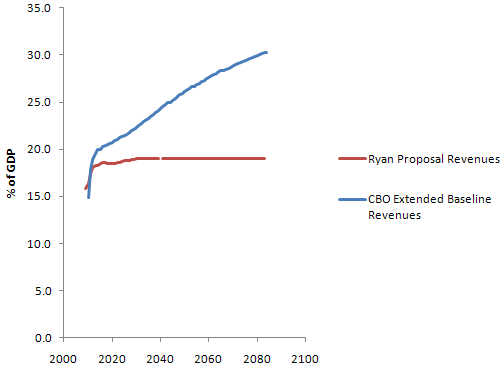
RevenueIt’s not clear how the 19% revenue level arises; the CBO used a trajectory from Ryan’s staff, not its own analysis. Ryan’s proposal says:

  • Provides individual income tax payers a choice of how to pay their taxes – through existing law, or through a highly simplified code that fits on a postcard with just two rates and virtually no special tax deductions, credits, or exclusions (except the health care tax credit).
  • Simplifies tax rates to 10 percent on income up to $100,000 for joint filers, and $50,000 for single filers; and 25 percent on taxable income above these amounts. Also includes a generous standard deduction and personal exemption (totaling $39,000 for a family of four).
  • Eliminates the alternative minimum tax [AMT].
  • Promotes saving by eliminating taxes on interest, capital gains, and dividends; also eliminates the death tax.
  • Replaces the corporate income tax – currently the second highest in the industrialized world – with a border-adjustable business consumption tax of 8.5 percent. This new rate is roughly half that of the rest of the industrialized world.

It’s not clear that there’s any analysis to back up the effects of this proposal. Certainly it’s an extremely regressive shift. Real estate fans will flip when they find out that the mortgage interest deduction is gone (actually a good idea, I think).

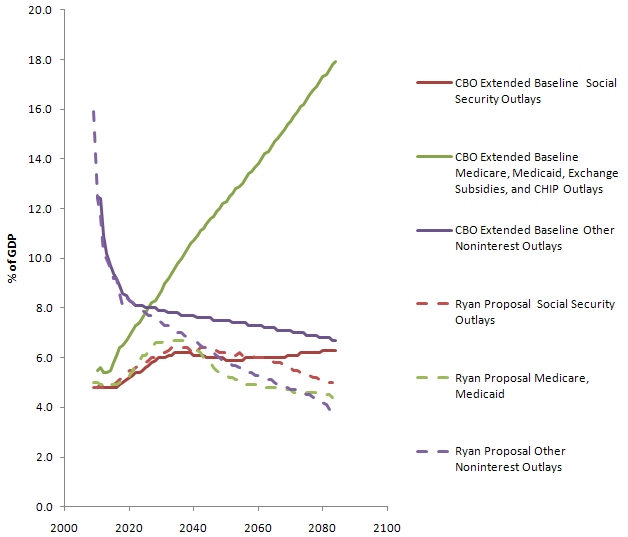
On the outlay side, here’s the picture (CBO in solid lines; Ryan proposal with dashes):
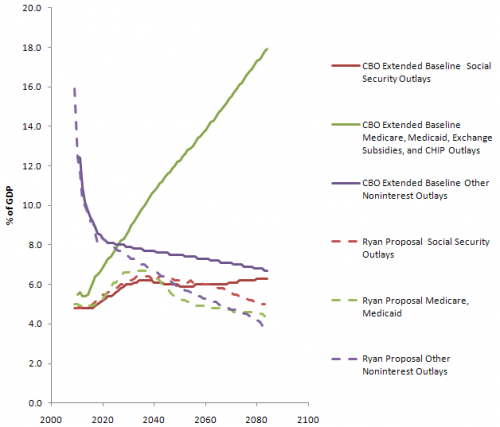
OutlaysYou can see several things here:

  • Social security is untouched until some time after 2050. CBO says that the proposal doesn’t change the program; Ryan’s web site partially privatizes it after about a decade and “eventually” raises the retirement age. There seems to be some disconnect here.
  • Health care outlays are drastically lower; this is clearly where the bulk of the savings originate. Even so, there’s not much change in the trend until at least 2025 (the initial absolute difference is definitional – inclusion of programs other than Medicare/Medicaid in the CBO version).
  • Other noninterest outlays also fall substantially – presumably this means that all other expenditures would have to fit into a box not much bigger than today’s defense budget, which seems like a heroic assumption even if you get rid of unemployment, SSI, food stamps, Section 8, and all similar support programs.

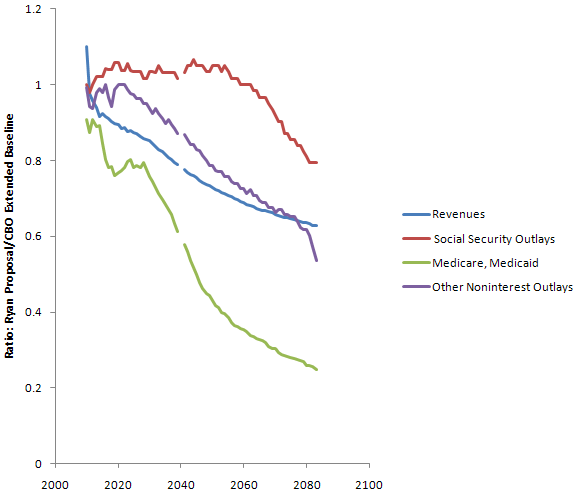
You can also look at the ratio of outlays under Ryan vs. CBO’s Extended Baseline:
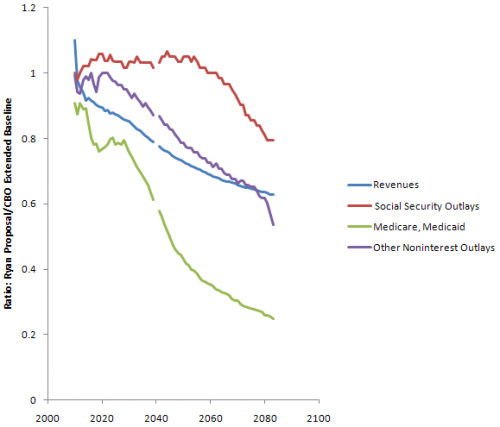
OutlayRatios

Since health care carries the flag for savings, the question is, will the proposal work? I’ll take a look at that next.
Polya urn with increasing returns

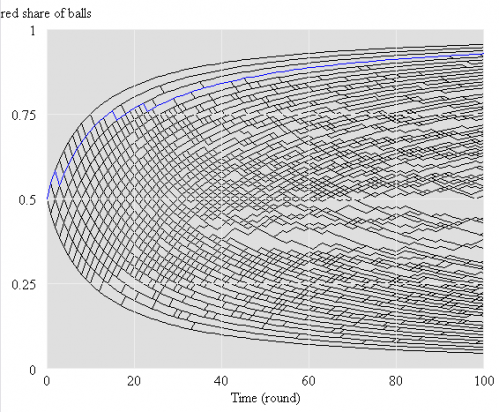
This set of models performs a variant of a Polya urn experiment, along the lines of that described in Bryan Arthur’s Increasing Returns and Path Dependence in the Economy, Chapter 10. There’s a small difference, which is that samples are drawn with replacement (Bernoulli distribution) rather than without (hypergeometric distribution).

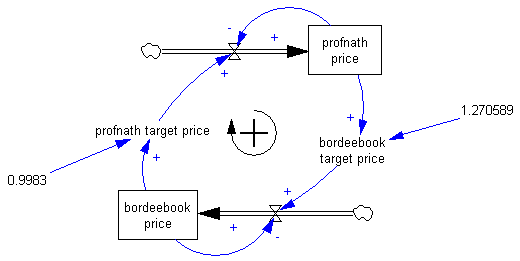
The interesting dynamics arise from competing positive feedback loops through the stocks of red and white balls. There’s useful related reading at http://tuvalu.santafe.edu/~wbarthur/Papers/Papers.html

I did the physical version of this experiment with Legos with my kids:

I tried the Polya urns experiment over lunch. We put 5 red and 5 white legos in a bowl, then took turns drawing a sample of 5. We returned the sample to the bowl, plus one lego of whichever color dominated the sample. Iterate. At the start, and after 2 or 3 rounds, I solicited guesses about what would happen. Gratifyingly, the consensus was that the bowl would remain roughly evenly divided between red and white. After a few more rounds, the reality began to diverge, and we stopped when white had a solid 2:1 advantage. I wondered aloud whether using a larger or smaller sample would lead to faster convergence. With no consensus about the answer, we tried it – drawing samples of just 1 lego. I think the experimental outcome was somewhat inconclusive – we quickly reached dominance of red, but the sampling process was much faster, so it may have actually taken more rounds to achieve that. There’s a lot of variation possible in the outcome, which means that superstitious learning is a possible trap.

This model automates the experiment, which makes it easier and more reliable to explore questions like the sensitivity of the rate of divergence to the sample size.

PolyaUrn.vpm

This version works with Vensim PLE (though it’s not supposed to, because it uses the RANDOM BERNOULLI function). It performs a single experiment per run, but includes sensitivity control files for performing hundreds of runs at a time (requires PLE Plus). That makes for a nice map of outcomes:

Continue reading “Polya urn with increasing returns”

We the Landowners

Montana Senate Bill 379 gives a few landowners veto power over zoning. I used GIS data to do a quick calculation of how that would play out in some Gallatin County zoning districts:

Zoning District Distinct owners Owners of 40% of Land Share of owners required to protest zoning acts
Bear Canyon District 84 5 6.0%
Bridger Canyon 885 10 1.1%
Middle Cottonwood 242 81 33.5%
River Rock 938 41 4.4%
Springhill 200 27 13.5%
Sypes Canyon #1 24 7 29.2%
Trail Creek District 339 10 2.9%

In remaining Gallatin County, 263 out of 42,576 distinct owners (less than 1%) could block zoning, but my calculations are incorrect because of missing data and the presence of Bozeman in the middle, but the truth is probably not too different from the calculations above.

In fact, the table above understates how dramatically this legislation moves toward a principle of “one acre, one vote.” First, represented “owners” in each district aren’t necessarily people; corporations and trusts get a vote in zoning protests too. Second, non-landowners are completely disenfranchised, even though as residents and citizens they still have an interest in land use policy.

Since MT legislators have already tried to override federal powers in a number of bills this session, perhaps next session they can introduce a MT-specific preamble to the US Constitution,

We the People Landowners of the United States, in Order to form a more perfect Union Subdivision, establish Justice, insure domestic Tranquility Profitability, provide for the common aristocracy’s defence, promote the general Welfare Subservience, and secure the Blessings of Liberty Property to ourselves and our Posterity, do ordain and establish this Constitution for the United States of America, LLC.

I hope that there is in fact some valid underlying intent to SB379. My guess is that it’s fear of a fairness issue: that the rabble will acquire their small lots, then seek to use zoning to lock up all land remaining in large undeveloped parcels, to preserve views and resources. So far, this is a strictly theoretical problem. County commissions, and a lot of MT voters, are a conservative lot, which militates against such developments, and agriculture and forestry are protected from zoning anyway. If there’s any real need for policy here, surely there is a means to achieve it that doesn’t do such violence to democracy.

If the real goal is to create a de facto zoning ban, by making it impossible to create districts or amend regulations, then the legislature should simply de-authorize zoning. But, following the wingwalker’s rule (don’t let go of one thing until you’ve got hold of another), they should first come up with an incentive  system that achieves the purposes of zoning more flexibly.

Crazy orbital dynamics

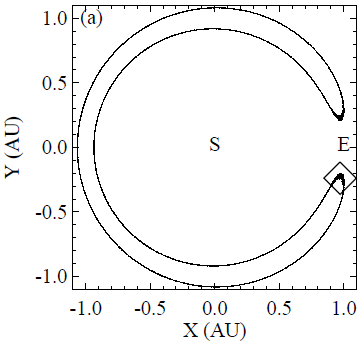
An asteroid has been discovered sharing earth’s orbit, with a horseshoe-shaped orbit (from an earthbound reference frame).

asteroid

The arXiv blog has a nice summary:

Near-Earth asteroids are common but SO16 is in a category of its own. First and foremost, it has an exotic horseshoe-shaped orbit (see diagram above) which astronomers believe to be very rare.

Its worth taking a few moments to think about horseshoe orbits. Two points are worth bearing in mind. First, objects further from the Sun than Earth, orbit more slowly. Second, objects that are closer to the Sun orbit more quickly than Earth.

So imagine an asteroid with an orbit around the Sun that is just a little bit smaller than Earth’s. Because it is orbiting more quickly, this asteroid will gradually catch up with Earth.

When it approaches Earth, the larger planet’s gravity will tend to pull the asteroid towards it and away from the Sun. This makes the asteroid orbit more slowly and if the asteroid ends up in a orbit that is slightly bigger than Earth’s, it will orbit the Sun more slowly than Earth and fall behind.

After that, the Earth will catch up with the slower asteroid in the bigger orbit, pulling it back into the small faster orbit and process begins again.

So from the point of view of the Earth, the asteroid has a horseshoe-shaped orbit, constantly moving towards and away from the Earth without ever passing it. (However, from the asteroid’s point of view, it orbits the Sun continuously in the same direction, sometimes more quickly in smaller orbits and sometimes more slowly in bigger orbits.)

For SO16, the period of this effect is about 350 years.

Even simple systems like the three-body problem can yield analytically intractable and surprising solutions, but this is the weirdest I’ve yet seen (and the competition is stiff this week). It even inspires poetry in the comments.

A System Zoo

I just picked up a copy of Hartmut Bossel’s excellent System Zoo 1, which I’d seen years ago in German, but only recently discovered in English. This is the first of a series of books on modeling – it covers simple systems (integration, exponential growth and decay), logistic growth and variants, oscillations and chaos, and some interesting engineering systems (heat flow, gliders searching for thermals). These are high quality models, with units that balance, well-documented by the book. Every one I’ve tried runs in Vensim PLE so they’re great for teaching.

I haven’t had a chance to work my way through the System Zoo 2 (natural systems – climate, ecosystems, resources) and System Zoo 3 (economy, society, development), but I’m pretty confident that they’re equally interesting.

You can get the models for all three books, in English, from the Uni Kassel Center for Environmental Systems Research – it’s now easy to find a .zip archive of the zoo models for the whole series, in Vensim .mdl format, on CESR’s home page: www2.cesr.de/downloads.

To tantalize you, here are some images of model output from Zoo 1. First, a phase map of a bistable oscillator, which was so interesting that I built one with my kids, using legos and neodymium magnets:

Continue reading “A System Zoo”

Delay Sandbox

There’s a handy rule of thumb for estimating how much of the input to a first order delay has propagated through as output: after three time constants, 95%. (This is the same as the rule for estimating how much material has left a stock that is decaying exponentially – about a 2/3 after one lifetime, 85% after two, 95% after three, and 99% after five lifetimes.)

I recently wanted rules of thumb for other delay structures (third order or higher), so I built myself a simple model to facilitate playing with delays. It uses Vensim’s DELAY N function, to make it easy to change the delay order.

Here’s the structure:

Continue reading “Delay Sandbox”

Production functions – so pretty, so unphysical

I’m rediscovering my old frustrations with aggregate production functions like the CES. They’re handy, but I have a nagging suspicion, never quite formalized, that they just don’t capture the engineering/thermodynamic realities of substitution. Anyone know any papers on that? I’m aware of critiques of KLEM applications, but not interfuel aggregation.

prodFimages

Click to enlarge. From a google images search for production function.

Candy Causality Confusion

Candy Professor is confused:

Contagious Cavities

One of the favorite themes of the candy alarmists is dental decay: candy causes cavities! How many times have you heard that one? But it just ain’t so.

From no less an authority than the New York Times, this week’s Science section:

While candy and sugar get all the blame, cavities are caused primarily by bacteria that cling to teeth and feast on particles of food from your last meal.

Your last meal. Did you hear that? Not candy, not at all. It’s food, just plain old food, that those cavity-causing bacteria crave.

This is just what we’d all like to hear – cavities are a random act of bacterial promiscuity, so we can gorge on candy as much as we want without dental repercussions!

Unfortunately, this is highly misleading.

The NYT article mentions that streptococcus mutans is one of the common cavity precursor bacteria. A quick trip to wikipedia and microbe wiki reveals all. Here’s a rough picture of the process:

candy

click to enlarge

At top left, food (including candy) goes in. The output of this system that we’re interested in is healthy tooth enamel – i.e. the opposite of cavities. There are many causal pathways between candy and cavities. The simplest (in red) starts when candy (i.e. sugars) goes into the mouth. There, in the presence of bacteria, it’s metabolized to acid, which is neutralized by eroding enamel. That’s bad.

Things get worse if the candy contains sucrose. Sucrose is enzymatically degraded to fructose and glucose (green path), directly fueling the acid process. More importantly, S. mutans preferentially hijacks sucrose, consuming the fructose for energy and using the glucose to make a sticky polysacharide scaffolding for its colonies, which we come to know as plaque. That plaque becomes a home for other less hardy bacteria (orange path). The existence of food and housing allows bacterial populations of all sorts to flourish (blue paths). All of this increases enamel-eroding acid metabolism.

Admittedly, none of this would happen without bacteria around to metabolize sugars. But that’s a feedback loop – sugar intake fuels the growth of the bacterial populations. The idea that “It’s food, just plain old food, that those cavity-causing bacteria crave” is surely nonsense, because there’s a metabolic penalty and a delay in converting complex carbohydrates into cavity-causing sugars. That delay means that the shorter time constant, of chewing and swallowing your food, dominates, so that the primary fuel for bacteria must be simpler (or stickier) carbohydrates.

The existence of at least half a dozen causal pathways from candy intake to loss of tooth enamel gives the lie to the notion that it’s “Not candy, not at all.” You can blame the bacteria if you like, but that’s a victim’s approach to policy. Absent an S. mutans vaccine or similar innovations, there’s not much we can do about our resident bacteria. We can, however, choose not to feed them substances that are uniquely suited to fueling their populations and the destructive processes that result.