Visualizing biological time

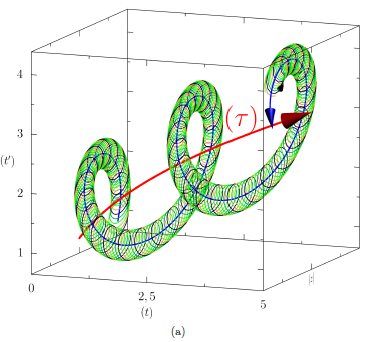
A new paper on arXiv shows an interesting approach to visualizing time in systems with circadian or other rhythms. I haven’t figured out if it’s useful for oscillatory dynamic systems more generally, but it makes some neat visuals:

scheme

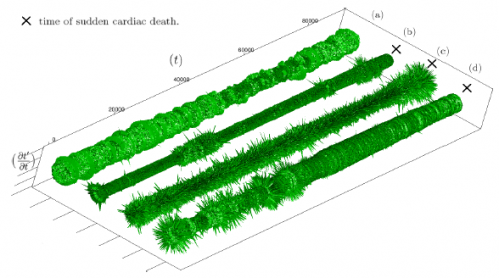
The method makes it possible to see changes in behavior in time series with waaay to many oscillations to explore on a normal 2D time-value plot:

cardiac

Read more on arXiv.

Hypnotizing chickens, Afghan insurgents, and spaghetti

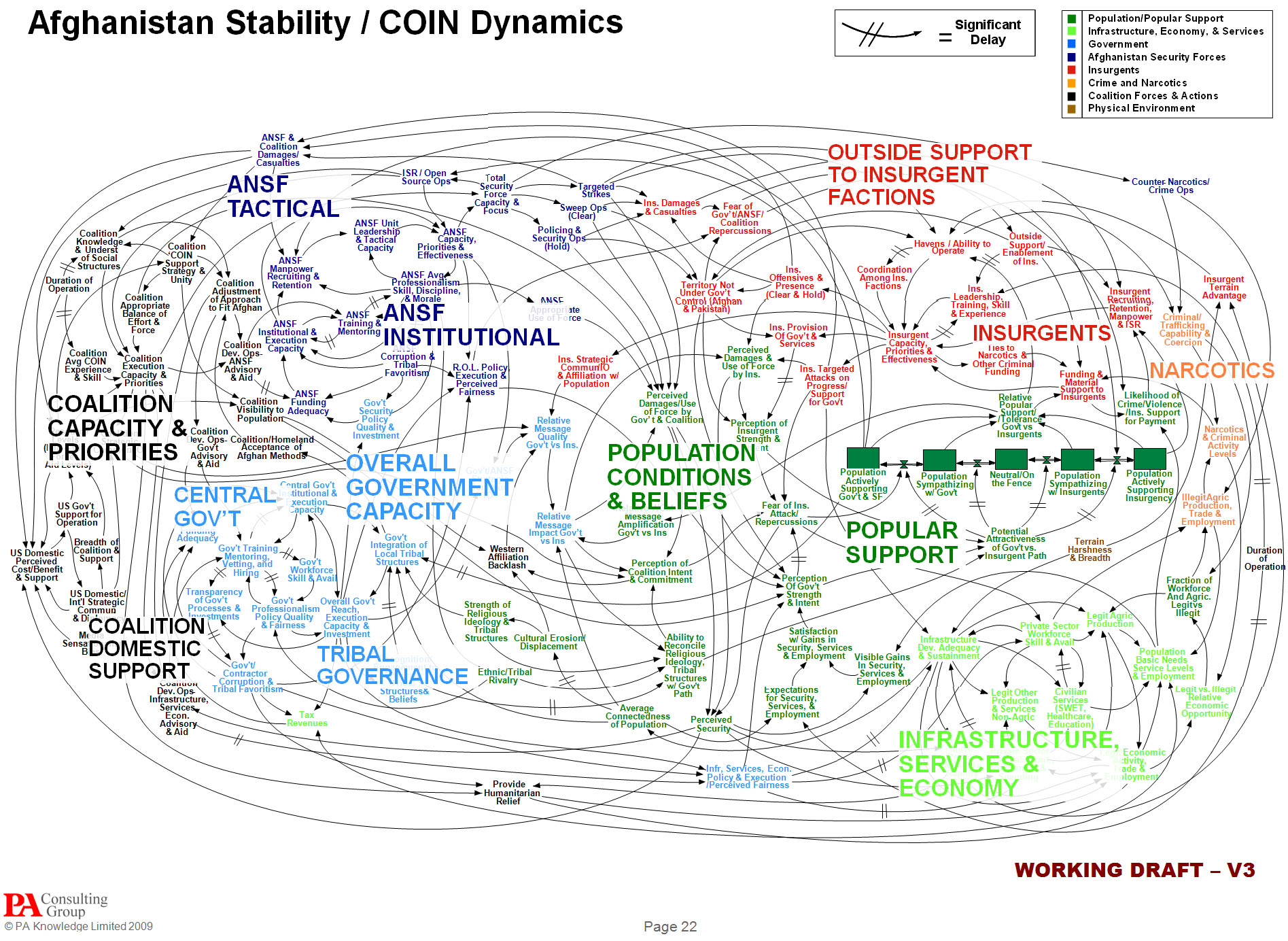
The NYT is about 4 months behind the times picking up on a spaghetti diagram of Afghanistan situation, which it uses to lead off a critique of Powerpoint use in the military. The reporter is evidently cheesed off at being treated like a chicken:

Senior officers say the program does come in handy when the goal is not imparting information, as in briefings for reporters.

The news media sessions often last 25 minutes, with 5 minutes left at the end for questions from anyone still awake. Those types of PowerPoint presentations, Dr. Hammes said, are known as “hypnotizing chickens.”

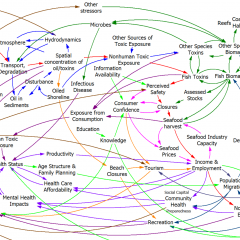
Afghanistan Stability: COIN (Counterinsurgency) Model
Click to enlarge

The Times reporter seems unaware of the irony of her own article. Early on, she quotes a general, “Some problems in the world are not bullet-izable.” But isn’t the spaghetti diagram an explicit attempt to get away from bullets, and present a rich, holistic picture of a complicated problem? The underlying point – that presentations are frequently awful and waste time – is well taken, but hardly news. If there’s a problem here, it’s not the fault of Powerpoint, and we’d do well to identify the real issue.

For those unfamiliar with the lingo, the spaghetti is actually a Causal Loop Diagram (CLD), a type of influence diagram. It’s actually a hybrid, because the Popular Support sector also has a stock-flow chain. Between practitioners, a good CLD can be an incredibly efficient communication device – much more so than the “five-pager” cited in the article. CLDs occupy a niche between formal mathematical models and informal communication (prose or ppt bullets). They’re extremely useful for brainstorming (which is what seems to have been going on here) and for communicating selected feedback insights from a formal model. They also tend to leave a lot to the imagination – if you try to implement a CLD in equations, you’ll discover many unstated assumptions and inconsistencies along the way. Still, the CLD is likely to be far more revealing of the tangle of assumptions that lie in someone’s head than a text document or conversation.

Evidently the Times has no prescription for improvement, but here’s mine:

  • If the presenters were serious about communicating with this diagram, they should have spent time introducing the CLD lingo and walking through the relationships. That could take a long time, i.e. a whole presentation could be devoted to the one slide. Also, the diagram should have been built up in digestible chunks, without overlapping links, and key feedback loops that lead to success or disaster should be identified.
  • If the audience were serious about understanding what’s going on, they shouldn’t shut off their brains and snicker when unconventional presentations appear. If reporters stick their fingers in their ears and mumble “not listening … not listening … not listening …” at the first sign of complexity, it’s no wonder DoD treats them like chickens.

Faking fitness

Geoffrey Miller wonders why we haven’t met aliens. I think his proposed answer has a lot to do with the state of the world and why it’s hard to sell good modeling.

I don’t know why this 2006 Seed article bubbled to the top of my reader, but here’s an excerpt:

The story goes like this: Sometime in the 1940s, Enrico Fermi was talking about the possibility of extraterrestrial intelligence with some other physicists. … Fermi listened patiently, then asked, simply, “So, where is everybody?” That is, if extraterrestrial intelligence is common, why haven’t we met any bright aliens yet? This conundrum became known as Fermi’s Paradox.

It looks, then, as if we can answer Fermi in two ways. Perhaps our current science over-estimates the likelihood of extraterrestrial intelligence evolving. Or, perhaps evolved technical intelligence has some deep tendency to be self-limiting, even self-exterminating. …

I suggest a different, even darker solution to the Paradox. Basically, I think the aliens don’t blow themselves up; they just get addicted to computer games. They forget to send radio signals or colonize space because they’re too busy with runaway consumerism and virtual-reality narcissism. …

The fundamental problem is that an evolved mind must pay attention to indirect cues of biological fitness, rather than tracking fitness itself. This was a key insight of evolutionary psychology in the early 1990s; although evolution favors brains that tend to maximize fitness (as measured by numbers of great-grandkids), no brain has capacity enough to do so under every possible circumstance. … As a result, brains must evolve short-cuts: fitness-promoting tricks, cons, recipes and heuristics that work, on average, under ancestrally normal conditions.

The result is that we don’t seek reproductive success directly; we seek tasty foods that have tended to promote survival, and luscious mates who have tended to produce bright, healthy babies. … Technology is fairly good at controlling external reality to promote real biological fitness, but it’s even better at delivering fake fitness—subjective cues of survival and reproduction without the real-world effects.

Fitness-faking technology tends to evolve much faster than our psychological resistance to it.

… I suspect that a certain period of fitness-faking narcissism is inevitable after any intelligent life evolves. This is the Great Temptation for any technological species—to shape their subjective reality to provide the cues of survival and reproductive success without the substance. Most bright alien species probably go extinct gradually, allocating more time and resources to their pleasures, and less to their children. They eventually die out when the game behind all games—the Game of Life—says “Game Over; you are out of lives and you forgot to reproduce.”

I think the shorter version might be,

The secret of life is honesty and fair dealing… if you can fake that, you’ve got it made. – Attributed to Groucho Marx

The general problem for corporations and countries is that there’s a big problem attributing success to individuals. People rise in power, prestige and wealth by creating the impression of fitness, rather than creating any actual fitness, as long as there are large stocks that separate action and result in time and space and causality remains unclear. That means that there are two paths to oblivion. Miller’s descent into a self-referential virtual reality could be one. More likely, I think, is sinking into a self-deluded reality that erodes key resource stocks, until catastrophe follows – nukes optional.

The antidote for the attribution problem is good predictive modeling. The trouble is, the truth isn’t selling very well. I suspect that’s partly because we have less of it than we typically think. More importantly, though, leaders who succeeded on BS and propaganda are threatened by real predictive power. The ultimate challenge for humanity, then, is to figure out how to make insight about complex systems evolutionarily successful.

Hell freezes over: Fox to go carbon neutral

I keep checking, but today is not April 1st:

In the Fox News universe, the world is definitely not warming. Quite the opposite: Climate change is “bunk,” a spectacular hoax perpetrated on the rest of us by a cabal of corrupt scientists. But while embracing climate skepticism may be good for ratings, the execs at Fox News’ parent company, News Corp., don’t see it as good for the long-term bottom line. By the end of this year, News Corp. aims to go carbon neutral — meaning that the home of über-global warming denialists like Sean Hannity and Glenn Beck may soon be one of the greener multinational corporations around.

News Corp. announced its plan in May 2007 with a groundbreaking speech from chairman Rupert Murdoch. “Climate change poses clear, catastrophic threats,” declared Murdoch. “We may not agree on the extent, but we certainly can’t afford the risk of inaction.” Formerly skeptical about global warming, Murdoch was reportedly converted by a presentation from Al Gore — whom Fox News commentators have described as “nuts” and “off his lithium” — and by his green-leaning son James, who is expected to inherit his business empire.

But Murdoch wasn’t acting out of altruism. For News Corp., he said, the move was “simply good business.” (Fox News barely mentioned the boss’ remarks.)

Murdoch’s logic was that higher energy costs are inevitable, given coming carbon regulations and dwindling supplies of conventional fuels such as oil. So why not get ahead of the game? “Whatever [going carbon neutral] costs will be minimal compared to our overall revenues,” the media mogul has remarked, “and we’ll get that back many times over.”

Read More at Wired

Writing a good system dynamics paper II

It’s SD conference paper review time again. Last year I took notes while reviewing, in an attempt to capture the attributes of a good paper. A few additional thoughts:

  • No model is perfect, but it pays to ask yourself, will your model stand up to critique?
  • Model-data comparison is extremely valuable and too seldom done, but trivial tests are not interesting. Fit to data is a weak test of model validity; it’s often necessary, but never sufficient as a measure of quality. I’d much rather see the response of a model to a step input or an extreme conditions test than a model-data comparison. It’s too easy to match the model to the data with exogenous inputs, so unless I see a discussion of a multi-faceted approach to validation, I get suspicious. You might consider how your model meets the following criteria:
    • Do decision rules use information actually available to real agents in the system?
    • Would real decision makers agree with the decision rules attributed to them?
    • Does the model conserve energy, mass, people, money, and other physical quantities?
    • What happens to the behavior in extreme conditions?
    • Do physical quantities always have nonnegative values?
    • Do units balance?
  • If you have time series output, show it with graphs – it takes a lot of work to “see” the behavior in tables. On the other hand, tables can be great for other comparisons of outcomes.
  • If all of your graphs show constant values, linear increases (ramps), or exponentials, my eyes glaze over, unless you can make a compelling case that your model world is really that simple, or that people fail to appreciate the implications of those behaviors.
  • Relate behavior to structure. I don’t care what happens in scenarios unless I know why it happens. One effective way to do this is to run tests with and without certain feedback loops or sectors of the model active.
  • Discuss what lies beyond the boundary of your model. What did you leave out and why? How does this limit the applicability of the results?
  • If you explore a variety of scenarios with your model (as you should), introduce the discussion with some motivation, i.e. why are the particular scenarios tested important, realistic, etc.?
  • Take some time to clean up your model diagrams. Eliminate arrows that cross unnecessarily. Hide unimportant parameters. Use clear variable names.
  • It’s easiest to understand behavior in deterministic experiments, so I like to see those. But the real world is noisy and uncertain, so it’s also nice to see experiments with stochastic variation or Monte Carlo exploration of the parameter space. For example, there are typically many papers on water policy in the ENV thread. Water availability is contingent on precipitation, which is variable on many time scales. A system’s response to variation or extremes of precipitation is at least as important as its mean behavior.
  • Modeling aids understanding, which is intrinsically valuable, but usually the real endpoint of a modeling exercise is a decision or policy change. Sometimes, it’s enough to use the model to characterize a problem, after which the solution is obvious. More often, though, the model should be used to develop and test decision rules that solve the problem you set out to conquer. Show me some alternative strategies, discuss their limitations and advantages, and describe how they might be implemented in the real world.
  • If you say that an SD model can’t predict or forecast, be very careful. SD practitioners recognized early on that forecasting was often a fool’s errand, and that insight into behavior modes for design of robust policies was a worthier goal. However, SD is generally about building good dynamic models with appropriate representations of behavior and so forth, and good models are a prerequisite to good predictions. An SD model that’s well calibrated can forecast as well as any other method, and will likely perform better out of sample than pure statistical approaches. More importantly, experimentation with the model will reveal the limits of prediction.
  • It never hurts to look at your paper the way a reviewer will look at it.

Another look at inadequate Copenhagen pledges

Joeri Rogelj and others argue that Copenhagen Accord pledges are paltry in a Nature Opinion,

Current national emissions targets can’t limit global warming to 2 °C, calculate Joeri Rogelj, Malte Meinshausen and colleagues — they might even lock the world into exceeding 3 °C warming.

  • Nations will probably meet only the lower ends of their emissions pledges in the absence of a binding international agreement
  • Nations can bank an estimated 12 gigatonnes of Co2 equivalents surplus allowances for use after 2012
  • Land-use rules are likely to result in further allowance increases of 0.5 GtCO2-eq per year
  • Global emissions in 2020 could thus be up to 20% higher than today
  • Current pledges mean a greater than 50% chance that warming will exceed 3°C by 2100
  • If nations agree to halve emissions by 2050, there is still a 50% chance that warming will exceed 2°C and will almost certainly exceed 1.5°C

Via Nature’s Climate Feedback, Copenhagen Accord – missing the mark.

Computer models running the EU? Eruptions, models, and clueless reporting

The EU airspace shutdown provides yet another example of ignorance of the role of models in policy:

Computer Models Ruining EU?

Flawed computer models may have exaggerated the effects of an Icelandic volcano eruption that has grounded tens of thousands of flights, stranded hundreds of thousands of passengers and cost businesses hundreds of millions of euros. The computer models that guided decisions to impose a no-fly zone across most of Europe in recent days are based on incomplete science and limited data, according to European officials. As a result, they may have over-stated the risks to the public, needlessly grounding flights and damaging businesses. “It is a black box in certain areas,” Matthias Ruete, the EU’s director-general for mobility and transport, said on Monday, noting that many of the assumptions in the computer models were not backed by scientific evidence. European authorities were not sure about scientific questions, such as what concentration of ash was hazardous for jet engines, or at what rate ash fell from the sky, Mr. Ruete said. “It’s one of the elements where, as far as I know, we’re not quite clear about it,” he admitted. He also noted that early results of the 40-odd test flights conducted over the weekend by European airlines, such as KLM and Air France, suggested that the risk was less than the computer models had indicated. – Financial Times

Other venues picked up similar stories:

Also under scrutiny last night was the role played by an eight-man team at the Volcanic Ash Advisory Centre at Britain’s Meteorological Office. The European Commission said the unit started the chain of events that led to the unprecedented airspace shutdown based on a computer model rather than actual scientific data. – National Post

These reports miss a number of crucial points:

  • The decision to shut down the airspace was political, not scientific. Surely the Met Office team had input, but not the final word, and model results were only one input to the decision.
  • The distinction between computer models and “actual scientific data” is false. All measurements involve some kind of implicit model, required to interpret the result. The 40 test flights are meaningless without some statistical interpretation of sample size and so forth.
  • It’s not uncommon for models to demonstrate that data are wrong or misinterpreted.
  • The fact that every relationship or parameter in a model can’t be backed up with a particular measurement does not mean that the model is unscientific.
    • Numerical measurements are not the only valid source of data; there are also laws of physics, and a subject matter expert’s guess is likely to be better than a politician’s.
    • Calibration of the aggregate result of a model provides indirect measurement of uncertain components.
    • Feedback structure may render some parameters insensitive and therefore unimportant.
  • Good decisions sometimes lead to bad outcomes.

The reporters, and maybe also the director-general (covering his you-know-what), have neatly shifted blame, turning a problem in decision making under uncertainty into an anti-science witch hunt. What alternative to models do they suggest? Intuition? Prayer? Models are just a way of integrating knowledge in a formal, testable, shareable way. Sure, there are bad models, but unlike other bad ideas, it’s at least easy to identify their problems.

Thanks to Jack Dirmann, Green Technology for the tip.

Cascading failures in interconnected networks

Wired covers a new article in Nature, investigating massive failures in linked networks.

interconNetworks

The interesting thing is that feedback between the connected networks destabilizes the whole:

“When networks are interdependent, you might think they’re more stable. It might seem like we’re building in redundancy. But it can do the opposite,” said Eugene Stanley, a Boston University physicist and co-author of the study, published April 14 in Nature.

The interconnections fueled a cascading effect, with the failures coursing back and forth. A damaged node in the first network would pull down nodes in the second, which crashed nodes in the first, which brought down more in the second, and so on. And when they looked at data from a 2003 Italian power blackout, in which the electrical grid was linked to the computer network that controlled it, the patterns matched their models’ math.

Wired

Interestingly, the interconnection alters the relationship between network structure (degree distribution) and robustness:

Surprisingly, a broader degree distribution increases the vulnerability of interdependent networks to random failure, which is opposite to how a single network behaves.

Nature

Chalk one up for counter-intuitive behavior of complex systems.

What looks like last year’s version of the paper is on arXiv.