The lure of border carbon adjustments

Are border carbon adjustments (BCAs) the wave of the future? Consider these two figures:
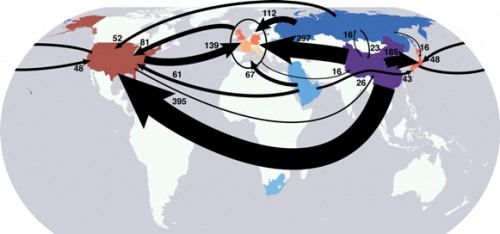
Carbon flows embodied in trade goods

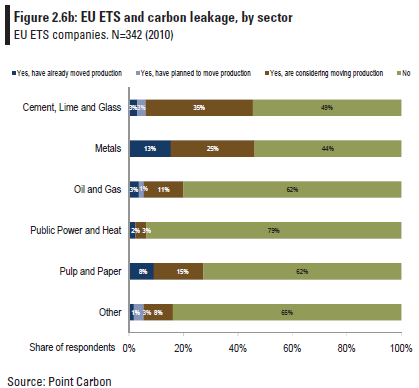
Leakage

The first shows the scale of carbon embodied in trade. The second, even if it overstates true intentions, demonstrates the threat of carbon outsourcing. Both are compelling arguments for border adjustments (i.e. tariffs) on GHG emissions.

I think things could easily go this route: it’s essentially a noncooperative route to a harmonized global carbon price. Unlike global emissions trading, it’s not driven by any principle of fair allocation of property rights in the atmosphere; instead it serves the more vulgar notion that everyone (or at least every nation) keeps their own money.

Consider the pros and cons:

Advocates of BCAs claim that the measures are intended to address three factors. First, competitiveness concerns where some industries in developed countries consider that a BCA will protect their global competitiveness vis-a-vis industries in countries that do not apply the same requirements. The second argument for BCAs is ‘carbon leakage’ – the notion that emissions might move to countries where rules are less stringent. A third argument, of the highest political relevance, has to do with ‘leveraging’ the participation of developing countries in binding mitigation schemes or to adopt comparable measures to offset emissions by their own industries.

from a developing country perspective, at least three arguments run counter to that idea: 1) that the use of BCAs is a prima facie violation of the spirit and letter of multilateral trade principles and norms that require equal treatment among equal goods; 2) that BCAs are a disguised form of protectionism; and 3) that BCAs undermine in practice the principle of common but differentiated responsibilities.

In other words: the advocates are a strong domestic constituency with material arguments in places where BCAs might arise. The opponents are somewhere else and don’t get to vote, and armed with legalistic principles more than fear and greed.
Fuzzy VISION

Like spreadsheets, open-loop models are popular but flawed tools. An open loop model is essentially a scenario-specification tool. It translates user input into outcomes, without any intervening dynamics. These are common in public discourse. An example turned up in the very first link when I googled “regional growth forecast”:

The growth forecast is completed in two stages. During the first stage SANDAG staff produces a forecast for the entire San Diego region, called the regionwide forecast. This regionwide forecast does not include any land use constraints, but simply projects growth based on existing demographic and economic trends such as fertility rates, mortality rates, domestic migration, international migration, and economic prosperity.

In other words, there’s unidirectional causality from inputs  to outputs, ignoring the possible effects of the outputs (like prosperity) on the inputs (like migration). Sometimes such scenarios are useful as a starting point for thinking about a problem. However, with no estimate of the likelihood of realization of such a scenario, no understanding of the feedback that would determine the outcome, and no guidance about policy levers that could be used to shape the future, such forecasts won’t get you very far (but they might get you pretty deep – in trouble).

The key question for any policy, is “how do you get there from here?” Models can help answer such questions. In California, one key part of the low-carbon fuel standard (LCFS) analysis was VISION-CA. I wondered what was in it, so I took it apart to see. The short answer is that it’s an open-loop model that demonstrates a physically-feasible path to compliance, but leaves the user wondering what combination of vehicle and fuel prices and other incentives would actually get consumers and producers to take that path.

First, it’s laudable that the model is publicly available for critique, and includes macros that permit replication of key results. That puts it ahead of most analyses right away. Unfortunately, it’s a spreadsheet, which makes it tough to know what’s going on inside.

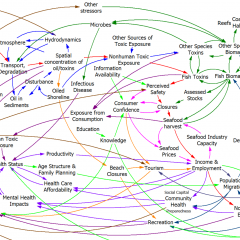
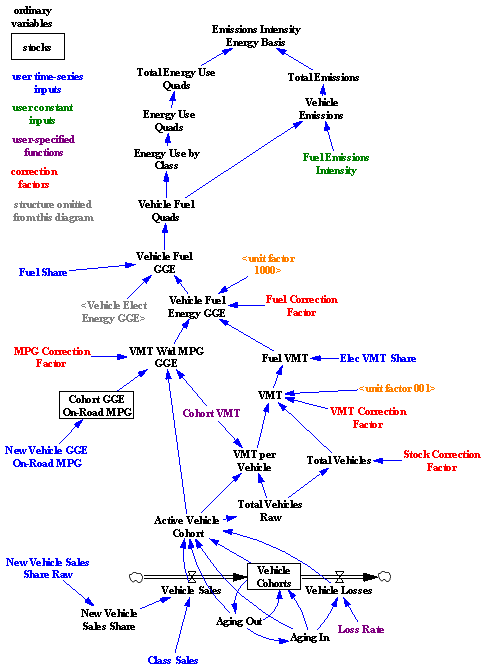
I translated some of the model core to Vensim for clarity. Here’s the structure:

VISION-CA

Bringing the structure into the light reveals that it’s basically a causal tree – from vehicle sales, fuel efficiency, fuel shares, and fuel intensity to emissions. There is one pair of minor feedback loops, concerning the aging of the fleet and vehicle losses. So, this is a vehicle accounting tool that can tell you the consequences of a particular pattern of new vehicle and fuel sales. That’s already a lot of useful information. In particular, it enforces some reality on scenarios, because it imposes the fleet turnover constraint, which imposes a delay in implementation from the time it takes for the vehicle capital stock to adjust. No overnight miracles allowed.

What it doesn’t tell you is whether a particular measure, like an LCFS, can achieve the desired fleet and fuel trajectory with plausible prices and other conditions. It also can’t help you to decide whether an LCFS, emissions tax, or performance mandate is the better policy. That’s because there’s no consumer choice linking vehicle and fuel cost and performance, consumer knowledge, supplier portfolios, and technology to fuel and vehicle sales. Since equilibrium analysis suggests that there could be problems for the LCFS, and disequilibrium generally makes things harder rather than easier, those omissions are problematic.

Continue reading “Fuzzy VISION”

LCFS in Equilibrium II

My last post introduced some observations from simulation of an equilibrium fuel portfolio standard model:

  • knife-edge behavior of market volume of alternative fuels as you approach compliance limits (discussed last year): as the required portfolio performance approaches the performance of the best component options, demand for those approaches 100% of volume rapidly.
  • differences in the competitive landscape for technology providers, when compared to alternatives like a carbon tax.
  • differences in behavior under uncertainty.
  • perverse behavior when the elasticity of substitution among fuels is low

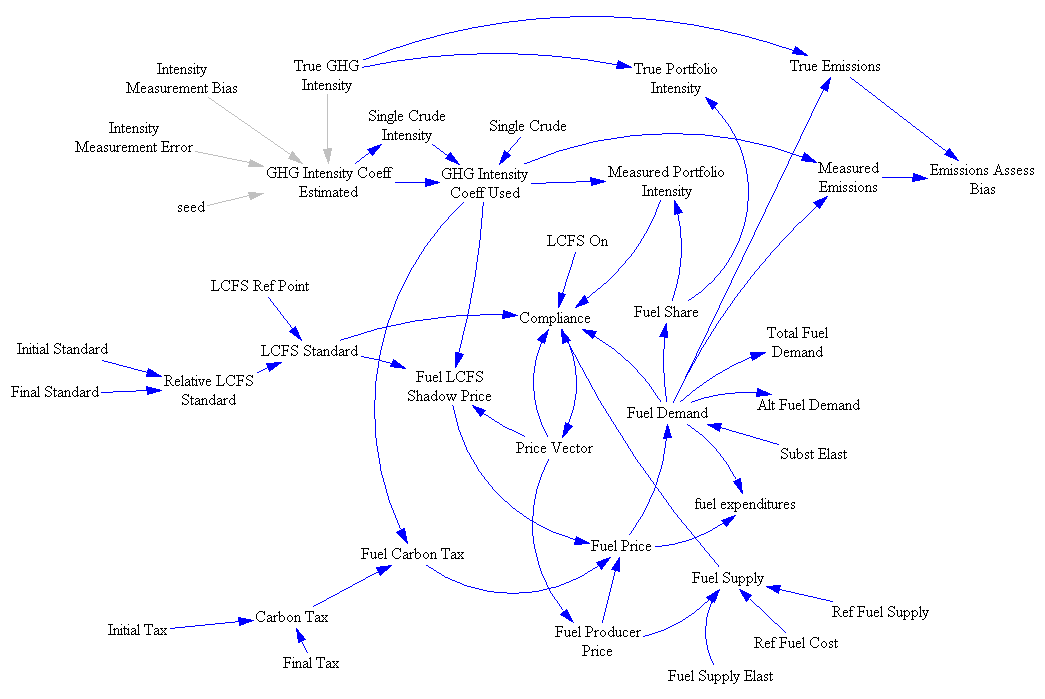
Here are some of the details. First, the model:

structure

Notice that this is not a normal SD model – there are loops but no stocks. That’s because this is a system of simultaneous equations solved in equilibrium. The Vensim FIND ZERO function is used to find a vector of prices (one for each fuel, plus the shadow price of emissions intensity) that matches supply and demand, subject to the intensity constraint.

Continue reading “LCFS in Equilibrium II”

A Tale of Three Models – LCFS in Equilibrium

This is the first of several posts on models of the transition to alternative fuel vehicles. The first looks at a static equilibrium model of the California Low Carbon Fuel Standard (LCFS). Another will look at another model of the LCFS, called VISION-CA, which generates fuel carbon intensity scenarios. Finally, I’ll discuss Jeroen Struben’s thesis, which is a full dynamic model that closes crucial loops among vehicle fleets, consumer behavior, fueling infrastructure, and manufacturers’ learning. At some point I will try to put the pieces together into a general reflection on alt fuel policy.

Those who know me might be surprised to see me heaping praise on a static model, but I’m about to do so. Not every problem is dynamic, and sometimes a comparative statics exercise yields a lot of insight.

In a no-longer-so-new paper, Holland, Hughes, and Knittel work out the implications of the LCFS and some variants. In a nutshell, a low carbon fuel standard is one of a class of standards that requires providers of a fuel (or managers of some kind of portfolio) to meet some criteria on average – X grams of carbon per MJ of fuel energy, or Y% renewable content, for example. If trading is allowed (fun, no?), then the constraint effectively applies to the market portfolio as a whole, rather than to individual providers, which should be more efficient. The constraint in effect requires the providers to set up an internal tax and subsidy system – taxing products that don’t meet the standard, and subsidizing those that do. The LCFS sounds good on paper, but when you do the math, some problems emerge:

We show this decreases high-carbon fuel production but increases low-carbon fuel production, possibly increasing net carbon emissions. The LCFS cannot be efficient, and the best LCFS may be nonbinding. We simulate a national LCFS on gasoline and ethanol. For a broad parameter range, emissions decrease; energy prices increase; abatement costs are large ($80-$760 billion annually); and average abatement costs are large ($307-$2,272 per CO tonne). A cost effective policy has much lower average abatement costs ($60-$868).

Continue reading “A Tale of Three Models – LCFS in Equilibrium”

Dumb and Dumber

Not to be outdone by Utah, South Dakota has passed its own climate resolution.

They raise the ante – where Utah cherry-picked twelve years of data, South Dakotans are happy with only 8. Even better, their pattern matching heuristic violates bathtub dynamics:

WHEREAS, the earth has been cooling for the last eight years despite small increases in anthropogenic carbon dioxide

They have taken the skeptic claim, that there’s little warming in the tropical troposphere, and bumped it up a notch:

WHEREAS, there is no evidence of atmospheric warming in the troposphere where the majority of warming would be taking place

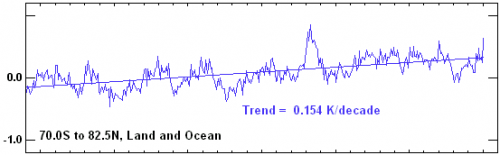
Nope, no trend here:

Satellite tropospheric temperature, RSS

Satellite tropospheric temperature (RSS, TLT)

Continue reading “Dumb and Dumber”

Legislating Science

The Utah House has declared that CO2 is harmless. The essence of the argument in HJR 12: temperature’s going down, climategate shows that scientists are nefarious twits, whose only interest is in riding the federal funding gravy train, and emissions controls hurt the poor. While it’s reassuring that global poverty is a big concern of Utah Republicans, the scientific observations are egregiously bad:

29 WHEREAS, global temperatures have been level and declining in some areas over the
30 past 12 years;
31 WHEREAS, the “hockey stick” global warming assertion has been discredited and
32 climate alarmists’ carbon dioxide-related global warming hypothesis is unable to account for
33 the current downturn in global temperatures;
34 WHEREAS, there is a statistically more direct correlation between twentieth century
35 temperature rise and Chlorofluorocarbons (CFCs) in the atmosphere than CO2;
36 WHEREAS, outlawed and largely phased out by 1978, in the year 2000 CFC’s began to
37 decline at approximately the same time as global temperatures began to decline;

49 WHEREAS, Earth’s climate is constantly changing with recent warming potentially an
50 indication of a return to more normal temperatures following a prolonged cooling period from
51 1250 to 1860 called the “Little Ice Age”;

The list cherry-picks skeptic arguments that rely on a few papers (if that), nearly all thoroughly discredited. There are so many things wrong here that it’s not worth the electrons to refute them one by one. The quality of their argument calls to mind to the 1897 attempt in Indiana to legislate that pi = 3.2. It’s sad that this resolution’s supporters are too scientifically illiterate to notice, or too dishonest to care. There are real uncertainties about climate; it would be nice to see a legislative body really grapple with the hard questions, rather than chasing red herrings.

Climate bill messaging

Interesting insights from pollster Frank Luntz, via Reuters:

“If you really want to scare Americans it’s not about glaciers that are melting or the struggle of the polar bear,” said the pollster and political adviser Frank Luntz, most known for his work with Republicans.

“What scares Americans is the idea that this great technological industry will be developed in China or India rather than America,” said Luntz, who once advised former President George W. Bush’s administration to emphasize that there was a lack of scientific certainty about climate change.

Luntz said polls his company conducted late last year showed that a combined 65 percent of respondents stated that climate change exists and action needs to be taken, or that the science was not settled but people should explore ways to cut emissions and adopt clean energy. “This is true of Republicans and Democrats alike,” he said.

Backers of the cap-and-trade bill have emphasized climate science too much, and the potential positive results from a clean-energy bill — domestic jobs, a healthier environment, and potentially less money sent to the Middle East for oil — too little, Luntz said.

Wording is important in drumming up support for the bill, he added. Backers should emphasize it would create “American” jobs rather than “green” jobs, while Americans want “reliable” technology more than “smart” technology, he said.

Poll respondents who were Democrats or Republicans believed the most important environmental and economic goal for the United States should be cutting dependence on foreign fuel and halting pollution of the air and water. Ending climate change came in last of the 10 priorities in that category.

Hat tip to Travis Franck.

Climate bills LITE

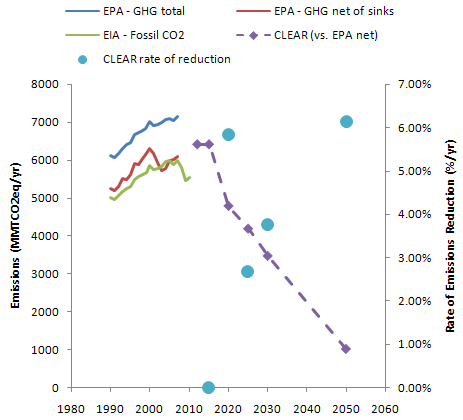
Over Christmas, with little fanfare, two new approaches to climate legislation were introduced, perhaps in response to the possibility that Boxer-Kerry’s prospects are dimming. VentureBeat has a summary. The Kerry-Lieberman-Graham approach is just a “framework” and too vague for me to sink my teeth into. The Cantwell-Collins CLEAR act on the other hand is a real bill. Unlike the 1000-page ACES (Waxman-Markey), it’s just about cap & trade,  so it’s refreshingly brief – 39 pages. CLEAR sets targets,

CLEAR targets

Source: EPA & EIA STEO

As in Waxman-Markey and other bills, the target trajectory is  mostly linear. That actually doesn’t make much sense, because it implies a much greater proportional effort late in the game. Emissions reductions finish at >6%/year. If GDP growth is 3%/year, that implies a final intensity reduction rate of >9%/year, which is fairly delusional. Unlike Waxman-Markey, which is strictly linear, the first three years are flat, then there’s a race to the 2020 target. It’s good to harvest the low-hanging fruit quickly, but the 2015-2020 trajectory seems a little sporty.

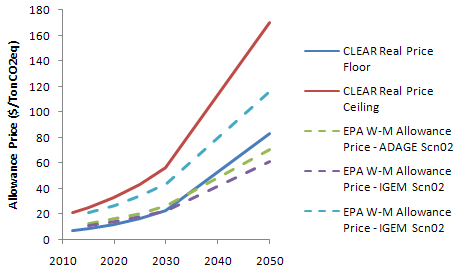
The real emissions trajectory is unknown, because there’s a safety valve price ceiling and floor, initially set at 7 to 21 $/tonCO2eq, and rising at the real interest rate, plus and minus 0.5%, respectively. The resulting prices neatly bracket EPA’s expectations for Waxman-Markey without international offsets (Scn07 on graph):

CLEAR price corridor

Source: EPA W-M analysis.

CLEAR is upstream, covering fuels at the minemouth, wellhead, import terminal, etc. This strikes me as a big advantage administratively and improves coverage as well. Offsets, funded by a set-aside from auction revenues, play a much smaller role, which is OK, because with better coverage there won’t be as big a market. International offsets are also assumed to play a much smaller role (a few % of reductions, vs. roughly half of W-M reductions). That makes the true target trajectory much more aggressive, and raises expected permit prices a lot. Whether this is good or bad is ambiguous; one drawback is that there’s potentially less “carrot” for developing countries, and less funding for forestry.

Unlike Waxman-Markey, CLEAR allocates most (75%) permits to citizens as “shares”. That’s bad news for coal-fired electric utilities, but possibly good news for low income residents of coal-intensive areas. My guess is that the totally flat distribution of revenue would more than compensate for regional inequities for the bottom quintile, who would come out ahead. The remaining permits go to a “CERT” fund for worker, business, and community transitions, stranded assets, targeted relief for energy-intensive industries exporting to countries without emissions controls, R&D, offsets and other usual suspects. There’s room for a lot of good here, but also a lot of pork. I think it would make sense to partially phase out the fund in the future, as its revenues would likely rise beyond the need.

Like W-M, CLEAR includes a border adjustment (effectively a tariff on the embodied carbon content of imports). This, plus the potential trade measures in CERT, should make labor happy and infuriate WTO partners like China.

Strategically, CLEAR seems to leave more of the detailed design of the market and related mechanisms to the executive branch. I think that’s a good thing. It’s impossible to have a sensible debate about a piece of legislation the size of the Oxford dictionary. Add in the fact that this proposal is much closer to economic ideals for a cap & trade (upstream coverage, flat rebates, safety valves) and I’m liking this a lot better than ACES.

Climate Panic?

Grist muses over the possibility that abrupt climate change in the not-too-distant future might trigger a chaotic response.

One morning in the not too distant future, you might wake up and walk to your mailbox. The newspaper is in there and it’s covered with shocking headlines: Coal Plants Shut Down! Airline Travel Down 50 Percent! New Federal Carbon Restrictions in Place! Governor Kicked Out of Office for Climate Indolence!

It is exactly these economic impacts that the Glenn Becks and the Rush Limbaughs fear we’ll impose on ourselves through restrictive government regulation of energy and carbon emissions. Ironically, a “no action” approach today actually makes a climate panic much more likely over time. What we’re describing would be popularly driven, not fueled by governments or policy wonks. It would be the direct result of free will, democracy, autonomy and the information superhighway. All these forces would accelerate, not mitigate, the greatest “Aha!” moment in the history of the human species. Imagine the sub-prime mortgage bubble pop multiplied a hundred fold.

I hesitate to argue for rationality (certainly our current climate and energy policies aren’t), but I think the physics of climate and human nature do not favor this outcome. The pain of economic dislocation is immediate. At the point of abrupt climate change, on the other hand, it would be evident that we’re stuck with it for decades, because there’s no quick way to reverse the accumulation of GHGs in the atmosphere. Even lowering emissions to zero overnight would have only a gradual climatic effect. Since that would be evident to everyone, especially those with GHG-intensive assets, it seems unlikely that rapid controls would emerge, and likely that they would be reversed when their pain was felt too keenly. I suppose macroeconomic feedbacks might make the damage irreversible, or countries might start launching cruise missiles at each others’ coal-fired power plants, but those seem like long odds.

More likely, I suspect, is that panic would yield enormous pressure to pursue geoengineering options – the only real prospect for a quick reversal of radiative imbalance. If, at that point, we’ve triggered abrupt climate changes without warning, it seems likely that our understanding of geoengineering side-effects would still be half-baked. The nasty side effects that might emerge from efforts under such circumstances strikes me as the greater threat of climate panic.

Setting climate aside, another panic scenario that should concern fossil-fired asset owners is a major oil supply disruption. That could de facto shut down emissions and use through high prices, no political will power required.