Kerry-Lieberman "American Power Act" leaked

I think it’s a second-best policy, but perhaps the most we can hope for, and better than nothing.

Climate Progress has a first analysis and links to the leaked draft legislation outline and short summary of the Kerry-Lieberman American Power Act. [Update: there’s now a nice summary table.] For me, the bottom line is, what are the emissions and price trajectories, what emissions are covered, and where does the money go?

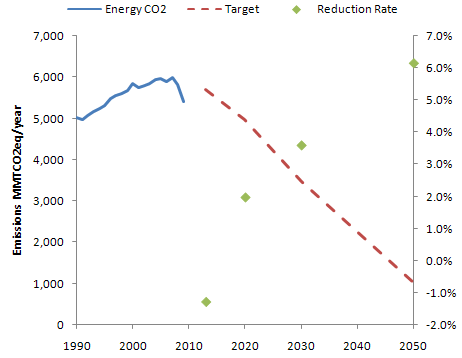
The target is 95.25% of 2005 by 2013, 83% by 2020, 58% by 2030, and 17% by 2050, with six Kyoto gases covered. Entities over 25 MTCO2eq/year are covered. Sector coverage is unclear; the summary refers to “the three major emitting sectors, power plants, heavy industry, and transportation” which is actually a rather incomplete list. Presumably the implication is that a lot of residential, commercial, and manufacturing emissions get picked up upstream, but the mechanics aren’t clear.

The target looks like this [Update: ignoring minor gases]:
Kerry Lieberman Target

This is not much different from ACES or CLEAR, and like them it’s backwards. Emissions reductions are back-loaded. The rate of reduction (green dots) from 2030 to 2050, 6.1%/year, is hardly plausible without massive retrofit or abandonment of existing capital (or negative economic growth). Given that the easiest reductions are likely to be the first, not the last, more aggressive action should be happening up front. (Actually there are a multitude of reasons for front-loading reductions as much as reasonable price stability allows).

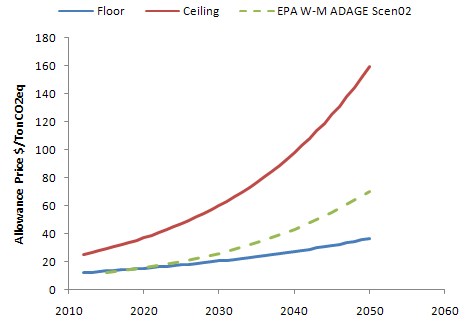
There’s also a price collar:
Kerry Lieberman Price

These mechanisms provide a predictable price corridor, with the expected prices of the EPA Waxman-Markey analysis (dashed green) running right up the middle. The silly strategic reserve is gone. Still, I think this arrangement is backwards, in a different sense from the target. The right way to manage the uncertainty in the long run emissions trajectory needed to stabilize climate without triggering short run economic dislocation is with a mechanism that yields stable prices over the short to medium term, while providing for adaptive adjustment of the long term price trajectory to achieve emissions stability. A cap and trade with no safety valve is essentially the opposite of that: short run volatility with long run rigidity, and therefore a poor choice. The price collar bounds the short term volatility to 2:1 (early) to 4:1 (late) price movements, but it doesn’t do anything to provide for adaptation of the emissions target or price collar if emissions reductions turn out to be unexpectedly hard, easy, important, etc. It’s likely that the target and collar will be regarded as property rights and hard to change later in the game.

I think we should expect the unexpected. My personal guess is that the EPA allowance price estimates are way too low. In that case, we’ll find ourselves stuck on the price ceiling, with targets unmet. 83% reductions in emissions at an emissions price corresponding with under $1/gallon for fuel just strike me as unlikely, unless we’re very lucky technologically. My preference would be an adaptive carbon price, starting at a substantially higher level (high enough to prevent investment in new carbon intensive capital, but not so high initially as to strand those assets – maybe $50/TonCO2). By default, the price should rise at some modest rate, with an explicit adjustment process taking place at longish intervals so that new information can be incorporated. Essentially the goal is to implement feedback control that stabilizes long term climate without short term volatility (as here or here and here).

Some other gut reactions:

Good:

  • Clean energy R&D funding.
  • Allowance distribution by auction.
  • Border adjustments (I can only find these in the summary, not the draft outline).

Bad:

  • More subsidies, guarantees and other support for nuclear power plants. Why not let the first round play out first? Is this really a good use of resources or a level playing field?
  • Subsidized CCS deployment. There are good reasons for subsidizing R&D, but deployment should be primarily motivated by the economic incentive of the emissions price.
  • Other deployment incentives. Let the price do the work!
  • Rebates through utilities. There’s good evidence that total bills are more salient to consumers than marginal costs, so this at least partially defeats the price signal. At least it’s temporary (though transient measures have a way of becoming entitlements).

Indifferent:

  • Preemption of state cap & trade schemes. Sorry, RGGI, AB32, and WCI. This probably has to happen.
  • Green jobs claims. In the long run, employment is controlled by a bunch of negative feedback loops, so it’s not likely to change a lot. The current effects of the housing bust/financial crisis and eventual effects of big twin deficits are likely to overwhelm any climate policy signal. The real issue is how to create wealth without borrowing it from the future (e.g., by filling up the atmospheric bathtub with GHGs) and sustaining vulnerability to oil shocks, and on that score this is a good move.
  • State preemption of offshore oil leasing within 75 miles of its shoreline. Is this anything more than an illusion of protection?
  • Banking, borrowing and offsets allowed.

Unclear:

  • Performance standards for coal plants.
  • Transportation efficiency measures.
  • Industry rebates to prevent leakage (does this defeat the price signal?).
Copenhagen – the breaking point

Der Spiegel has obtained audio of the heads of state negotiating in the final hours of COP15. Its fascinating stuff. The headline reads, How China and India Sabotaged the UN Climate Summit. This point was actually raised back in December by Mark Lynas at the Guardian (there’s a nice discussion and event timeline at Inside-Out China). On the surface the video supports the view that China and India were the material obstacle to agreement on a -50% by 2050 target. However, I think it’s still hard to make attributions about motive. We don’t know, for example, whether China is opposed because it anticipates raising emissions to levels that would make 50% cuts physically impossible, or because it sees the discussion of cuts as fundamentally linked to the unaddressed question of responsibility, as hinted by He Yafei near the end of the video. Was the absence of Wen Jiabao obstruction or a defensive tactic?  We have even less information about India, merely that it objected to “prejudging options,” whatever that means.

What the headline omits is the observation in the final pages of the article, that the de facto US position may not have been so different from China’s:

Part 3: Obama Stabs the Europeans in the Back

But then Obama stabbed the Europeans in the back, saying that it would be best to shelve the concrete reduction targets for the time being. “We will try to give some opportunities for its resolution outside of this multilateral setting … And I am saying that, confident that, I think China still is as desirous of an agreement, as we are.”

‘Other Business to Attend To’

At the end of his little speech, which lasted 3 minutes and 42 seconds, Obama even downplayed the importance of the climate conference, saying “Nicolas, we are not staying until tomorrow. I’m just letting you know. Because all of us obviously have extraordinarily important other business to attend to.”

Some in the room felt queasy. Exactly which side was Obama on? He couldn’t score any domestic political points with the climate issue. The general consensus was that he was unwilling to make any legally binding commitments, because they would be used against him in the US Congress. Was he merely interested in leaving Copenhagen looking like an assertive statesman?

It was now clear that Obama and the Chinese were in fact in the same boat, and that the Europeans were about to drown.

This article and video almost makes up for Spiegel’s terrible coverage of the climate email debacle.


Related analysis of developed-developing emissions trajectories:

You can’t fix emissions inequity with more emissions

The AWG-LCA draft agreement

The AOSIS draft agreement

Danish text – emissions trajectories

Stop talking, start studying?

Roger Pielke Jr. poses a carbon price paradox:

The carbon price paradox is that any politically conceivable price on carbon can do little more than have a marginal effect on the modern energy economy. A price that would be high enough to induce transformational change is just not in the cards. Thus, carbon pricing alone cannot lead to a transformation of the energy economy.

Put another way:

Advocates for a response to climate change based on increasing the costs of carbon-based energy skate around the fact that people react very negatively to higher prices by promising that action won’t really cost that much. … If action on climate change is indeed “not costly” then it would logically follow the only reasons for anyone to question a strategy based on increasing the costs of energy are complete ignorance and/or a crass willingness to destroy the planet for private gain. … There is another view. Specifically that the current ranges of actions at the forefront of the climate debate focused on putting a price on carbon in order to motivate action are misguided and cannot succeed. This argument goes as follows: In order for action to occur costs must be significant enough to change incentives and thus behavior. Without the sugarcoating, pricing carbon (whether via cap-and-trade or a direct tax) is designed to be costly. In this basic principle lies the seed of failure. Policy makers will do (and have done) everything they can to avoid imposing higher costs of energy on their constituents via dodgy offsets, overly generous allowances, safety valves, hot air, and whatever other gimmick they can come up with.

His prescription (and that of the Breakthrough Institute)  is low carbon taxes, reinvested in R&D:

We believe that soon-to-be-president Obama’s proposal to spend $150 billion over the next 10 years on developing carbon-free energy technologies and infrastructure is the right first step. … a $5 charge on each ton of carbon dioxide produced in the use of fossil fuel energy would raise $30 billion a year. This is more than enough to finance the Obama plan twice over.

… We would like to create the conditions for a virtuous cycle, whereby a small, politically acceptable charge for the use of carbon emitting energy, is used to invest immediately in the development and subsequent deployment of technologies that will accelerate the decarbonization of the U.S. economy.

Stop talking, start solving

As the nation begins to rely less and less on fossil fuels, the political atmosphere will be more favorable to gradually raising the charge on carbon, as it will have less of an impact on businesses and consumers, this in turn will ensure that there is a steady, perhaps even growing source of funds to support a process of continuous technological innovation.

This approach reminds me of an old joke:

Lenin, Stalin, Khrushchev and Brezhnev are travelling together on a train. Unexpectedly the train stops. Lenin suggests: “Perhaps, we should call a subbotnik, so that workers and peasants fix the problem.” Kruschev suggests rehabilitating the engineers, and leaves for a while, but nothing happens. Stalin, fed up, steps out to intervene. Rifle shots are heard, but when he returns there is still no motion. Brezhnev reaches over, pulls the curtain, and says, “Comrades, let’s pretend we’re moving.”

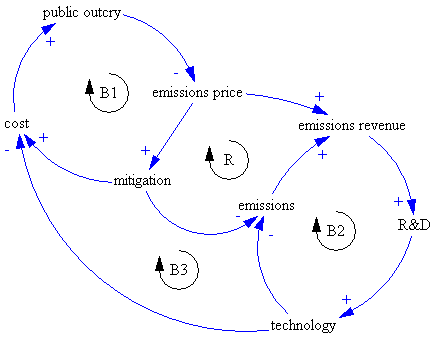
I translate the structure of Pielke’s argument like this:

Pielke Loops

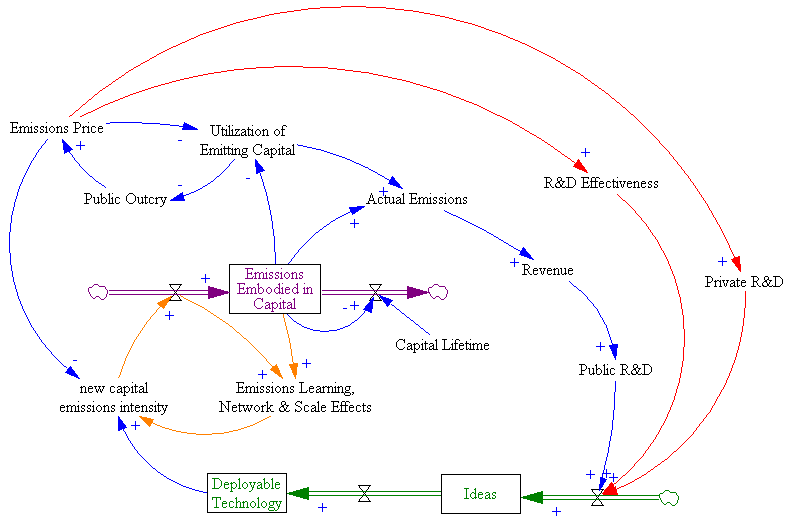
Implementation of a high emissions price now would be undone politically (B1). A low emissions price triggers a virtuous cycle (R), as revenue reinvested in technology lowers the cost of future mitigation, minimizing public outcry and enabling the emissions price to go up. Note that this structure implies two other balancing loops (B2 & B3) that serve to weaken the R&D effect, because revenues fall as emissions fall.

If you elaborate on the diagram a bit, you can see why the technology-led strategy is unlikely to work:

PielkeLoopsSF

First, there’s a huge delay between R&D investment and emergence of deployable technology (green stock-flow chain). R&D funded now by an emissions price could take decades to emerge. Second, there’s another huge delay from the slow turnover of the existing capital stock (purple) – even if we had cars that ran on water tomorrow, it would take 15 years or more to turn over the fleet. Buildings and infrastructure last much longer. Together, those delays greatly weaken the near-term effect of R&D on emissions, and therefore also prevent the virtuous cycle of reduced public outcry due to greater opportunities from getting going. As long as emissions prices remain low, the accumulation of commitments to high-emissions capital grows, increasing public resistance to a later change in direction. Continue reading “Stop talking, start studying?”

Are causal loop diagrams useful?

Reflecting on the Afghanistan counterinsurgency diagram in the NYTimes, Scott Johnson asked me whether I found causal loop diagrams (CLDs) to be useful. Some system dynamics hardliners don’t like them, and others use them routinely.

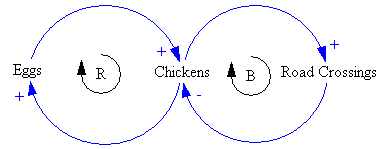
Here’s a CLD:

Chicken CLD

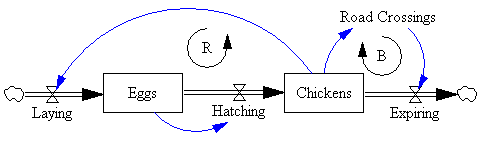
And here’s it’s stock-flow sibling:

Chicken Stock Flow

My bottom line is:

  • CLDs are very useful, if developed and presented with a little care.
  • It’s often clearer to use a hybrid diagram that includes stock-flow “main chains”. However, that also involves a higher burden of explanation of the visual language.
  • You can get into a lot of trouble if you try to mentally simulate the dynamics of a complex CLD, because they’re so underspecified (but you might be better off than talking, or making lists).
  • You’re more likely to know what you’re talking about if you go through the process of building a model.
  • A big, messy picture of a whole problem space can be a nice complement to a focused, high quality model.

Here’s why:

Continue reading “Are causal loop diagrams useful?”

Another look at inadequate Copenhagen pledges

Joeri Rogelj and others argue that Copenhagen Accord pledges are paltry in a Nature Opinion,

Current national emissions targets can’t limit global warming to 2 °C, calculate Joeri Rogelj, Malte Meinshausen and colleagues — they might even lock the world into exceeding 3 °C warming.

  • Nations will probably meet only the lower ends of their emissions pledges in the absence of a binding international agreement
  • Nations can bank an estimated 12 gigatonnes of Co2 equivalents surplus allowances for use after 2012
  • Land-use rules are likely to result in further allowance increases of 0.5 GtCO2-eq per year
  • Global emissions in 2020 could thus be up to 20% higher than today
  • Current pledges mean a greater than 50% chance that warming will exceed 3°C by 2100
  • If nations agree to halve emissions by 2050, there is still a 50% chance that warming will exceed 2°C and will almost certainly exceed 1.5°C

Via Nature’s Climate Feedback, Copenhagen Accord – missing the mark.

Computer models running the EU? Eruptions, models, and clueless reporting

The EU airspace shutdown provides yet another example of ignorance of the role of models in policy:

Computer Models Ruining EU?

Flawed computer models may have exaggerated the effects of an Icelandic volcano eruption that has grounded tens of thousands of flights, stranded hundreds of thousands of passengers and cost businesses hundreds of millions of euros. The computer models that guided decisions to impose a no-fly zone across most of Europe in recent days are based on incomplete science and limited data, according to European officials. As a result, they may have over-stated the risks to the public, needlessly grounding flights and damaging businesses. “It is a black box in certain areas,” Matthias Ruete, the EU’s director-general for mobility and transport, said on Monday, noting that many of the assumptions in the computer models were not backed by scientific evidence. European authorities were not sure about scientific questions, such as what concentration of ash was hazardous for jet engines, or at what rate ash fell from the sky, Mr. Ruete said. “It’s one of the elements where, as far as I know, we’re not quite clear about it,” he admitted. He also noted that early results of the 40-odd test flights conducted over the weekend by European airlines, such as KLM and Air France, suggested that the risk was less than the computer models had indicated. – Financial Times

Other venues picked up similar stories:

Also under scrutiny last night was the role played by an eight-man team at the Volcanic Ash Advisory Centre at Britain’s Meteorological Office. The European Commission said the unit started the chain of events that led to the unprecedented airspace shutdown based on a computer model rather than actual scientific data. – National Post

These reports miss a number of crucial points:

  • The decision to shut down the airspace was political, not scientific. Surely the Met Office team had input, but not the final word, and model results were only one input to the decision.
  • The distinction between computer models and “actual scientific data” is false. All measurements involve some kind of implicit model, required to interpret the result. The 40 test flights are meaningless without some statistical interpretation of sample size and so forth.
  • It’s not uncommon for models to demonstrate that data are wrong or misinterpreted.
  • The fact that every relationship or parameter in a model can’t be backed up with a particular measurement does not mean that the model is unscientific.
    • Numerical measurements are not the only valid source of data; there are also laws of physics, and a subject matter expert’s guess is likely to be better than a politician’s.
    • Calibration of the aggregate result of a model provides indirect measurement of uncertain components.
    • Feedback structure may render some parameters insensitive and therefore unimportant.
  • Good decisions sometimes lead to bad outcomes.

The reporters, and maybe also the director-general (covering his you-know-what), have neatly shifted blame, turning a problem in decision making under uncertainty into an anti-science witch hunt. What alternative to models do they suggest? Intuition? Prayer? Models are just a way of integrating knowledge in a formal, testable, shareable way. Sure, there are bad models, but unlike other bad ideas, it’s at least easy to identify their problems.

Thanks to Jack Dirmann, Green Technology for the tip.

One child at the crossroads

China’s one child policy is at its 30th birthday. Inside-Out China has a quick post on the debate over the future of the policy. That caught my interest, because I’ve seen recent headlines calling for an increase in China’s population growth to facilitate dealing with an aging population – a potentially disastrous policy that nevertheless has adherents in many countries, including the US.

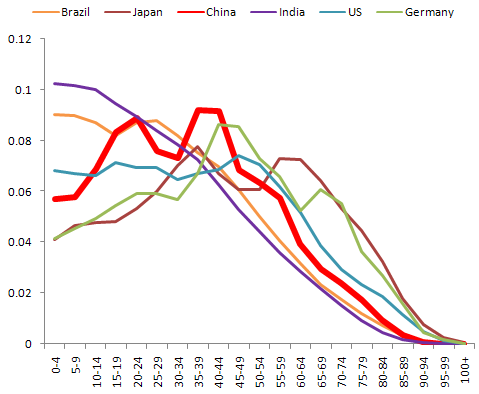
Here are the age structures of some major countries, young and old:

population structure

Vertical axis indicates the fraction of the population that resides in each age category.

Germany and Japan have the pig-in-the-python shape that results from falling birthrates. The US has a flatter age structure, presumably due to a combination of births and immigration. Brazil and India have very young populations, with the mode at the left hand side. Given the delay between birth and fertility, that builds in a lot of future growth.

Compared to Germany and Japan, China hardly seems to be on the verge of an aging crisis. In any case, given the bathtub delay between birth and maturity, a baby boom wouldn’t improve the dependency ratio for almost two decades.

More importantly, growth is not a sustainable strategy for coping with aging. At the same time that growth augments labor, it dilutes the resource base and capital available per capita. If you believe that people are the ultimate resource, i.e. that increasing returns to human capital will create offsetting technical opportunities, that might work. I rather doubt that’s a viable strategy though; human capital is more than just warm bodies (of which there’s no shortage); it’s educated and productive bodies – which are harder to get. More likely, a growth strategy just accelerates the arrival of resource constraints. In any case, the population growth play is not robust to uncertainty about future returns to human capital – if there are bumps on the technical road, it’s disastrous.

To say that population growth is a bad strategy for China is not necessarily to say that the one child policy should stay. If its enforcement is spotty, perhaps lifting it would be a good thing. Focusing on incentives and values that internalize population tradeoffs might lead to a better long term outcome than top-down control.

Painting ourselves into a green corner

At the Green California Summit & Expo this week, I saw a strange sight: a group of greentech manufacturers hanging out in the halls, griping about environmental regulations. Their point? That a surfeit of command-and-control measures makes compliance such a lengthy and costly process that it’s hard to bring innovations to market. That’s a nice self-defeating outcome!

Consider this situation:

greenCorner
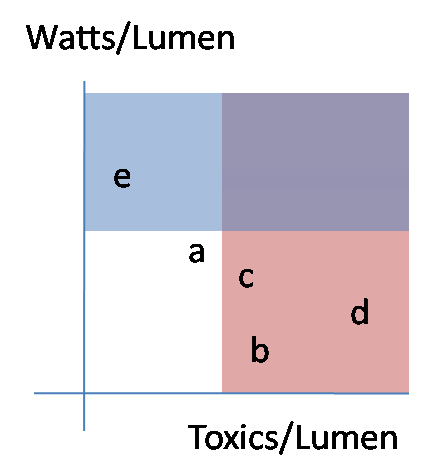
I was thinking of lighting, but it could be anything. Letters a-e represent technologies with different properties. The red area is banned as too toxic. The blue area is banned as too inefficient. That leaves only technology a. Maybe that’s OK, but what if a is made in Cuba, or emits harmful radiation, or doesn’t work in cold weather? That’s how regulations get really complicated and laden with exceptions. Also, if we revise our understanding of toxics, how should we update this to reflect the tradeoffs between toxics in the bulb and toxics from power generation, or using less toxic material per bulb vs. using fewer bulbs? Notice that the only feasible option here – a – is not even on the efficient frontier; a mix of e and b could provide the same light with slightly less power and toxics.

Proliferation of standards creates a situation with high compliance costs, both for manufacturers and the bureaucracy that has to administer them. That discourages small startups, leaving the market for large firms, which in turn creates the temptation for the incumbents to influence the regulations in self-serving ways. There are also big coverage issues: standards have to be defined clearly, which usually means that there are fringe applications that escape regulation. Refrigerators get covered by Energy Star, but undercounter icemakers and other cold energy hogs don’t. Even when the standards work, lack of a price signal means that some of their gains get eaten up by rebound effects. When technology moves on, today’s seemingly sensible standard becomes part of tomorrow’s “dumb laws” chain email.

The solution is obviously not total laissez faire; then the environmental goals just don’t get met. There probably are some things that are most efficient to ban outright (but not the bulb), but for most things it would be better to impose upstream prices on the problems – mercury, bisphenol A, carbon, or whatever – and let the market sort it out. Then providers can make tradeoffs the way they usually do – which package of options makes the cheapest product? -without a bunch of compliance risk involved in bringing their product to market.

Here’s the alternative scheme:

greenTradeoffs

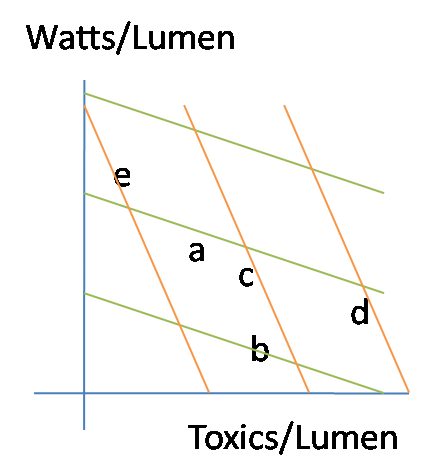
The green and orange lines represent isocost curves for two different sets of energy and toxic prices. If the unit prices of a-e were otherwise the same, you’d choose b with the green pricing scheme (cheap toxics, expensive energy) and e in the opposite circumstance (orange). If some of the technologies are uniquely valuable in some situations, pricing also permits that tradeoff – perhaps c is not especially efficient or clean, but has important medical applications.

With a system driven by prices and values, we could have very simple conversations about adaptive environmental control. Are NOx levels acceptable? If not, raise the price of emitting NOx until it is. End of discussion.

Two related tidbits:

Fed green buildings guru Kevin Kampschroer gave an interesting talk on the GSA’s greening efforts. He expressed hope that we could move from LEED (checklists) to LEEP (performance-based ratings).

I heard from a lighting manufacturer that the cost of making a CFL is under a buck, but running a recycling program (for mercury recapture) costs $1.50/bulb. There must be a lot of markup in the distribution channels to get them up to retail prices.