The rabble in the streets, calling for more power to the monarchy

When I see policies that formally allocate political power in proportion to wealth, I think back to a game I played in college, called Starpower.

It’s a simple trading game, using plastic chips. It starts with a trading round, where everyone has a chance to improve their lot by swapping to get better combinations of size and color. After trading, scores are tallied, and the players are divided into three groups: Triangles, Circles, and Squares. Then there’s a vote, in which players get to change the rules of the game. There’s a catch though: the Squares, who reaped the most points in the first round, get more votes. Subsequent rounds follow the same steps (lather, rinse, repeat).

When I played, I was lucky enough in the first round to wind up in the top group, the Squares. In the subsequent vote, no one proposed any significant rule changes, so we went back to trading. One of our fellow Squares was unlucky or incautious enough to make a few bad trades, and wound up demoted to the Circles when scores were tallied. That was a wake-up call – a challenge to the camaraderie of Squares. We promptly changed the rules, to slightly favor the accumulation of chips by those who already had many; we bribed the middle Circles to go along with it. We breathed a collective sigh of relief when, after the next trading round, we found that we were all still Squares. Then, we Squares abandoned all egalitarian thoughts. With our increased wealth, we voted to allocate future chip distributions so that the Circle and Triangle classes would perpetually trade places, never accumulating enough wealth to reach elite Square status. It worked, at least until the end of class (we were probably “saved by the bell” from having a revolution).

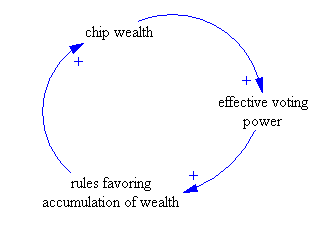
The interesting thing about the game is that it’s a perfect market economy. Property rights in chips are fully allocated, everyone walks in with a similar initial endowment of brains and chips, and there are mutual benefits to trade, even when wealth is distributed unequally. Yet the libertarian ideals are completely undone when the unequal allocation of wealth spills over to become an unequal allocation of power, where votes are weighted by money. That creates a reinforcing feedback:

starpower

Allocating votes in a zoning protest in proportion to acreage, or any other policy that matches power to wealth, has the same properties as the Starpower game, and will lead to the same ugly outcome if left unchecked. As Donella Meadows put it,

The wise Squares whom we call Founding Fathers, who set up the rules of our national game, knew that. They invented ingenious devices for giving everyone a chance to win — democratic elections, universal education, and a Bill of Rights. Out of their structure have come further methods for interrupting accumulations of power — anti-trust regulations, progressive taxation, inheritance restrictions, affirmative action programs.

All of which, you might note, have been weakened over the past decade or so. We have moved a long way toward a Starpower structure. One one the worst steps in that direction was the evolution of expensive, television-mediated election campaigns, which permit only Squares to run for office. That puts Squares increasingly in control of the rules, and they make rules to benefit Squares.

Is that the game we want to be playing?

The new Montana House of Lords

Feudalism is back in Montana – or at least if SB379 passes, we’ll be well on the way.

SB379is to protect real property owners from unreasonable land use restrictions and reductions in land value due to county zoning.” Translation: make zoning impossible by allowing a superminority of owners to protest its implementation.

The real devil is in the details:

Section 2.  Definitions. For purposes of [sections 1, 2, 4 through 9, 11, and 12], the following definitions apply:

(1) (a) “Affected property” means property taxed on an ad valorem basis on the county tax rolls and directly subject to a proposed zoning action.

(2) “Affected property owner” means the owner of affected property, including natural persons, corporations, trusts, partnerships, incorporated or unincorporated associations, and any other legal entity owning land in fee simple, as joint tenants, or as tenants in common.

(3) “Protest override procedure” means the procedures described in [sections 6 through 9].

(4) “Protesting landowner” means an affected property owner who protests a zoning action.

(5) “Successful protest” means a protest by owners of 25% or more of the affected property.

Section 5.  Protest. (1) Within 60 days of the date that notice of passage of the resolution of intention to take a zoning action pursuant to [section 4] is first published, affected property owners may protest the proposed zoning action by delivering written notification to the board of county commissioners.

Notice how this assigns the right to protest to owners on the basis of area. Owners don’t even have to be people. A protest is a de facto vote. In other words, this policy is “one acre, one vote.” This bill elevates property rights, as in the 5th Amendment,

No person shall … be deprived of life, liberty, or property, without due process of law; nor shall private property be taken for public use, without just compensation.

above the Equal Protection Clause of the 14th Amendment,

No State shall make or enforce any law which shall … deny to any person within its jurisdiction the equal protection of the laws.

If the drafters of this bill are unclear as to which principle is the more fundamental, they could consult the Declaration of Independence,

We hold these truths to be self-evident, that all men are created equal, …

Update: one could also check the Montana constitution,

Section 1. Popular sovereignty. All political power is vested in and derived from the people. All government of right originates with the people, is founded upon their will only, and is instituted solely for the good of the whole.

I’ll gladly admit that zoning is a blunt instrument. But a de facto ban on zoning, with the idea that it’s a taking, guarantees a tragedy-of-the-commons outcome (unless you live in the faux-libertarian lalaland where property rights are fully allocated, markets are complete and there are no externalities). Even if that’s the road we choose to take, the governing principle must be “one person, one vote.”

Let’s see: government of the landowners, by the landowners, for the landowners – check. Elevation of politics above science – check. Montana is two thirds of the way to the Middle Ages! All we need now is to get rid of separation of church and state.

Legislators' vision for Montana

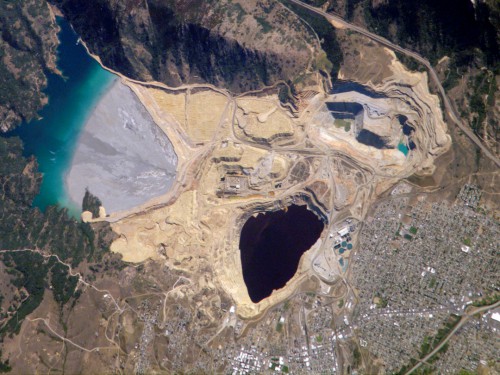
This is it: a depleted mining wasteland:

NASA Berkeley Pit

Berkeley Pit, Butte MT, NASA Earth Observatory

The spearhead is an assault on the MT constitution’s language on the environment,

All persons are born free and have certain inalienable rights. They include the right to a clean, and healthful, and economically productive environment and the rights of pursuing life’s basic necessities, enjoying and defending their lives and liberties, acquiring, possessing and protecting property, and seeking their safety, health and happiness in all lawful ways. In enjoying these rights, all persons recognize corresponding responsibilities.

What does “economically productive” add that wasn’t already covered by “pursuing … acquiring … posessing” anyway? Ironically, this could cut both ways – would it facilitate restrictions on future resource extraction, because depleted mines become economically unproductive?

Other bills attempt to legalize gravel pits in residential areas, sell coal at discount prices, and dismantle or cripple any other environmental protection you could think of.

The real kicker is Joe Read’s HB 549, AN ACT STATING MONTANA’S POSITION ON GLOBAL WARMING:

Section 1.  Public policy concerning global warming. (1) The legislature finds that to ensure economic development in Montana and the appropriate management of Montana’s natural resources it is necessary to adopt a public policy regarding global warming.

At least we’re clear up front that the coal industry is in charge!

(2) The legislature finds:

I’m sure you can guess how many qualified climate scientists are in the Montana legislature.

(a) global warming is beneficial to the welfare and business climate of Montana;

I guess Joe didn’t get the memo, that skiing and fishing could be hard hit. Maybe he thinks crops and trees do just fine with too little water and warmth, or too much.

(b) reasonable amounts of carbon dioxide released into the atmosphere have no verifiable impacts on the environment; and

Yeah, and pi is 3.2, just like it was in Indiana in 1897. I guess you could argue about the meaning of “reasonable,” but apparently Joe even rejects chemistry (ocean acidification) and biology (CO2 fertilization) along with atmospheric science.

(c) global warming is a natural occurrence and human activity has not accelerated it.

Ahh, now we’re doing detection & attribution. Legislating the answers to scientific questions is a fool’s errand. How did this text go through peer review?

(3) (a) For the purposes of this section, “global warming” relates to an increase in the average temperature of the earth’s surface.

Well, at least one sentence in this bill makes sense – at least if you assume that “average” is over time as well as space.

(b) It does not include a one-time, catastrophic release of carbon dioxide.

Where did that strawdog come from? Apparently there’s a catastrophic release of CO2 every time Joe Read opens his mouth.

A few parts per million

IMG_1937

There’s a persistent rumor that CO2 concentrations are too small to have a noticeable radiative effect on the atmosphere. (It appears here, for example, though mixed with so much other claptrap that it’s hard to wrap your mind around the whole argument – which would probably cause your head to explode due to an excess of self-contradiction anyway.)

To fool the innumerate, one must simply state that CO2 constitutes only about 390 parts per million, or .039%, of the atmosphere. Wow, that’s a really small number! How could it possibly matter? To be really sneaky, you can exploit stock-flow misperceptions by talking only about the annual increment (~2 ppm) rather than the total, which makes things look another 100x smaller (apparently a part of the calculation in Joe Bastardi’s width of a human hair vs. a 1km bridge span).

Anyway, my kids and I got curious about this, so we decided to put 390ppm of food coloring in a glass of water. Our precision in shaving dye pellets wasn’t very good, so we actually ended up with about 450ppm. You can see the result above. It’s very obviously blue, in spite of the tiny dye concentration. We think this is a conservative visual example, because a lot of the tablet mass was apparently a fizzy filler, and the atmosphere is 1000 times less dense than water, but effectively 100,000 times thicker than this glass. However, we don’t know much about the molecular weight or radiative properties of the dye.

This doesn’t prove much about the atmosphere, but it does neatly disprove the notion that an effect is automatically small, just because the numbers involved sound small. If you still doubt this, try ingesting a few nanograms of the toxin infused into the period at the end of this sentence.

Monday tidbits- tools, courses

I neglected to cross-post an interesting new Vensim model documentation tool that’s in my model library.

Shameless commerce dept.: I’m teaching Vensim courses in Palo Alto in April and Bozeman in June. Following the June offering, Ventana’s Bill Arthur will be teaching “SMLOD” – Small Models with Lots of Data – a deep technical dive into the extraction of insight from large datasets.

Bad data, bad models

Baseline Scenario has a nice post on bad data:

To make a vast generalization, we live in a society where quantitative data are becoming more and more important. Some of this is because of the vast increase in the availability of data, which is itself largely due to computers. Some is because of the vast increase in the capacity to process data, which is also largely due to computers. …

But this comes with a problem. The problem is that we do not currently collect and scrub good enough data to support this recent fascination with numbers, and on top of that our brains are not wired to understand data. And if you have a lot riding on bad data that is poorly understood, then people will distort the data or find other ways to game the system to their advantage.

In spite of ubiquitous enterprise computing, bad data is the norm in my experience with corporate consulting. At one company, I had access to very extensive data on product pricing, promotion, advertising, placement, etc., but the information system archived everything inaccessibly on a rolling 3-year horizon. That made it impossible to see long term dynamics of brand equity, which was really the most fundamental driver of the firm’s success. Our experience with large projects includes instances where managers don’t want to know the true state of the system, and therefore refuse to collect or provide needed data – even when billions are at stake. And some firms jealously guard data within stovepipes – it’s hard to optimize the system when the finance group keeps the true product revenue stream secret in order to retain leverage over the marketing group.

People worry about garbage-in-garbage out, but modeling can actually be the antidote to bad data. If you pay attention to quality, the process of building a model will reveal all kinds of gaps in data. We recently discovered that various sources of vehicle fleet data are in serious disagreement, because of double-counting of transactions and interstate sales, and undercounting of inspections. Once data issues are known, a model can be used to remove biases and filter noise (your GPS probably runs a Kalman Filter to combine a simple physical model of your trajectory with noisy satellite measurements).

Not just any model will do; causal models are important. It’s hard to discover that your data fails to observe physical laws or other reality checks with a model that permits negative cows and buries the acceleration of gravity in a regression coefficient.

The problem is, a lot of people have developed an immune response against models, because there are so many that don’t pay attention to quality and serve primarily propagandistic purposes. The only antidote for that, I think, is to teach modeling skills, or at least model consumption skills, so that they know the right questions to ask in order to separate the babies from the bathwater.

Another tangible user interface: the sandtable

This looks fun to play with: it’s a sandbox combined with digital sensing and projection tools. You shape your sand, and it maps the surface:

Digital Sandtable by Redfish Group @ Santa Fe Complex from stephen guerin on Vimeo.

Once your sandscape is constructed, you can simulate a forest fire on it, using a cigarette lighter as the ignition source, just like a real arsonist:

Lighting a fire on the Digital Sandtable from stephen guerin on Vimeo.

This isn’t quite as exciting to me as Jim Hines’ tangible user interface, because you can essentially change the initial conditions of your sandsystem, but not the structure of the model. However, it sure would be fun to play with, and could be pretty good at giving people insights about physical systems. It’s gone commercial as simtable.

I predict that this will soon go meta, with an ipad app that simulates the sandtable, allowing the user to push simsand around on the surface, flicking a lighter with a finger tap, creating the first virtual virtual forest fire environment.

The alien Hail Mary, and other climate policy plays

Cap & Trade is suspended in Europe and dead in the US, and the techno delusion may not be far behind. Some strange bedfellows have lined up behind the idea of R&D-driven climate policy. But now it appears that clean energy research is not a bipartisan no-brainer after all. Energy committee member Rand Paul’s bill would not only cut energy R&D funding by eliminating DOE altogether, it would cut our ability to even monitor the global environment by gutting NOAA and NASA. That only leaves one option:

13 In the otherwise dull year 2327, mankind successfully contacts aliens. Well, technically their answering machine, as the aliens themselves have gone to Alpha Centauri for the summer.

14 Desperate for help, humans leave increasingly stalker-y messages, turning off the aliens with how clingy our species is.

15 The aliens finally agree to equip Earth with a set of planet-saving carbon neutralizers, but work drags on as key parts must be ordered from a foreign supplier in the Small Magellanic Cloud.

16 The job comes in $3.7 quadrillion above estimate. Humanity thinks it is being taken advantage of but isn’t sure.

“20 things you didn’t know about the future,” in Discover

Seriously, where does that leave us? In terms of what we should do, I don’t think much has changed. As I wrote a while back, the climate policy table needs four legs:

  1. Prices
  2. Technology (the landscape of possibilities on which we make decisions)
  3. Institutional rules and procedures
  4. Preferences, operating within social networks

Preferences and technology are really the fundamentals among the four. Technology represents the set of options available to us for transforming energy and resources into life and play. Preferences guide how we choose among those options. Prices and rules are really just the information signals that allow us to coordinate those decisions.

However, neither preferences nor technology are as fundamental as they look. Models generally take preferences as a given, but in fact they’re endogenous. What we want on a day to day basis is far removed from our most existential needs. Instead, we construct preferences on the basis of technologies we know about, prices, rules, and the preferences and choices of others. That creates norms, fads, marketing, keep-up-with-the Joneses and other positive feedback mechanisms. Similarly, technology is more than discovery of principles and invention of devices. Those innovations don’t do anything until they’re woven into the fabric of society, guided by (you guessed it), prices, institutions, and preferences. That creates more positive feedbacks, like the chicken-egg problems of alternative fuel vehicle deployment.

If we could all get up in the morning and work out in our heads how to make Pareto-efficient decisions, we might not need prices and institutions, but we can’t, so we do. Prices matter because they’re a primary carrier of information through the economy. Not every decision is overtly economic, so we also have institutions, rules and routinized procedures to guide behavior. The key is that these signals should serve our values (the deeply held ones we’d articulate upon reflection, which might differ from the preferences revealed by transactions), not the other way around.

Preferences clearly can have a lot of direct leverage on behavior – if we all equated driving a big gas guzzler with breaking wind in a crowded elevator, we’d probably see different cars on the lot. However, most decisions are not so transparent. It’s already hard to choose “paper or plastic?” How about “desktop or server?” When you add multiple layers of supply chain and varied national origins to the picture, it becomes very hard to create a green information system paralleling the price system. It’s probably even harder to get individuals and firms to conform to such a system, when there are overwhelming evolutionary rewards to defection. Borrowing from Giraudoux, the secret to success is sustainability; once you can fake that you’ve got it made.

Similarly, the sheer complexity of society makes it hard to predict which technologies constitute a winning combination for creating low-carbon happiness. A technology-led strategy runs the risk of failing in the attempt to recreate a high-carbon lifestyle with low-carbon inputs.  I don’t think anyone has the foresight to select that portfolio. Even if we could do it, there’s no guarantee that, absent other signals, new technologies will be put to their intended uses, or that they will survive the “valley of death” between R&D and commercialization. It’s like airdropping a tyrannosaurus into an arctic ecosystem – sure, he’s got big teeth, but will he survive?

Complexity also militates against a rules-led approach. It’s simply too cumbersome to codify a rich set of tradeoffs in command-and-control regulations, which can become an impediment to innovation and are subject to regulatory capture. Also, systems like the CAFE standard create shadow prices of compliance, rather than explicit prices. This makes it hard to diagnose the effects of constraints and to coordinate them with other policies. There’s a niche for rules, but they shouldn’t be the big stick (on the other hand, eliminating the legacy of some past measures could be a win-win).

That’s why emissions pricing is really a keystone policy. Once you have prices aligned with the long term value of stable climate (and other resources), it’s easier to align the other legs of the table. Emissions prices create huge incentives for private R&D, leaving a smaller gap for government to fill – just the market failures in appropriation of benefits of technology. The points of pain where institutions are inadequate, or stand in the way of progress, will be more evident and easier to correct, and there will be less burden on policy making institutions, because they won’t have to coordinate many small programs to do the job of one big signal. Preferences will start evolving in a low-carbon direction, with rewards to those who (through luck or altruism) have already done so. Most importantly, emissions pricing gets some changes moving now, not after a decade or two of delay.

Concretely, I still think an upstream, revenue-neutral carbon tax is a practical implementation route. If there’s critical mass among trade partners, it could even evolve into a harmonized global system through the pressure of border carbon adjustments. The question is, how to get started?