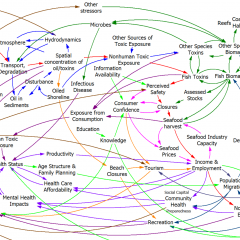
The model that ate Europe is back, and it's bigger than ever

The FuturICT Knowledge Accelerator, a grand unified model of everything, is back in the news.

What if global scale computing facilities were available that could analyse most of the data available in the world? What insights could scientists gain about the way society functions? What new laws of nature would be revealed? Could society discover a more sustainable way of living? Developing planetary scale computing facilities that could deliver answers to such questions is the long term goal of FuturICT.

I’ve been rather critical of this effort before, but I think there’s also much to like.

  • An infrastructure for curated public data would be extremely useful.
  • There’s much to be gained through a multidisciplinary focus on simulation, which is increasingly essential and central to all fields.
  • Providing a public portal into the system could have valuable educational benefits.
  • Creating more modelers, and more sophisticated model users, helps build capacity for science-based self governance.

But I still think the value of the project is more about creating an infrastructure, within which interesting models can emerge, than it is in creating an oracle that decision makers and their constituents will consult for answers to life’s pressing problems.

  • Even with Twitter and Google, usable data spans only a small portion of human existence.
  • We’re not even close to having all the needed theory to go with the data. Consider that general equilibrium is the dominant modeling paradigm in economics, yet equilibrium is not a prevalent feature of reality.
  • Combinatorial explosion can overwhelm any increase in computing power for the foreseeable future, so the very idea of simulating everything social and physical at once is laughable.
  • Even if the technical hurdles can be overcome,
    • People are apparently happy to hold beliefs that are refuted by the facts, as long as buffering stocks afford them the luxury of a persistent gap between reality and mental models.
    • Decision makers are unlikely to cede control to models that they don’t understand or can’t manipulate to generate desired results.

I don’t think you need to look any further than the climate debate and the history of Limits to Growth to conclude that models are a long way from catalyzing a sustainable world.

If I had a billion Euros to spend on modeling, I think less of it would go into a single platform and more would go into distributed efforts that are working incrementally. It’s easier to evolve a planetary computing platform than to design one.

With the increasing accessibility of computing and visualization, we could be on the verge of a model-induced renaissance. Or, we could be on the verge of an explosion of fun and pretty but vacuous, non-transparent and unvalidated model rubbish that lends itself more to propaganda than thinking. So, I’d be plowing a BIG chunk of that billion into infrastructure and incentives for model and data quality.

On the usefulness of big models

Steven Wright’s “life size map” joke is a lot older than I thought:

On Exactitude in Science
Jorge Luis Borges, Collected Fictions, translated by Andrew Hurley.
…In that Empire, the Art of Cartography attained such Perfection that the map of a single Province occupied the entirety of a City, and the map of the Empire, the entirety of a Province. In time, those Unconscionable Maps no longer satisfied, and the Cartographers Guilds struck a Map of the Empire whose size was that of the Empire, and which coincided point for point with it. The following Generations, who were not so fond of the Study of Cartography as their Forebears had been, saw that that vast Map was Useless, and not without some Pitilessness was it, that they delivered it up to the Inclemencies of Sun and Winters. In the Deserts of the West, still today, there are Tattered Ruins of that Map, inhabited by Animals and Beggars; in all the Land there is no other Relic of the Disciplines of Geography.
—Suarez Miranda,Viajes de varones prudentes, Libro IV,Cap. XLV, Lerida, 1658

It’s no less relevant to big models, though.

h/t Benjamin Blonder

In search of SD conference excellence

I was pleasantly surprised by the quality of presentations I attended at the SD conference in St. Gallen. Many of the posters were also very good – the society seems to have been successful in overcoming the booby-prize stigma, making it a pleasure to graze on the often-excellent work in a compact format (if only the hors d’oeuvre line had had brevity to match its tastiness…).

In anticipation of an even better array of papers next year, here’s my quasi-annual reminder about resources for producing good work in SD:

I suppose I should add posts on good presentation technique and poster development (thoughts welcome).

Thanks to the organizers for a well-run enterprise in a pleasant venue.

Beggaring ourselves through coal mining

Old joke: How do you make a small fortune breeding horses? Start with a large fortune ….

It appears that the same logic applies to coal mining here in the Northern Rockies.

With US coal use in slight decline, exports are the growth market. Metallurgical and steam coal currently export for about $140 and $80 per short ton, respectively. But the public will see almost none of that, because unmanaged quantity and “competitive” auctions that are uncompetitive (just like Montana trust land oil & gas), plus low royalty, rent and bonus rates, result in a tiny slice of revenue accruing to the people (via federal and state governments) who actually own the resource.

For the Powder River Basin, here’s how it pencils out in rough terms:

Item $/ton
Minemouth price $10
Royalty, rents & bonus $2
Social Cost of Carbon (@ $21/tonCo2 medium value) -$55
US domestic SCC (at 15% of global, average of 7% damage share and 23% GDP share) -$8
Net US public benefit < -$6

In other words, the US public loses at least $3 for every $1 of coal revenue earned. The reality is probably worse, because the social cost of carbon estimate is extremely conservative, and other coal externalities are omitted. And of course the global harm is much greater than the US’ narrow interest.

Even if you think of coal mining as a jobs program, at Wyoming productivity, the climate subsidy alone is almost half a million dollars per worker.

This makes it hard to get enthusiastic about the planned expansion of exports.

Global lukewarming

Fred Krupp, President of EDF, has an opinion on climate policy in the WSJ. I have to give him credit for breaking into a venue that is staunchly ignorant the realities of climate change. An excerpt:

If both sides can now begin to agree on some basic propositions, maybe we can restart the discussion. Here are two:

The first will be uncomfortable for skeptics, but it is unfortunately true: Dramatic alterations to the climate are here and likely to get worse—with profound damage to the economy—unless sustained action is taken. As the Economist recently editorialized about the melting Arctic: “It is a stunning illustration of global warming, the cause of the melt. It also contains grave warnings of its dangers. The world would be mad to ignore them.”

The second proposition will be uncomfortable for supporters of climate action, but it is also true: Some proposed climate solutions, if not well designed or thoughtfully implemented, could damage the economy and stifle short-term growth. As much as environmentalists feel a justifiable urgency to solve this problem, we cannot ignore the economic impact of any proposed action, especially on those at the bottom of the pyramid. For any policy to succeed, it must work with the market, not against it.

If enough members of the two warring climate camps can acknowledge these basic truths, we can get on with the hard work of forging a bipartisan, multi-stakeholder plan of action to safeguard the natural systems on which our economic future depends.

I wonder, though, if the price of admission was too high. Krupp equates two risks: climate impacts, and policy side effects. But this is a form of false balance – these risks are not in the same league.

Policy side effects are certainly real – I’ve warned against inefficient policies multiple times (e.g., overuse of standards). But the effects of a policy are readily visible to well-defined constituencies, mostly short term, and diverse across jurisdictions with different implementations. This makes it easy to learn what’s working and to stop doing what’s not working (and there’s never a shortage of advocates for the latter), without suffering large cumulative effects. Most of the inefficient approaches (like banning the bulb) are economically miniscule.

Climate risk, on the other hand, accrues largely to people in far away places, who aren’t even born yet. It’s subject to reinforcing feedbacks (like civil unrest) and big uncertainties, known and unknown, that lend it a heavy tail of bad outcomes, which are not economically marginal.

The net balance of these different problem characteristics is that there’s little chance of catastrophic harm from climate policy, but a substantial chance from failure to have a climate policy. There’s also almost no chance that we’ll implement a too-stringent climate policy, or that it would stick if we did.

The ultimate irony is that EDF’s preferred policy is cap & trade, which trades illusory environmental certainty for considerable economic inefficiency.

Does this kind of argument reach a wavering middle ground? Or does it fail to convince skeptics, while weakening the position of climate policy proponents by conceding strawdog growth arguments?

Algebra, Eroding Goals and Systems Thinking

A NY Times editorial wonders, Is Algebra Necessary?*

I think the short answer is, “yes.”

The basic point of having a brain is to predict the consequences of actions before taking them, particularly where those actions might be expensive or fatal. There are two ways to approach this:

  • pattern matching or reinforcement learning – hopefully with storytelling as a conduit for cumulative experience with bad judgment on the part of some to inform the future good judgment of others.
  • inference from operational specifications of the structure of systems, i.e. simulation, mental or formal, on the basis of theory.

If you lack a bit of algebra and calculus, you’re essentially limited to the first option. That’s bad, because a lot of situations require the second for decent performance.

The evidence the article amasses to support abandonment of algebra does not address the fundamental utility of algebra. It comes in two flavors:

  • no one needs to solve certain arcane formulae
  • setting the bar too high for algebra discourages large numbers of students

I think too much reliance on the second point risks creating an eroding goals trap. If you can’t raise the performance, lower the standard:

eroding goals
B. Jana, Wikimedia Commons, Creative Commons Attribution-Share Alike 3.0 Unported

This is potentially dangerous, particularly when you also consider that math performance is coupled with a lot of reinforcing feedback.

As an alternative to formal algebra, the editorial suggests more practical math,

It could, for example, teach students how the Consumer Price Index is computed, what is included and how each item in the index is weighted — and include discussion about which items should be included and what weights they should be given.

I can’t really fathom how one could discuss weighting the CPI in a meaningful way without some elementary algebra, so it seems to me that this doesn’t really solve the problem.

However, I think there is a bit of wisdom here. What earthly purpose does solving the quadratic formula serve, until one is able to map that to some practical problem space? There is growing evidence that even high-performing college students can manipulate symbols without gaining the underlying intuition needed to solve real-world problems.

I think the obvious conclusion is not that we should give up on teaching algebra, but that we should teach it quite differently. It should emerge as a practical requirement, motivated by a student-driven search for the secrets of life and systems thinking in particular.

* Thanks to Richard Dudley for pointing this out.

Is Algebra Necessary?

The Capen Quiz at the System Dynamics Conference

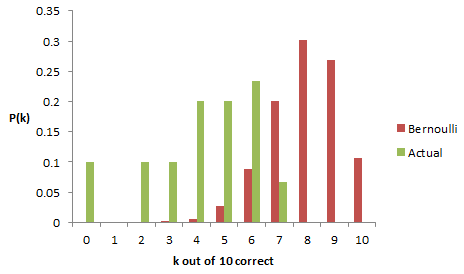
I ran my updated Capen quiz at the beginning of my Vensim mini-course on optimization and uncertainty at the System Dynamics conference. The results were pretty typical – people expressed confidence bounds that were too narrow compared to their actual knowledge of the questions. Thus their effective confidence was at the 40% level rather than the 80% level desired. Here’s the distribution of actual scores from about 30 people, compared to a Binomial (10,.8) distribution:

(I’m going from memory here on the actual distribution, because I forgot to grab the flipchart of results. Did anyone take a picture? I won’t trouble you with my confidence bounds on the the confidence bounds.)

My take on this is that it’s simply very hard to be well-calibrated intuitively, unless you dedicate time for explicit contemplation of uncertainty. But it is a learnable skill – my kids, who had taken the original Capen quiz, managed to score 7 out of 10.

Even if you can get calibrated on a set of independent questions, real-world problems where dimensions covary are really tough to handle intuitively. This is yet another example of why you need a model.

Spot the health care smokescreen

A Tea Party presentation on health care making the rounds in Montana claims that life expectancy is a smoke screen, and it’s death rates we should be looking at. The implication is that we shouldn’t envy Japan’s longer life expectancy, because the US has lower death rates, indicating superior performance of our health care system.

Which metric really makes the most sense from a systems perspective?

Here’s a simple, 2nd order model of life and death:

From the structure, you can immediately observe something important: life expectancy is a function only of parameters, while the death rate also includes the system states. In other words, life expectancy reflects the expected life trajectory of a person, given structure and parameters, while the aggregate death rate weights parameters (cohort death rates) by the system state (the distribution of population between old and young).

In the long run, the two metrics tell you the same thing, because the system comes into equilibrium such that the death rate is the inverse of the life expectancy. But people live a long time, so it might take decades or even centuries to achieve that equilibrium. In the meantime, the death rate can take on any value between the death rates of the young and old cohorts, which is not really helpful for understanding what a new person can expect out of life.

So, to the extent that health care performance is visible in the system trajectory at all, and not confounded by lifestyle choices, life expectancy is the metric that tells you about performance, and the aggregate death rate is the smokescreen.

Here’s the model: LifeExpectancyDeathRate.mdl or LifeExpectancyDeathRate.vpm

It’s initialized in equilibrium. You can explore disequilbrium situations by varying the initial population distribution (Init Young People & Init Old People), or testing step changes in the death rates.

False positives, publication bias and systems models

A PLOS Medicine paper asserts that most published results are false.

It can be proven that most claimed research findings are false

Corollary 1: The smaller the studies conducted in a scientific field, the less likely the research findings are to be true.

Corollary 2: The smaller the effect sizes in a scientific field, the less likely the research findings are to be true.

Corollary 3: The greater the number and the lesser the selection of tested relationships in a scientific field, the less likely the research findings are to be true.

Corollary 4: The greater the flexibility in designs, definitions, outcomes, and analytical modes in a scientific field, the less likely the research findings are to be true.

Corollary 5: The greater the financial and other interests and prejudices in a scientific field, the less likely the research findings are to be true.

Corollary 6: The hotter a scientific field (with more scientific teams involved), the less likely the research findings are to be true.

This somewhat alarming result arises from fairly simple statistics of false positives, publication selection bias, and causation vs. correlation problems. While the math is incontrovertible, some of the assumptions have been challenged:

… calculating the unreliability of the medical research literature, in whole or in part, requires more empirical evidence and different inferential models than were used. The claim that “most research findings are false for most research designs and for most fields” must be considered as yet unproven.

Still, the argument seems to be a matter of how much rather than whether publication bias influences findings:

We agree with the paper’s conclusions and recommendations that many medical research findings are less definitive than readers suspect, that P-values are widely misinterpreted, that bias of various forms is widespread, that multiple approaches are needed to prevent the literature from being systematically biased and the need for more data on the prevalence of false claims.

(Others propose similar challenges. There’s conflicting literature about whether (weak) observational studies hold up with (strong) randomized follow-up trials.)

This is obviously a big problem from a control perspective, because the kind of information provided by the studies in question is key to managing many systems, as in Nancy Leveson‘s pharma safety example:

It’s also leads me to a rather pointed self-question. To what extent is typical system dynamics modeling practice subject to the same kinds of biases? Can we say not only that all models are wrong, but that most are useless?

First the good news.

  • SD doesn’t usually operate in the data mining space, where large observational studies seek effects absent any a priori causal theory. That means we’re not operating where false positives are most likely to arise.
  • Often, SD practitioners are not testing our own pet theories, but those of some decision makers – perhaps even theories of competing interests in an organization.
  • SD models play a “knowledge integration” role that’s somewhat analogous to meta-analysis. A meta-analysis pools the statistics from a number of replications of some observation, which improves the signal to noise ratio, making it easier to see whether there’s any baby in the bathwater. An SD model instead pools the effect sizes of inputs (studies or anecdotes) and puts them to a functional test: do the individual components, assembled into a system, yield the observed behavior of the macro system?
  • Similarly, good SD modelers tend to supplement purely statistical inputs with Reality Checks that effectively provide additional data verification by testing extreme conditions where outcomes are known (though this is not helpful if you don’t know anything about relationships to begin with).
  • Including physics (using the term loosely to include things like conservation of people) in models also greatly constrains the space of plausible hypotheses a priori.

Now the bad news.

  • Models are often used in one-off, non-replicable strategic decision making situations, so we’ll never know. Refereed forecasting helps, but success can still be due to luck rather than skill.
  • We often have to formalize soft variable concepts for which definitions are uncertain and measurements are lacking.
  • SD models are often reliant on thin literature bases, small studies, or subject matter expertise to establish relationships. Studies with randomized control are a rarity.
  • Available data for model verification is often of low quality and short duration.
  • Data can provide a weak check on the model – if a system exhibits exponential growth, for example, one positive feedback loop in the dynamic hypothesis is as good as another (though of course good a priori explanations of the structure of the system help).

My suspicion is that savvy modelers are already well aware of just how messy and uncertain their problem domains are. Decisions will be taken, with or without a model, so the real objective is to use the model to add value by rejecting ideas that don’t work. The problem then is not that wrong models make decisions worse, but that we could probably do a lot better if we could be smarter about the possible biases in models and thinking in general.

Alex Tabarrok at Marginal Revolution has a nice take on remedies:

What can be done about these problems? (Some cribbed straight from Ioannidis and some my own suggestions.)

1) In evaluating any study try to take into account the amount of background noise. That is, remember that the more hypotheses which are tested and the less selection which goes into choosing hypotheses the more likely it is that you are looking at noise.

2) Bigger samples are better. (But note that even big samples won’t help to solve the problems of observational studies which is a whole other problem).

3) Small effects are to be distrusted.

4) Multiple sources and types of evidence are desirable.

5) Evaluate literatures not individual papers.

6) Trust empirical papers which test other people’s theories more than empirical papers which test the author’s theory.

7) As an editor or referee, don’t reject papers that fail to reject the null.

For SD modeling, I’d add a few more:

8) Reserve time for exploration of uncertainty (lots of Monte Carlo simulation).

9) Calibrate your confidence bounds.

10) Help clients to appreciate the extent and implications of uncertainty.

11) Pay attention to the language used to describe statistical concepts. Words like “expectation” and “significance” that have specific mathematical interpretations don’t mean the same thing to managers.

11) Look for robust policies that work irrespective of uncertain relationships.

12) Explicitly seek out and test alternative hypotheses (This sounds like it’s at odds with Corollary 3 above, but I think it’s the right thing to do. Testing multiple hypotheses in the context of the model is not the same thing as mining data for multiple relationships.).

13) If you can’t estimate something directly from data, or back it up with literature (more than a single paper), at least articulate some bounds on the effect, perhaps through experiments with a submodel.

What do you think? When is modeling and statistical analysis helpful, and when is it risky business?