Doing quality simulation research

Unless the Journal of Irreproducible Results is your target, you should check out this paper:

Rahmandad, H., Sterman J., (forthcoming). Reporting Guidelines for Simulation-based Research in Social Sciences

Abstract: Reproducibility of research is critical for the healthy growth and accumulation of reliable knowledge, and simulation-based research is no exception. However, studies show many simulation-based studies in the social sciences are not reproducible. Better standards for documenting simulation models and reporting results are needed to enhance the reproducibility of simulation-based research in the social sciences. We provide an initial set of Reporting Guidelines for Simulation-based Research (RGSR) in the social sciences, with a focus on common scenarios in system dynamics research. We discuss these guidelines separately for reporting models, reporting simulation experiments, and reporting optimization results. The guidelines are further divided into minimum and preferred requirements, distinguishing between factors that are indispensable for reproduction of research and those that enhance transparency. We also provide a few guidelines for improved visualization of research to reduce the costs of reproduction. Suggestions for enhancing the adoption of these guidelines are discussed at the end.

I should add that this advice isn’t just for the social sciences, nor just for research. Business and public policy models developed by consultants should be no less replicable, even if they remain secret. This is not only a matter of intellectual honesty; it’s a matter of productivity (documented components are easier to reuse) and learning (if you don’t keep track of what you do, you can’t identify and learn from mistakes when reality evolves away from your predictions).

This reminds me that I forgot to plug my annual advice on good writing for the SD conference:

I’m happy to report that the quality of papers in the thread I see was higher than usual (or at least the variance was lower – no plenary blockbuster, but also no dreadful, innumerate, ungrammatical horrors to wade through).

The vicious cycle of ignorance

XKCD:

XKCD - Forgot Algebra

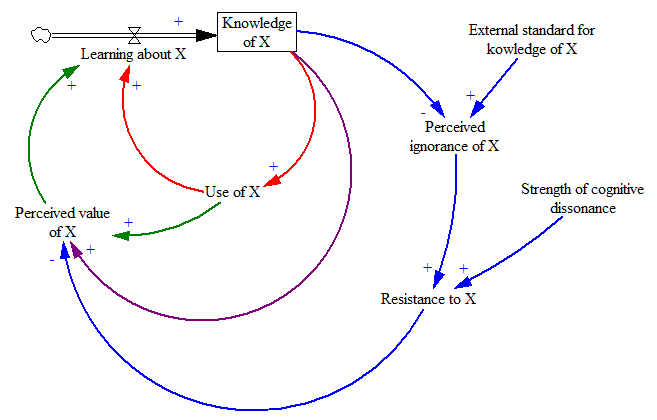
Here’s my quick take on the feedback structure behind this:

Knowledge of X (with X = algebra, cooking, …) is at the heart of a nest of positive feedback loops that make learning about X subject to vicious or virtuous cycles.

  • The more you know about X, the more you find opportunities to use it, and vice versa. If you don’t know calculus, you tend to self-select out of engineering careers, thus fulfilling the “I’ll never use it” prophecy. Through use, you learn by doing, and gain further knowledge.
  • Similarly, the more use you get out of X, the more you perceive it as valuable, and the more motivated you are to learn about it.
  • When you know more, you also may develop intrinsic interest or pride of craft in the topic.
  • When you confront some external standard for knowledge, and find yourself falling short, cognitive dissonance can kick in. Rather than thinking, “I really ought to up my game a bit,” you think, “algebra is for dorks, and those pointy-headed scientists are just trying to seize power over us working stiffs.”

I’m sure this could be improved on, for example by recognizing that attitudes are a stock.

Still, it’s easy to see here how algebra education goes wrong. In school, the red and green loops are weak, because there’s typically no motivating application more compelling than a word problem. Instead, there’s a lot of reliance on external standards (grades and testing), which encourages resistance.

A possible remedy therefore is to drive education with real-world projects, so that algebra emerges as a tool with an obvious need, emphasizing the red and green loops over the blue. An interesting real-world project might be self-examination of the role of the blue loop in our lives.


Bathtub Statistics

The pitfalls of pattern matching don’t just apply to intuitive comparisons of the behavior of associated stocks and flows. They also apply to statistics. This means, for example, that a linear regression like

stock = a + b*flow + c*time + error

is likely to go seriously wrong. That doesn’t stop such things from sneaking into the peer reviewed literature though. A more common quasi-statistical error is to take two things that might be related, measure their linear trends, and declare the relationship falsified if the trends don’t match. This bogus reasoning remains a popular pastime of climate skeptics, who ask, how could temperature go down during some period when emissions went up? (See this example.) This kind of naive naive statistical reasoning, with static mental models of dynamic phenomena, is hardly limited to climate skeptics though.

Given the dynamics, it’s actually quite easy to see how such things can occur. Here’s a more complete example of a realistic situation:

At the core, we have the same flow driving a stock. The flow is determined by a variety of test inputs , so we’re still not worrying about circular causality between the stock and flow. There is potentially feedback from the stock to an outflow, though this is not active by default. The stock is also subject to other random influences, with a standard deviation given by Driving Noise SD. We can’t necessarily observe the stock and flow directly; our observations are subject to measurement error. For purposes that will become evident momentarily, we might perform some simple manipulations of our measurements, like lagging and differencing. We can also measure trends of the stock and flow. Note that this still simplifies reality a bit, in that the flow measurement is instantaneous, rather than requiring its own integration process as physics demands. There are no complications like missing data or unequal measurement intervals.

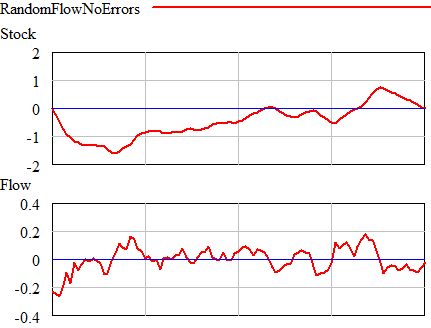
Now for an experiment. First, suppose that the flow is random (pink noise) and there are no measurement errors, driving noise, or outflows. In that case, you see this:

Once could actually draw some superstitious conclusions about the stock and flow time series above by breaking them into apparent episodes, but that’s quite likely to mislead unless you’re thinking explicitly about the bathtub. Looking at a stock-flow scatter plot, it appears that there is no relationship:
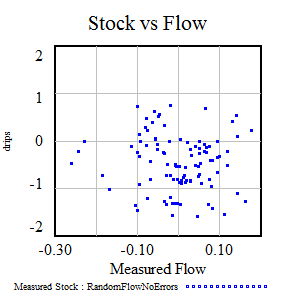

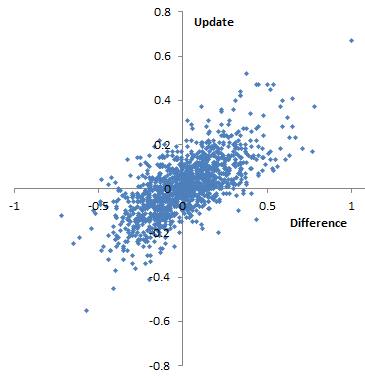
Of course, we know this is wrong because we built the model with perfect Flow->Stock causality. The usual statistical trick to reveal the relationship is to undo the integration by taking the first difference of the stock data. When you do that, plotting the change in the stock vs. the flow (lagged one period to account for the differencing), the relationship reappears: Continue reading “Bathtub Statistics”

Bathtub Dynamics

Failure to account for bathtub dynamics is a basic misperception of system structure, that occurs even in simple systems that lack feedback. Research shows that pattern matching, a common heuristic, leads even highly educated people to draw incorrect conclusions about systems as simple as the entry and exit of people in a store.

This can occur in any stock-flow system, which means that it’s ubiquitous. Here’s the basic setup:

Replace “Flow” and “Stock” with your favorite concepts – income and bank balance, sales rate and installed base, births and rabbits, etc. Obviously the flow causes the stock – by definition, the flow rate is the rate of change of the stock level. There is no feedback here; just pure integration, i.e. the stock accumulates the flow.

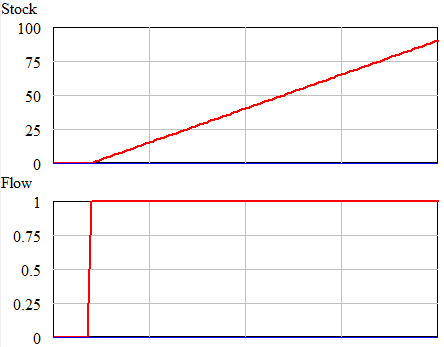
The pattern matching heuristic attempts to detect causality, or make predictions about the future, by matching the temporal patterns of cause and effect. So, naively, a pattern matcher expects to see a step in the stock in response to a step in the flow. But that’s not what happens:

Pattern matching fails because we shouldn’t expect the patterns to match through an integration. Above, the integral of the step ( flow = constant ) is a ramp ( stock = constant * time ). Other patterns are possible. For example, a monotonically decreasing cause (flow) can yield an increasing effect (stock), or even nonmonotonic behavior if it crosses zero: Continue reading “Bathtub Dynamics”

Bathtub Statistics sandbox

See my related blog posts:

https://metasd.com/2012/05/bathtub-dynamics/

https://metasd.com/2012/05/bathtub-statistics/

The model uses macros for pink noise generation and second-order trend smoothing, so it requires Vensim Pro or DSS or the free Model Reader.

integration3.mdl

Update: new version.

  • Runs in PLE (no macros)
  • Packaged .vpmx version for the Model Reader
  • Includes a set of .cin files containing some interesting cases
  • Some cosmetic improvements

BathtubStatistics-integration6.zip

Unskeptical skepticism

Atmospheric CO2 doesn’t drive temperature, and temperature doesn’t drive CO2. They drive each other, in a feedback loop. Each relationship involves integration – CO2 accumulates temperature changes through mechanisms like forest growth and ocean uptake, and temperature is the accumulation of heat flux controlled by the radiative effects of CO2.

This has been obvious for at least decades, yet it still eludes many. A favorite counter-argument for an influence of CO2 on temperature has long been the observation that temperature appears to lead CO2 at turning points in the ice core record. Naively, this violates the requirement for establishing causality, that cause must precede effect. But climate is not a simple system with binary states and events, discrete time and single causes. In a feedback system, the fact that X lags Y by some discernible amount doesn’t rule out an influence of Y on X; in fact such bidirectional causality is essential for simple oscillators.

A newish paper by Shakun et al. sheds some light on the issue of ice age turning points. It turns out that much of the issue is a matter of data – that ice core records are not representative of global temperatures. But it still appears that CO2 is not the triggering mechanism for deglaciation. The authors speculate that the trigger is northern hemisphere temperatures, presumably driven by orbital insolation changes, followed by changes in ocean circulation. Then CO2 kicks in as amplifier. Simulation backs this up, though it appears to me from figure 3 that models capture the qualitative dynamics, but underpredict the total variance in temperature over the period. To me, this is an interesting step toward a more complete understanding of ice age terminations, but I’ll wait for a few more papers before accepting declarations of victory on the topic.

Predictably, climate skeptics hate this paper. For example, consider Master Tricksed Us! at WattsUpWithThat. Commenters positively drool over the implication that Shakun et al. “hid the incline” by declining to show the last 6000 years for proxy temperature/CO2 relationship.

I leave the readers to consider the fact that for most of the Holocene, eight millennia or so, half a dozen different ice core records say that CO2 levels were rising pretty fast by geological standards … and despite that, the temperatures have been dropping over the last eight millennia …

But not so fast. First, there’s no skepticism about the data. Perhaps Shakun et al. omitted the last 6k years for a good reason, like homogeneity. A spot check indicates that there might be issues – series MD95-2037 ends in the year 6838 BP, for example. So, perhaps the WUWT graph merely shows spatial selection bias in the dataset. Second, the implication that rising CO2 and falling temperatures somehow disproves a CO2->temperature link is yet another failure to appreciate bathtub dynamics and multivariate causality.

This credulous fawning over the slightest hint of a crack in mainstream theory strikes me as the opposite of skepticism. The essence of a skeptical attitude, I think, is to avoid early lock-in to any one pet theory or data stream. Winning theories emerge from testing lots of theories against lots of constraints. That requires continual questioning of models and data, but also questioning of the questions. Objections that violate physics like accumulation, or heaps of mutually exclusive objections, have to be discarded like any other failed theory. The process should involve more than fools asking more questions than a wise man can answer. At the end of the day, “no theory is possible” is itself a theory that implies null predictions that can be falsified like any other, if it’s been stated explicitly enough.

Burt Rutan's climate causality confusion

I’ve always thought Burt Rutan was pretty cool, so I was rather disappointed when he signed on to a shady climate op-ed in the WSJ (along with Scott Armstrong). I was curious what Rutan’s mental model was, so I googled and found his arguments summarized in an extensive slide deck, available here.

It would probably take me 98 posts to detail the problems with these 98 slides, so I’ll just summarize a few that are particularly noteworthy from the perspective of learning about complex systems.

Data Quality

Rutan claims to be motivated by data fraud,

In my background of 46 years in aerospace flight testing and design I have seen many examples of data presentation fraud. That is what prompted my interest in seeing how the scientists have processed the climate data, presented it and promoted their theories to policy makers and the media. (here)

This is ironic, because he credulously relies on much fraudulent data. For example, slide 18 attempts to show that CO2 concentrations were actually much higher in the 19th century. But that’s bogus, because many of those measurements were from urban areas or otherwise subject to large measurement errors and bias. You can reject many of the data points on first principles, because they imply physically impossible carbon fluxes (500 billion tons in one year).

Slides 32-34 also present some rather grossly distorted comparisons of data and projections, complete with attributions of temperature cycles that appear to bear no relationship to the data (Slide 33, right figure, red line).

Slides 50+ discuss the urban heat island effect and surfacestations.org effort. Somehow they neglect to mention that the outcome of all of that was a cool bias in the data, not a warm bias.

Bathtub Dynamics

Slides 27 and 28 seek a correlation between the CO2 and temperature time series. Failure is considered evidence that temperature is not significantly influenced by CO2. But this is a basic failure to appreciate bathtub dynamics. Temperature is an indicator of the accumulation of heat. Heat integrates radiative flux, which depends on GHG concentrations. So, even in a perfect system where CO2 is the only causal influence on temperature, we would not expect to see matching temporal trends in emissions, concentrations, and temperatures. How do you escape engineering school and design airplanes without knowing about integration?

Correlation and causation

Slide 28 also engages in the fallacy of the single cause and denying the antecedent. It proposes that, because warming rates were roughly the same from 1915-1945 and 1970-2000, while CO2 concentrations varied, CO2 cannot be the cause of the observations. This of course presumes (falsely) that CO2 is the only influence on temperatures, neglecting volcanoes, endogenous natural variability, etc., not to mention blatantly cherry-picking arbitrary intervals.

Slide 14 shows another misattribution of single cause, comparing CO2 and temperature over 600 million years, ignoring little things like changes in the configuration of the continents and output of the sun over that long period.

In spite of the fact that Rutan generally argues against correlation as evidence for causation, Slide 46 presents correlations between orbital factors and sunspots (the latter smoothed in some arbitrary way) as evidence that these factors do drive temperature.

Feedback

Slide 29 shows temperature leading CO2 in ice core records, concluding that temperature must drive CO2, and not the reverse. In reality, temperature and CO2 drive one another in a feedback loop. That turning points in temperature sometimes lead turning points in CO2 does not preclude CO2 from acting as an amplifier of temperature changes. (Recently there has been a little progress on this point.)

Too small to matter

Slide 12 indicates that CO2 concentrations are too small to make a difference, which has no physical basis, other than the general misconception that small numbers don’t matter.

Computer models are not evidence

So Rutan claims on slide 47. Of course this is true in a trivial sense, because one can always build arbitrary models that bear no relationship to anything.

But why single out computer models? Mental models and pencil-and-paper calculations are not uniquely privileged. They are just as likely to fail to conform to data, laws of physics, and rules of logic as a computer model. In fact, because they’re not stated formally, testable automatically, or easily shared and critiqued, they’re more likely to contain some flaws, particularly mathematical ones. The more complex a problem becomes, the more the balance tips in favor of formal (computer) models, particularly in non-experimental sciences where trial-and-error is not practical.

There’s also no such thing as model-free inference. Rutan presents many of his charts as if data speaks for itself. In fact, no measurements can be taken without a model of the underlying process to be measured (in a thermometer, the thermal expansion of a fluid). More importantly, event the simplest trend calculation or comparison of time series implies a model. Leaving that model unstated just makes it easier to engage in bathtub fallacies and other errors in reasoning.

The bottom line

The problem here is that Rutan has no computer model. So, he feels free to assemble a dog’s breakfast of data, sourced from illustrious scientific institutions like the Heritage Foundation (slide 12), and call it evidence. Because he skips the exercise of trying to put everything into a rigorous formal feedback model, he’s received no warning signs that he has strayed far from reality.

I find this all rather disheartening. Clearly it is easy for a smart, technical person to be wildly incompetent outside his original field of expertise. But worse, it’s even easy for them to assemble a portfolio of pseudoscience that looks like evidence, capitalizing on past achievements to sucker a loyal following.

Strange times for Europe's aviation carbon tax

The whole global climate negotiation process is a bit of a sideshow, in that negotiators don’t have the freedom to actually agree to anything meaningful. When they head to Poznan, or Copenhagen, or Durban, they get their briefings from finance and economic ministries, not environment ministries. The mandates are evidently that there’s no way most countries will agree to anything like the significant emissions cuts needed to achieve stabilization.

That’s particularly clear at the moment, with Europe imposing a carbon fee on flights using their airspace, and facing broad opposition. And what opponent makes the biggest headlines? India’s environment minister – possibly the person on the planet who should be happiest to see any kind of meaningful emissions policy anywhere.

Clearly, climate is not driving the bus.

A Titanic feedback reversal

Ever get in a hotel shower and turn the faucet the wrong way, getting scalded or frozen as a result? It doesn’t help when the faucet is unmarked or backwards. If a new account is correct, that’s what happened to the Titanic.

(Reuters) – The Titanic hit an iceberg in 1912 because of a basic steering error, and only sank as fast as it did because an official persuaded the captain to continue sailing, an author said in an interview published on Wednesday.

“They could easily have avoided the iceberg if it wasn’t for the blunder,” Patten told the Daily Telegraph.

“Instead of steering Titanic safely round to the left of the iceberg, once it had been spotted dead ahead, the steersman, Robert Hitchins, had panicked and turned it the wrong way.”

Patten, who made the revelations to coincide with the publication of her new novel “Good as Gold” into which her account of events are woven, said that the conversion from sail ships to steam meant there were two different steering systems.

Crucially, one system meant turning the wheel one way and the other in completely the opposite direction.

Once the mistake had been made, Patten added, “they only had four minutes to change course and by the time (first officer William) Murdoch spotted Hitchins’ mistake and then tried to rectify it, it was too late.”

It sounds like the steering layout violates most of Norman’s design principles (summarized here):

  1. Use both knowledge in the world and knowledge in the head.
  2. Simplify the structure of tasks.
  3. Make things visible: bridge the Gulfs of Execution and Evaluation.
  4. Get the mappings right.
  5. Exploit the power of constraints, both natural and artificial.
  6. Design for error.
  7. When all else fails, standardize.

Notice that these are really all about providing appropriate feedback, mental models, and robustness.

(This is a repost from Sep. 22, 2010, for the 100 year anniversary).