Illustrations of a ‘Normal’ (first order) Outflow, a Delay Outflow, and a Fixed Delay Outflow
LEARN_comparison_of_delay_n_and_delay_fixed_etc_RGD (Vensim .vmf)
Don't just do something, stand there! Reflections on the counterintuitive behavior of complex systems, seen through the eyes of System Dynamics, Systems Thinking and simulation.
Illustrations of a ‘Normal’ (first order) Outflow, a Delay Outflow, and a Fixed Delay Outflow
LEARN_comparison_of_delay_n_and_delay_fixed_etc_RGD (Vensim .vmf)
Contributed by Bruce Skarin
Introduction
This model is the product of my Major Qualifying Project (MQP) for my Bachelors degree in the field of system dynamics at Worcester Polytechnic Institute. There were two goals to this project:
1) To develop a model that reasonably simulates the historic attacks by the al-Qaida terrorist network against the United States.
2) To evaluate the usefulness of the model for developing public understanding of the terrorism problem.
The full model and report are available on my website.
Reference Mode
The reference mode for this model was the escalation of attacks linked to al-Qaida against the U.S., as shown below. The data for this chart is available through this Google Document.

Causal View of the Model
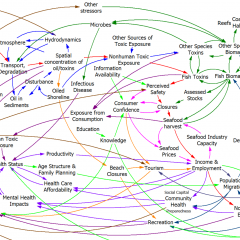
Below is the causal diagram of the primary feedback loops in the model.
Online Story Model
There is an online story version that explains the primary model structure as well as complete iThink and Vensim models on my MQP page.
Model Name: payments, penalties, and environmental ethic
Citation: Dudley, R. 2007. Payments, penalties, payouts, and environmental ethics: a system dynamics examination Sustainability: Science, Practice, & Policy 3(2):24-35. http://ejournal.nbii.org/archives/vol3iss2/0706-013.dudley.html.
Source: Richard G. Dudley
Copyright: Richard G. Dudley (2007)
License: Gnu GPL
Peer reviewed: Yes (probably when submitted for publication?)
Units balance: Yes
Format: Vensim
Target audience: People interested in the concept of payments for environmental services as a means of improving land use and conservation of natural resources.
Questions answered: How might land users’ environmental ethic be influenced by, and influence, payments for environmental services.
Software: Vensim
Submitted by Richard Dudley:
Models in the Special Issue of the System Dynamics Review on Environmental and Resource Systems, Andrew Ford & Robert Cavana, Editors. System Dynamics Review, Volume 20, Number 2, Summer of 2004.
See the following web site for article summaries and downloadable models described in this special issue: http://www.wsu.edu/~forda/SIOpen.html
Long ago, in the MIT SD PhD seminar, a group of us replicated and critiqued a number of classic models. Some of those formed the basis for my model library. Around that time, Liz Keating wrote a nice summary of “How to Critique a Model.” That used to be on my web site in the mid-90s, but I lost track of it. I haven’t seen an adequate alternative, so I recently tracked down a copy. Here it is: SD Model Critique (thanks, Liz). I highly recommend a look, especially with the SD conference paper submission deadline looming.
This is the first of several posts on models of the transition to alternative fuel vehicles. The first looks at a static equilibrium model of the California Low Carbon Fuel Standard (LCFS). Another will look at another model of the LCFS, called VISION-CA, which generates fuel carbon intensity scenarios. Finally, I’ll discuss Jeroen Struben’s thesis, which is a full dynamic model that closes crucial loops among vehicle fleets, consumer behavior, fueling infrastructure, and manufacturers’ learning. At some point I will try to put the pieces together into a general reflection on alt fuel policy.
Those who know me might be surprised to see me heaping praise on a static model, but I’m about to do so. Not every problem is dynamic, and sometimes a comparative statics exercise yields a lot of insight.
In a no-longer-so-new paper, Holland, Hughes, and Knittel work out the implications of the LCFS and some variants. In a nutshell, a low carbon fuel standard is one of a class of standards that requires providers of a fuel (or managers of some kind of portfolio) to meet some criteria on average – X grams of carbon per MJ of fuel energy, or Y% renewable content, for example. If trading is allowed (fun, no?), then the constraint effectively applies to the market portfolio as a whole, rather than to individual providers, which should be more efficient. The constraint in effect requires the providers to set up an internal tax and subsidy system – taxing products that don’t meet the standard, and subsidizing those that do. The LCFS sounds good on paper, but when you do the math, some problems emerge:
We show this decreases high-carbon fuel production but increases low-carbon fuel production, possibly increasing net carbon emissions. The LCFS cannot be efficient, and the best LCFS may be nonbinding. We simulate a national LCFS on gasoline and ethanol. For a broad parameter range, emissions decrease; energy prices increase; abatement costs are large ($80-$760 billion annually); and average abatement costs are large ($307-$2,272 per CO tonne). A cost effective policy has much lower average abatement costs ($60-$868).
Continue reading “A Tale of Three Models – LCFS in Equilibrium”
Not to be outdone by Utah, South Dakota has passed its own climate resolution.
They raise the ante – where Utah cherry-picked twelve years of data, South Dakotans are happy with only 8. Even better, their pattern matching heuristic violates bathtub dynamics:
WHEREAS, the earth has been cooling for the last eight years despite small increases in anthropogenic carbon dioxide
They have taken the skeptic claim, that there’s little warming in the tropical troposphere, and bumped it up a notch:
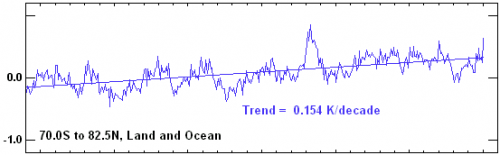
WHEREAS, there is no evidence of atmospheric warming in the troposphere where the majority of warming would be taking place
Nope, no trend here:
I linked some newish work on sea level by Aslak Grinsted et al. in my last post. There are some other new developments:
On the data front, Rohling et al. investigate sea level over the last half a million years and in the Pliocene (3+ million years ago). Here’s the relationship between CO2 and Antarctic temperatures:

Two caveats and one interesting observation here:
I’m waaayyy overdue for an update on sea level models.
I’ve categorized my 6 previous posts on the Rahmstorf (2007) and Grinsted et al. models under sea level.
I had some interesting correspondence last year with Aslak Grinsted.
I agree with the ellipsis idea that you show in the figure on page IV. However, i conclude that if i use the paleo temperature reconstructions then the long response times are ‘eliminated’. You can sort of see why on this page: Fig2 here illustrates one problem with having a long response time:
http://www.glaciology.net/Home/Miscellaneous-Debris/rahmstorf2007lackofrealism
It seems it is very hard to make the turn at the end of the LIA with a large inertia.
I disagree with your statement “this suggests to me that G’s confidence bounds, +/- 67 years on the Moberg variant and +/- 501 years on the Historical variant are most likely slices across the short dimension of a long ridge, and thus understate the true uncertainty of a and tau.”
The inverse monte carlo method is designed not to “slice across” the distributions. I think the reason we get so different results is that your payoff function is very different from my likelihood function – as you also point out on page VI.
Aslak is politely pointing out that I screwed up one aspect of the replication. We agree that the fit payoff surface is an ellipse (I think the technical I used was “banana-ridge”). However, my hypothesis about the inexplicably narrow confidence bounds in the Grinsted et al. paper was wrong. It turns out that the actual origin of the short time constant and narrow confidence bounds is a constraint that I neglected to implement. The constraint involves the observation that variations in sea level over the last two millenia have been small. That basically chops off most of the long-time-constant portion of the banana, leaving the portion described in the paper. I’ve confirmed this with a quick experiment.
Daniel Sarewitz has a recent column in Nature (paywall, unfortunately). It contains some wisdom, but the overall drift conclusion is bonkers.
First, the good stuff: Sarewitz rightly points out the folly of thinking that more climate science (like regional downscaling) will lead to action where existing science has failed to yield any. Similarly, he observes that good scientific information about the vulnerability of New Orleans didn’t lead to avoidance of catastrophe.
For complex, long-term problems such as climate change or nuclear-waste disposal, the accuracy of predictions is often unknowable, uncertainties are difficult to characterize and people commonly disagree about the outcomes they desire and the means to achieve them. For such problems, the belief that improved scientific predictions will compel appropriate behaviour and lead to desired outcomes is false.
Then things go off the rails. Continue reading “Earthquakes != climate”