NUMMI – an innovation killed by its host's immune system?

This American Life had a great show on the NUMMI car plant, a remarkable joint venture between Toyota and GM. It sheds light on many of the reasons for the decline of GM and the American labor movement. More generally, it’s a story of a successful innovation that failed to spread, due to policy resistance, inability to confront worse-before-better behavior and other dynamics.

I noticed elements of a lot of system dynamics work in manufacturing. Here’s a brief reading list:

Montana's climate future

A selection of data and projections on past and future climate in Montana:

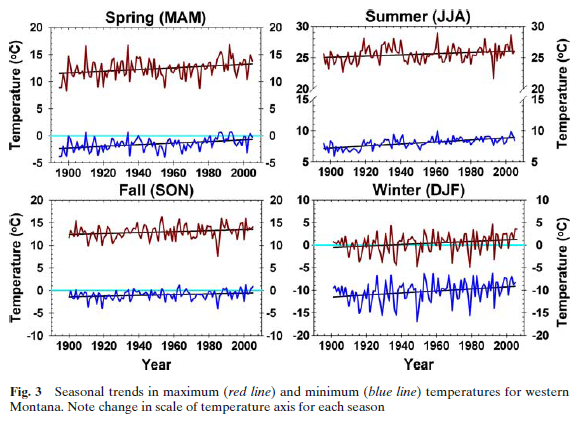
Temperature Trends Western MT

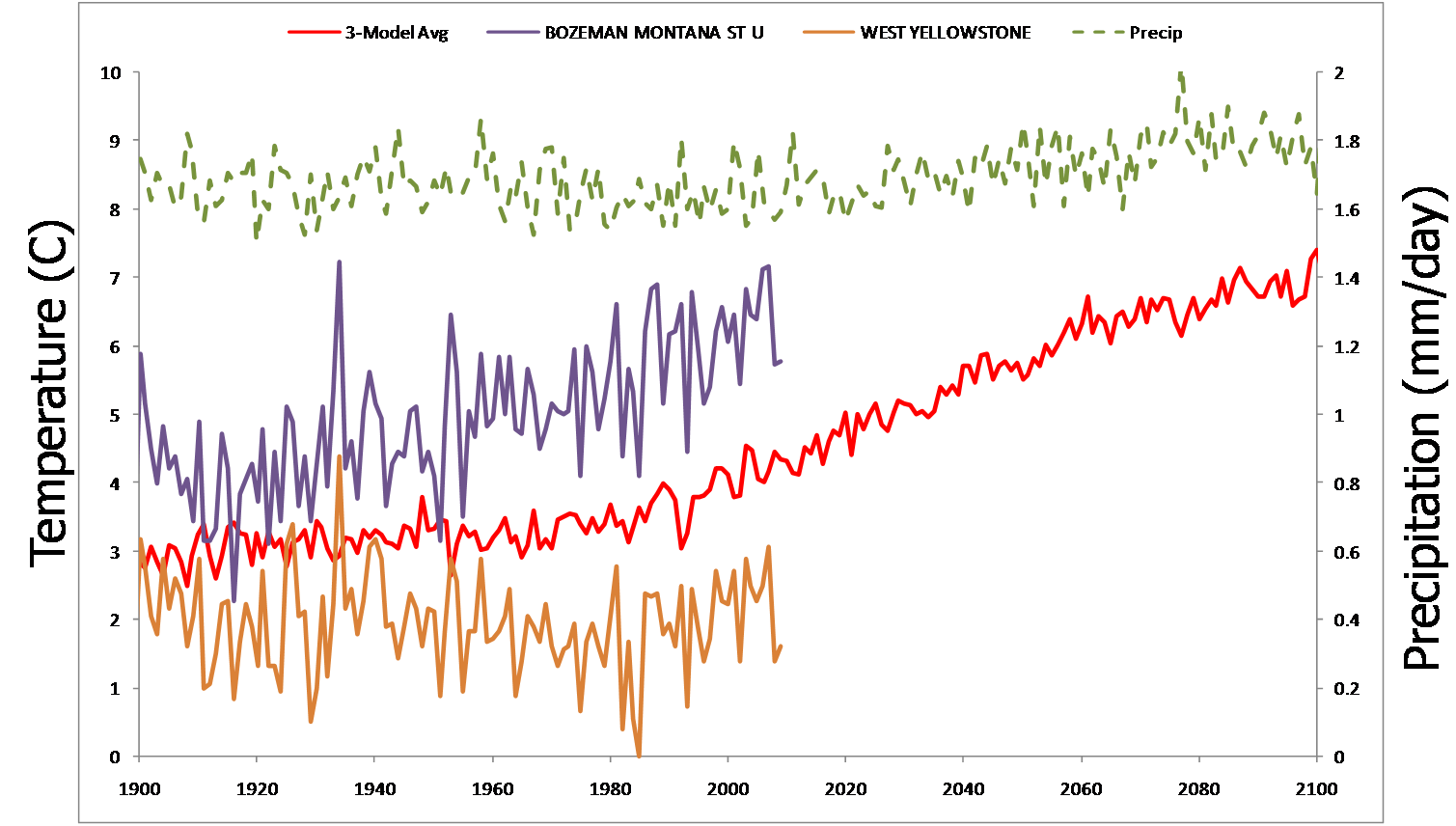
Pederson et al. (2010) A century of climate and ecosystem change in Western Montana: what do temperature trends portend? Climatic Change 98:133-154. It’s hard to read precisely off the graph, but there have been significant increases in maximum and minimum temperatures, with the greatest increases in the minimums and in winter – exactly what you’d expect from a change in radiative properties. As a result the daily temperature range has shrunk slightly and there are fewer below freezing and below zero days. That last metric is critical, because it’s the severe cold that controls many forest pests. There’s much more on this in a poster.

Model Futures

Not every station shows a trend – the figure above contrasts Bozeman (purple, strong trend) with West Yellowstone (orange, flat). The Bozeman trend is probably not an urban heat island effect – surfacestations.org thinks it’s a good site, and White Sulphur (a nice sleepy town up the road a piece) is about the same. The red line is an ensemble of  simulations (GISS, CCSM & ECHAM5) from climexp.knmi.nl, projected into the future with A1B forcings (i.e., a fairly high emissions trajectory). I interpolated the data to latitude 47.6, longitude -110.9 (roughly my house, near Bozeman). Simulated temperature rises about 4C, while precipitation (green) is almost unmoved. If that came true, Montana’s future climate might be a lot like current central Utah.

NovelDisappearingClimates

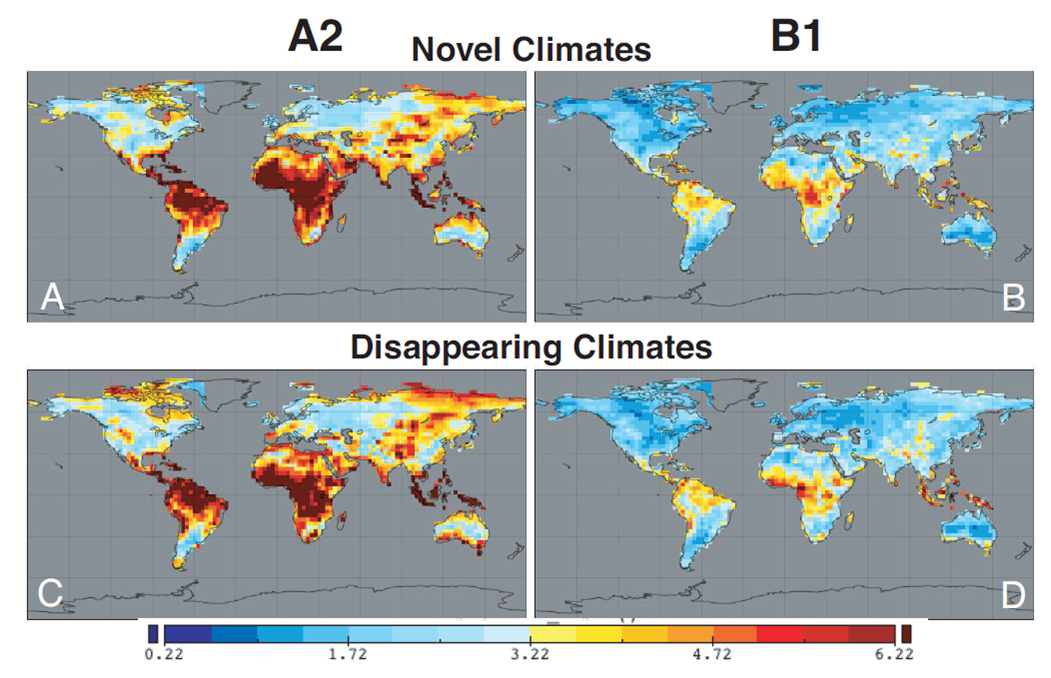
The figure above – from John W. Williams, Stephen T. Jackson, and John E. Kutzbach. Projected distributions of novel and disappearing climates by 2100 AD. PNAS, vol. 104 no. 14 – shows global grid points that have no neighbors within 500km that now have a climate like what the future might bring. In panel C (disappearing climates with the high emissions A2 scenario), there’s a hotspot right over Montana. Presumably that’s loss of today’s high altitude ecosystems. As it warms up, climate zones move uphill, but at the top of mountains there’s nowhere to go. That’s why pikas may be in trouble.

pika

MT Field Guide

Sea Level Roundup

Realclimate has Martin Vermeer’s reflections on the making of his recent sea level paper with Stefan Rahmstorf. At some point I hope to post a replication of that study, in a model with the Grinsted and Rahmstorf 2007 structures, but I haven’t managed to replicate it yet. The problem may be that I haven’t yet tackled the reservoir storage issue.

At Nature Reports, Olive Heffernan introduces several sea level articles. Rahmstorf contrasts the recent set of semi-empirical models, predicting sea level of a meter or more this century, with the AR4 finding. Lowe and Gregory wonder if the semi-empirical models are really seeing enough of the dynamic ice signal to have predictive power, and worry about overadaptation to high scenarios. Mark Schrope reports on underadaptation – vulnerable developments in Florida. Mason Inman reports on ecological engineering, a softer approach to coastal defense.

Who eats the risk?

From the Asilomar geoengineering conference, via WorldChanging:

Lesson two: Nobody has any clear idea how to resolve the inequalities inherent in geoengineering. One of the most quoted remarks at the conference came from Pablo Suarez, the associate director of programs with the Red Cross/Red Crescent Climate Centre, who asked during one plenary session, “Who eats the risk?” In Suarez’s view, geoengineering is all about shifting the risk of global warming from rich nations — i.e., those who can afford the technologies to manipulate the climate — to poor nations. Suarez admitted that one way to resolve this might be for rich nations to pay poor nations for the damage caused by, say, shifting precipitation patterns. But that conjured up visions of Bangladeshi farmers suing Chinese geoengineers for ruining their rice crop — a legalistic can of worms that nobody was willing to openly explore.

If geoengineering is a for-profit operation, it presumably also involves the public bearing the risk of private acts, because investors aren’t likely to have an appetite for the essentially unlimited liability.

US manufacturing … are you high?

The BBC today carries the headline, “US manufacturing output hits 6 year high.” That sounded like an April Fool’s joke. Sure enough, FRED shows manufacturing output 15% below its 2007 peak at the end of last year, a gap that would be almost impossible to make up in a quarter. The problem is that the ISM-PMI index reported by the BBC is a measure of growth, not absolute level. The BBC has confused the stock (output) with the flow (output growth). In reality, things are improving, but there’s still quite a bit of ground to cover to recover the peak.

One child at the crossroads

China’s one child policy is at its 30th birthday. Inside-Out China has a quick post on the debate over the future of the policy. That caught my interest, because I’ve seen recent headlines calling for an increase in China’s population growth to facilitate dealing with an aging population – a potentially disastrous policy that nevertheless has adherents in many countries, including the US.

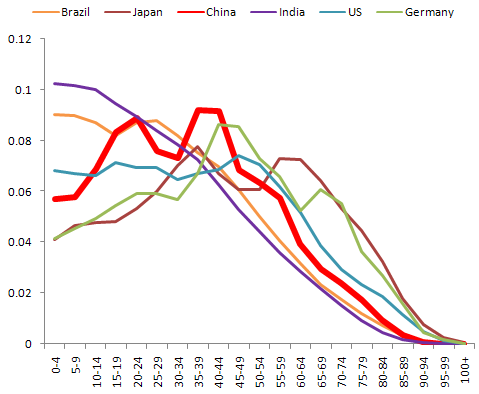
Here are the age structures of some major countries, young and old:

population structure

Vertical axis indicates the fraction of the population that resides in each age category.

Germany and Japan have the pig-in-the-python shape that results from falling birthrates. The US has a flatter age structure, presumably due to a combination of births and immigration. Brazil and India have very young populations, with the mode at the left hand side. Given the delay between birth and fertility, that builds in a lot of future growth.

Compared to Germany and Japan, China hardly seems to be on the verge of an aging crisis. In any case, given the bathtub delay between birth and maturity, a baby boom wouldn’t improve the dependency ratio for almost two decades.

More importantly, growth is not a sustainable strategy for coping with aging. At the same time that growth augments labor, it dilutes the resource base and capital available per capita. If you believe that people are the ultimate resource, i.e. that increasing returns to human capital will create offsetting technical opportunities, that might work. I rather doubt that’s a viable strategy though; human capital is more than just warm bodies (of which there’s no shortage); it’s educated and productive bodies – which are harder to get. More likely, a growth strategy just accelerates the arrival of resource constraints. In any case, the population growth play is not robust to uncertainty about future returns to human capital – if there are bumps on the technical road, it’s disastrous.

To say that population growth is a bad strategy for China is not necessarily to say that the one child policy should stay. If its enforcement is spotty, perhaps lifting it would be a good thing. Focusing on incentives and values that internalize population tradeoffs might lead to a better long term outcome than top-down control.

Painting ourselves into a green corner

At the Green California Summit & Expo this week, I saw a strange sight: a group of greentech manufacturers hanging out in the halls, griping about environmental regulations. Their point? That a surfeit of command-and-control measures makes compliance such a lengthy and costly process that it’s hard to bring innovations to market. That’s a nice self-defeating outcome!

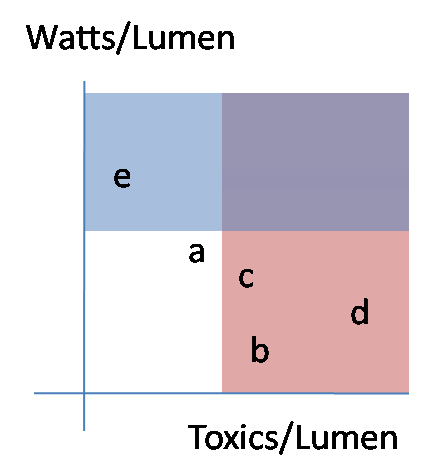
Consider this situation:
greenCorner
I was thinking of lighting, but it could be anything. Letters a-e represent technologies with different properties. The red area is banned as too toxic. The blue area is banned as too inefficient. That leaves only technology a. Maybe that’s OK, but what if a is made in Cuba, or emits harmful radiation, or doesn’t work in cold weather? That’s how regulations get really complicated and laden with exceptions. Also, if we revise our understanding of toxics, how should we update this to reflect the tradeoffs between toxics in the bulb and toxics from power generation, or using less toxic material per bulb vs. using fewer bulbs? Notice that the only feasible option here – a – is not even on the efficient frontier; a mix of e and b could provide the same light with slightly less power and toxics.

Proliferation of standards creates a situation with high compliance costs, both for manufacturers and the bureaucracy that has to administer them. That discourages small startups, leaving the market for large firms, which in turn creates the temptation for the incumbents to influence the regulations in self-serving ways. There are also big coverage issues: standards have to be defined clearly, which usually means that there are fringe applications that escape regulation. Refrigerators get covered by Energy Star, but undercounter icemakers and other cold energy hogs don’t. Even when the standards work, lack of a price signal means that some of their gains get eaten up by rebound effects. When technology moves on, today’s seemingly sensible standard becomes part of tomorrow’s “dumb laws” chain email.

The solution is obviously not total laissez faire; then the environmental goals just don’t get met. There probably are some things that are most efficient to ban outright (but not the bulb), but for most things it would be better to impose upstream prices on the problems – mercury, bisphenol A, carbon, or whatever – and let the market sort it out. Then providers can make tradeoffs the way they usually do – which package of options makes the cheapest product? -without a bunch of compliance risk involved in bringing their product to market.

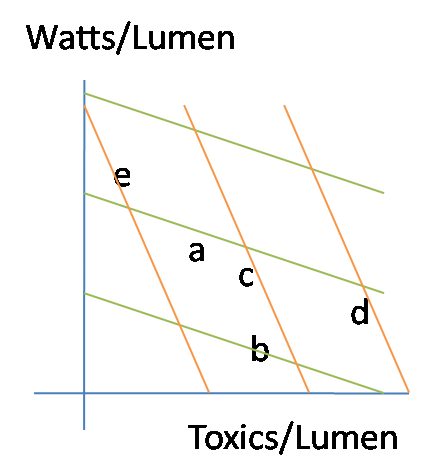
Here’s the alternative scheme:
greenTradeoffs

The green and orange lines represent isocost curves for two different sets of energy and toxic prices. If the unit prices of a-e were otherwise the same, you’d choose b with the green pricing scheme (cheap toxics, expensive energy) and e in the opposite circumstance (orange). If some of the technologies are uniquely valuable in some situations, pricing also permits that tradeoff – perhaps c is not especially efficient or clean, but has important medical applications.

With a system driven by prices and values, we could have very simple conversations about adaptive environmental control. Are NOx levels acceptable? If not, raise the price of emitting NOx until it is. End of discussion.

Two related tidbits:

Fed green buildings guru Kevin Kampschroer gave an interesting talk on the GSA’s greening efforts. He expressed hope that we could move from LEED (checklists) to LEEP (performance-based ratings).

I heard from a lighting manufacturer that the cost of making a CFL is under a buck, but running a recycling program (for mercury recapture) costs $1.50/bulb. There must be a lot of markup in the distribution channels to get them up to retail prices.
The lure of border carbon adjustments

Are border carbon adjustments (BCAs) the wave of the future? Consider these two figures:

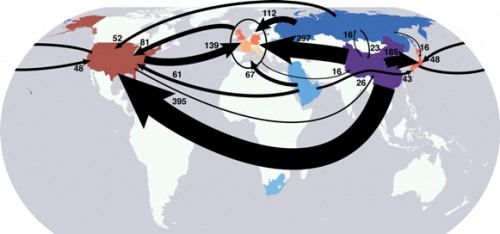
Carbon flows embodied in trade goods

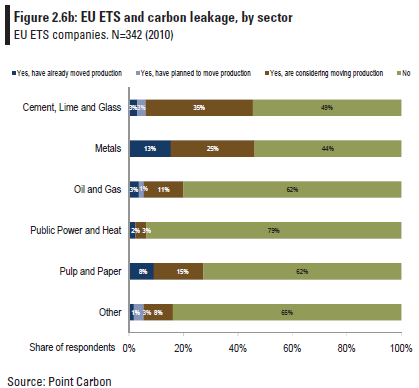
Leakage

The first shows the scale of carbon embodied in trade. The second, even if it overstates true intentions, demonstrates the threat of carbon outsourcing. Both are compelling arguments for border adjustments (i.e. tariffs) on GHG emissions.

I think things could easily go this route: it’s essentially a noncooperative route to a harmonized global carbon price. Unlike global emissions trading, it’s not driven by any principle of fair allocation of property rights in the atmosphere; instead it serves the more vulgar notion that everyone (or at least every nation) keeps their own money.

Consider the pros and cons:

Advocates of BCAs claim that the measures are intended to address three factors. First, competitiveness concerns where some industries in developed countries consider that a BCA will protect their global competitiveness vis-a-vis industries in countries that do not apply the same requirements. The second argument for BCAs is ‘carbon leakage’ – the notion that emissions might move to countries where rules are less stringent. A third argument, of the highest political relevance, has to do with ‘leveraging’ the participation of developing countries in binding mitigation schemes or to adopt comparable measures to offset emissions by their own industries.

from a developing country perspective, at least three arguments run counter to that idea: 1) that the use of BCAs is a prima facie violation of the spirit and letter of multilateral trade principles and norms that require equal treatment among equal goods; 2) that BCAs are a disguised form of protectionism; and 3) that BCAs undermine in practice the principle of common but differentiated responsibilities.

In other words: the advocates are a strong domestic constituency with material arguments in places where BCAs might arise. The opponents are somewhere else and don’t get to vote, and armed with legalistic principles more than fear and greed.

Feedbackwards

In the 80s, my mom had an Audi 5000. It’s value was destroyed by allegations of sudden, uncontrollable acceleration. No plausible physical mechanism was ever identified.

Today, Toyota’s suffering from the same fate. A more likely explanation? Operator error. Stepping on the gas instead of the brake transforms the normal negative feedback loop controlling velocity into a runaway positive feedback:

… A driver would step on the wrong pedal, panic when the car did not perform as expected, continue to mistake the accelerator for the brake, and press down on the accelerator even harder.

This had disastrous consequences in a 1992 Washington Square Park incident that killed five and a 2003 Santa Monica Farmers’ Market incident that killed ten …

Given time, the driver can model the situation, figure out what’s wrong, and correct. But, as my sister can attest, when you’re six feet in front of the garage with the 350 V8 Buick at full throttle, there isn’t a lot of time.

Read more at the Washington Examiner