Does statistics trump physics?

My dissertation was a critique and reconstruction of William Nordhaus’ DICE model for climate-economy policy (plus a look at a few other models). I discovered a lot of issues, for example that having a carbon cycle that didn’t conserve carbon led to a low bias in CO2 projections, especially in high-emissions scenarios.

There was one sector I didn’t critique: the climate itself. That’s because Nordhaus used an established model, from climatologists Schneider & Thompson (1981). It turns out that I missed something important: Nordhaus reestimated the parameters of the model from time series temperature and forcing data.

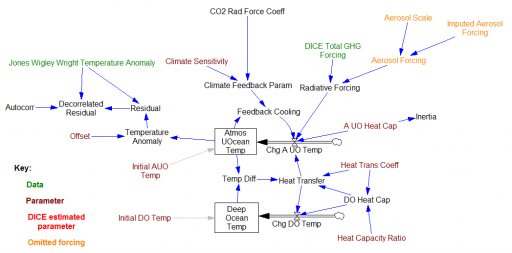
Nordhaus’ estimation focused on a parameter representing the thermal inertia of the atmosphere/surface ocean system. The resulting value was about 3x higher than Schneider & Thompson’s physically-based parameter choice. That delays the effects of GHG emissions by about 15 years. Since the interest rate in the model is about 5%, that lag substantially diminishes the social cost of carbon and the incentive for mitigation.

DICE Climate Sector
The climate subsystem of the DICE model, implemented in Vensim

So … should an economist’s measurement of a property of the climate, from statistical methods, overrule a climatologist’s parameter choice, based on physics and direct observations of structure at other scales?

I think the answer could be yes, IF the statistics are strong and reconcilable with physics or the physics is weak and irreconcilable with observations. So, was that the case?

Continue reading “Does statistics trump physics?”

ICE Roadkill

Several countries have now announced eventual bans of internal combustion engines. It’s nice that such a thing can now be contemplated, but this strikes me as a fundamentally flawed approach.

Banning a whole technology class outright is inefficient. When push comes to shove, that inefficiency is likely to lead to an implementation that’s complex and laden with exceptions. Bans and standards are better than nothing, but that regulatory complexity gives opponents something real to whine about. Then the loonies come out. At any plausible corporate cost of capital, a ban in 2040 has near-zero economic weight today.

Rather than banning gas and diesel vehicles at some abstract date in the far future, we should be pricing their externalities now. Air and water pollution, noise, resource extraction, the opportunity cost of space for roads and parking, and a dozen other free rides are good candidates. And, electric vehicles should not be immune to the same charges where applicable.

Once the basic price signal points the transportation market in the right direction, we can see what happens, and tinker around the edges with standards that address particular misperceptions and market failures.

A tale of Big Data and System Dynamics

I recently worked on a fascinating project that combined Big Data and System Dynamics (SD) to good effect. Neither method could have stood on its own, but the outcome really emphasized some of the strategic limitations of the data-driven approach. Including SD in the project simultaneously lowered the total cost of analysis, by avoiding data processing for things that could be determined a priori, and increased its value by connecting the data to business context.

I can’t give a direct account of what we did, because it’s proprietary, but here’s my best shot at the generalizable insights. The context was health care for some conditions that particularly affect low income and indigent populations. The patients are hard to track and hard to influence.

Two efforts worked in parallel: Big Data (led by another vendor) and System Dynamics (led by Ventana). I use the term “SD” loosely, because much of what we ultimately did was data-centric: agent based modeling and estimation of individual-level nonlinear dynamic models in Vensim. The Big Data vendor’s budget was two orders of magnitude greater than ours, mostly due to some expensive system integration tasks, but partly due to the caché of their brand and flashy approach, I suspect. Continue reading “A tale of Big Data and System Dynamics”

AI is killing us now

I’ve been watching the debate over AI with some amusement, as if it were some other planet at risk. The Musk-Zuckerberg kerfuffle is the latest installment. Ars Technica thinks they’re both wrong:

At this point, these debates are largely semantic.

I don’t see how anyone could live through the last few years and fail to notice that networking and automation have enabled an explosion of fake news, filter bubbles and other information pathologies. These are absolutely policy relevant, and smarter AI is poised to deliver more of what we need least. The problem is here now, not from some impending future singularity.

Ars gets one point sort of right:

Plus, computer scientists have demonstrated repeatedly that AI is no better than its datasets, and the datasets that humans produce are full of errors and biases. Whatever AI we produce will be as flawed and confused as humans are.

I don’t think the data is really the problem; it’s the assumptions the data’s treated with and the context in which that occurs that’s really problematic. In any case, automating flawed aspects of ourselves is not benign!

Here’s what I think is going on:

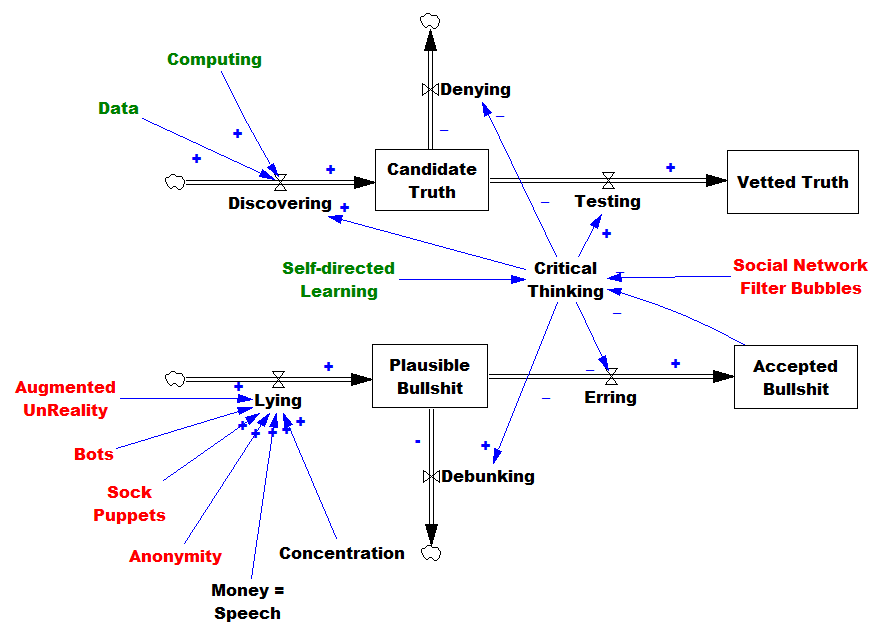
AI, and more generally computing and networks are doing some good things. More data and computing power accelerate the discovery of truth. But truth is still elusive and expensive. On the other hand, AI is making bullsh!t really cheap (pardon the technical jargon). There are many mechanisms by which this occurs:

These amplifiers of disinformation serve increasingly concentrated wealth and power elites that are isolated from their negative consequences, and benefit from fueling the process. We wind up wallowing in a sea of information pollution (the deadliest among the sins of managing complex systems).

As BS becomes more prevalent, various reinforcing mechanisms start kicking in. Accepted falsehoods erode critical thinking abilities, and promote the rejection of ideas like empiricism that were the foundation of the Enlightenment. The proliferation of BS requires more debunking, taking time away from discovery. A general erosion of trust makes it harder to solve problems, opening the door for opportunistic rent-seeking non-solutions.

I think it’s a matter of survival for us to do better at critical thinking, so we can shift the balance between truth and BS. That might be one area where AI could safely assist. We have other assets as well, like the explosion of online learning opportunities. But I think we also need some cultural solutions, like better management of trust and anonymity, brakes on concentration, sanctions for lying, rewards for prediction, and more time for reflection.

The survival value of wrong beliefs

… reasons for the survival of antiscientific views. It’s basically a matter of evolution. When crazy ideas negatively affect survival, they die out. But evolutionary forces are vastly diminished under some conditions, or even point the wrong way …

NPR has an alarming piece on school science.

She tells her students — like Nick Gurol, whose middle-schoolers believe the Earth is flat — that, as hard as they try, science teachers aren’t likely to change a student’s misconceptions just by correcting them. Gurol says his students got the idea of a flat planet from basketball star Kyrie Irving, who said as much on a podcast.

“And immediately I start to panic. How have I failed these kids so badly they think the Earth is flat just because a basketball player says it?” He says he tried reasoning with the students and showed them a video. Nothing worked.

“They think that I’m part of this larger conspiracy of being a round-Earther. That’s definitely hard for me because it feels like science isn’t real to them.”

For cases like this, Yoon suggests teachers give students the tools to think like a scientist. Teach them to gather evidence, check sources, deduce, hypothesize and synthesize results. Hopefully, then, they will come to the truth on their own.

This called to mind a post from way back, in which I considered reasons for the survival of antiscientific views.

It’s basically a matter of evolution. When crazy ideas negatively affect survival, they die out. But evolutionary forces are vastly diminished under some conditions, or even point the wrong way:

  1. Non-experimental science (reliance on observations of natural experiments; no controls or randomized assignment)
  2. Infrequent replication (few examples within the experience of an individual or community)
  3. High noise (more specifically, low signal-to-noise ratio)
  4. Complexity (nonlinearity, integrations or long delays between cause and effect, multiple agents, emergent phenomena)
  5. “Unsalience” (you can’t touch, taste, see, hear, or smell the variables in question)
  6. Cost (there’s some social or economic penalty  imposed by the policy implications of the theory)
  7. Commons (the risk of being wrong accrues to society more than the individual)

These are, incidentally, some of the same circumstances that make medical trials difficult, such that most papers are false.

Consider the flat earth idea. What cost accrues to students who hold this belief? None whatsoever, I think. A flat earth model will make terrible predictions of all kinds of things, but students are not making or relying on such predictions. The roundness of the earth is obviously not salient. So really, the only survival value that matters to students is the benefit of tribal allegiance.

If there are intertemporal dynamics, the situation is even worse. For any resource or capability investment problem, there’s worse before better behavior. Recovering depleted fish stocks requires diminished effort, and less to eat, in the near term. If a correct belief implies good long run stock management, adherents of the incorrect belief will have an advantage in the short run. You can’t count on selection weeding out the “dumb tribes” for planetary-scale problems, because we’re all in one.

This seems like a pretty intractable problem. If there’s a way out, it has to be cultural. If there were a bit more recognition of the value on making correct predictions, the halo of that would spill over to diminish the attractiveness of silly theories. That’s a case that ought to be compelling for basketball fans. Who wants to play on a team that can’t predict what the opponents will do, or how the ball will bounce?

System 3 thinking

There was lots of talk of dual process theory at the 2017 System Dynamics Conference. Nelson Repenning discussed it in his plenary presentation. The Donella Meadows Award paper investigated the effects on stock-flow task performance of priming subjects to think in System 2:

The dual-process theory and understanding of stocks and flows

Arash Baghaei Lakeh and Navid Ghaffarzadegan

Recent evidence suggests that using the analytic mode of thinking (System 2) can improve people’s performance in stock–flow (SF) tasks. In this paper, we further investigate the effects by implementing several different interventions in two studies. First, we replicate a previous finding that answering analytical questions before the SF task approximately doubles the likelihood of answering the stock questions correctly. We also investigate effects of three other interventions that can potentially prime participants to use their System 2. Specifically, the first group is asked to justify their response to the SF task; the second group is warned about the difficulty of the SF task; and the third group is offered information about cognitive biases and the role of the analytic mode of thinking. We find that the second group showed a statistically significant improvement in their performance. We claim that there are simple interventions that can modestly improve people’s response in SF tasks.

Dual process refers to the idea that there are two systems of thinking at work in our minds. System 1 is fast, automatic intuition. System 2 is slow, rational reasoning.

I’ve lost track of the conversation, but some wag at the conference (not me; possibly Arash)  coined the term “System 3” for model-assisted thinking.

In a sense, any reasoning is “model-assisted,” but I think there’s an important distinction between purely mental reasoning and reasoning with a formal (usually computerized) modeling method like a dynamic simulation or even a spreadsheet.

When we reason in our heads, we have to simultaneously (A) describe the structure of the problem, (B) predict the behavior implied by the structure, and (C) test the structure against available information. Mentally, we’re pretty good at A, but pretty bad at B and C. No one can reliably simulate even a low-order dynamic system in their head, and there are too many model checks against data and thought experiments (like extreme conditions) to “run” without help.

System 3’s great weakness is that it takes still more time than using System 2. But it makes up for that in three ways. First, reliable predictions and tests of behavior reveal misconceptions about the problem/system structure that are otherwise inaccessible, so the result is higher quality. Second, the model is shareable, so it’s easier to convey insights to other stakeholders who need to be involved in a solution. Third, formal models can be reused, which lowers the effective cost of an application.

But how do you manage that “still more time” problem? Consider this advice:

I discovered a simple solution to making challenging choices more efficiently at an offsite last week with the CEO and senior leadership team of a high tech company. They were facing a number of unique, one-off decisions, the outcomes of which couldn’t be accurately predicted.

These are precisely the kinds of decisions which can linger for weeks, months, or even years, stalling the progress of entire organizations. …

But what if we could use the fact that there is no clear answer to make a faster decision?

“It’s 3:15pm,” He [the CEO] said. “We need to make a decision in the next 15 minutes.”

“Hold on,” the CFO responded, “this is a complex decision. Maybe we should continue the conversation at dinner, or at the next offsite.”

“No,” The CEO was resolute, “We will make a decision within the next 15 minutes.”

And you know what? We did.

Which is how I came to my third decision-making method: use a timer.

I’m in favor of using a timer to put a stop to dithering. Certainly a body with scarce time should move on when it perceives that it can’t add value. But this strikes me as a potentially costly reversion to System 1.

If a problem is strategic enough to make it to the board, but the board sees a landscape that prevents a clear decision, it ought to be straightforward to articulate why. Are there tradeoffs that make the payoff surface flat? The timer is a sensible response to that, because the decision doesn’t require precision. Are there competing feedback loops that suggest different leverage points, for which no one can agree about the gain? In that case, the consequence of an error could be severe, so the default answer should include a strategy for detection and correction. One ought to have a way to discriminate between these two situations, and a simple application of System 3 might be just the tool.
 

The intuitive mind is a gag gift

I saw Einstein quoted yesterday, “The intuitive mind is a sacred gift and the rational mind is a faithful servant. We have created a society that honors the servant and has forgotten the gift.”

I wondered what he meant, because I think of the intuitive mind as a treacherous friend. We can’t do without it, because we have too many decisions to make. You’d never get out of bed if everything had to be evaluated rationally. But at the same time, whatever heuristics are going on in there are the same ones that,

… and indulge in dozens of other biases. I think they’re also why Lightroom’s face recognition mixes me up with my dog.

How could Einstein revere intuition above reason? Perhaps he relished the intuitive guess at an equation, or some kind of Occam’s Razor argument about simplicity and beauty?

Well, it appears that the answer is simple, but not too simple. He didn’t say it.

Data Science should be about more than data

There are lots of “top 10 skills” lists for data science and analytics. The ones I’ve seen are all missing something huge.

Here’s an example:

Business Broadway – Top 10 Skills in Data Science

Modeling barely appears here. Almost all the items concern the collection and analysis of data (no surprise there). Just imagine for a moment what it would be like if science consisted purely of observation, with no theorizing.

What are you doing with all those data points and the algorithms that sift through them? At some point, you have to understand whether the relationships that emerge from your data make any sense and answer relevant questions. For that, you need ways of thinking and talking about the structure of the phenomena you’re looking at and the problems you’re trying to solve.

I’d argue that one’s literacy in data science is greatly enhanced by knowledge of mathematical modeling and simulation. That could be system dynamics, control theory, physics, economics, discrete event simulation, agent based modeling, or something similar. The exact discipline probably doesn’t matter, so long as you learn to formalize operational thinking about a problem, and pick up some good habits (like balancing units) along the way.

The Ambiguity of Causal Loop Diagrams and Archetypes

I find causal loop diagramming to be a very useful brainstorming and presentation tool, but it falls short of what a model can do for you.

Here’s why. Consider the following pair of archetypes (Eroding Goals and Escalation, from wikipedia):

Eroding Goals and Escalation archetypes

Archetypes are generic causal loop diagram (CLD) templates, with a particular behavior story. The Escalation and Eroding Goals archetypes have identical feedback loop structures, but very different stories. So, there’s no unique mapping from feedback loops to behavior. In order to predict what a set of loops is going to do, you need more information.

Here’s an implementation of Eroding Goals:

Notice several things:

  • I had to specify where the stocks and flows are.
  • “Actions to Improve Goals” and “Pressure to Adjust Conditions” aren’t well defined (I made them proportional to “Gap”).
  • Gap is not a very good variable name.
  • The real world may have structure that’s not mentioned in the archetype (indicated in red).

Here’s Escalation:

The loop structure is mathematically identical; only the parameterization is different. Again, the missing information turns out to be crucial. For example, if A and B start with the same results, there is no escalation – A and B results remain constant. To get escalation, you either need (1) A and B to start in different states, or (2) some kind of drift or self-excitation in decision making (green arrow above).

Even then, you may get different results. (2) gives exponential growth, which is the standard story for escalation. (1) gives escalation that saturates:

The Escalation archetype would be better if it distinguished explicit goals for A and B results. Then you could mathematically express the key feature of (2) that gives rise to arms races:

  • A’s goal is x% more bombs than B
  • B’s goal is y% more bombs than A

Both of these models are instances of a generic second-order linear model that encompasses all possible things a linear model can do:

Notice that the first-order and second-order loops are disentangled here, which makes it easy to see the “inner” first order loops (which often contribute damping) and the “outer” second order loop, which can give rise to oscillation (as above) or the growth in the escalation archetype. That loop is difficult to discern when it’s presented as a figure-8.

Of course, one could map these archetypes to other figure-8 structures, like:

How could you tell the difference? You probably can’t, unless you consider what the stocks and flows are in an operational implementation of the archetype.

The bottom line is that the causal loop diagram of an archetype or anything else doesn’t tell you enough to simulate the behavior of the system. You have to specify additional assumptions. If the system is nonlinear or stochastic, there might be more assumptions than I’ve shown above, and they might be important in new ways. The process of surfacing and testing those assumptions by building a stock-flow model is very revealing.

If you don’t build a model, you’re in the awkward position of intuiting behavior from structure that doesn’t uniquely specify any particular mode. In doing so, you might be way ahead of non-systems thinkers approaching the same problem with a laundry list. But your ability to discover errors, incorporate data and discover leverage is far greater if you can simulate.

The model: wikiArchetypes1b.mdl (runs in any version of Vensim)